Cryogenic Flow Measurement
Cryogenic Flow Measurement
Cryogenic flow measurement involves the precise quantification of fluids at extremely low temperatures, typically defined as temperatures below -150°C (-238°F). In industrial sectors such as aerospace, medical gases, and energy (particularly Liquefied Natural Gas or LNG), managing these fluids requires specialized instrumentation capable of withstanding thermal shock, preventing phase changes, and maintaining high accuracy under volatile conditions.
Unlike standard liquid measurement, cryogenic fluids exist near their boiling points. Any heat ingress or pressure drop can cause "flashing," where the liquid transitions into a gas, leading to two-phase flow and significant measurement errors. This article explores the principles, selection criteria, and installation requirements for effective cryogenic flow measurement.
Measurement Principles for Cryogenic Fluids
Selecting a flow meter for cryogenic service requires an understanding of how the sensor interacts with the fluid's physical properties. The following technologies are the most common in industrial applications.
1. Differential Pressure (DP) Measurement
Differential pressure meters, such as orifice plates, Venturi tubes, and flow nozzles, operate on Bernoulli’s principle. As fluid passes through a restriction, its velocity increases and its pressure decreases. The square root of the pressure difference is proportional to the flow rate.
In cryogenic applications, Venturi tubes are often preferred over orifice plates because they offer lower permanent pressure loss, which reduces the risk of cavitation or flashing. However, the impulse lines connecting the primary element to the transmitter must be carefully managed. These lines typically contain a "gas seal" where the cryogenic liquid boils into a gas, creating a thermal barrier that protects the electronics from extreme cold.
2. Coriolis Mass Flow Measurement
Coriolis meters provide a direct measurement of mass flow by utilizing the Coriolis effect. The fluid passes through vibrating tubes; the resulting phase shift in the vibration is directly proportional to the mass flow rate.
Coriolis meters are highly valued in cryogenic service because they are independent of fluid density and viscosity changes. They are frequently used for custody transfer of liquid nitrogen and hydrogen. The primary challenge is thermal stress on the sensor tubes. High-quality Coriolis meters for cryogenics use specialized alloys like Stainless Steel 316L or Hastelloy to manage the contraction and expansion cycles.
3. Ultrasonic Flow Measurement (Transit-Time)
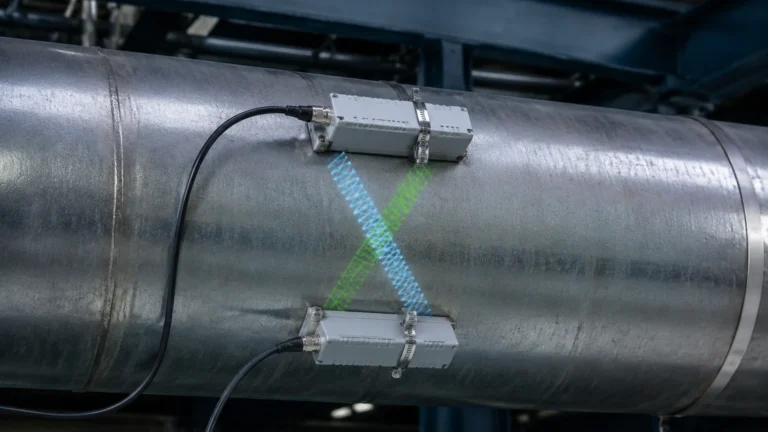
Ultrasonic meters use acoustic signals to determine flow velocity. In transit-time ultrasonic meters, transducers send signals upstream and downstream. The difference in travel time is used to calculate the velocity.
For cryogenics, non-intrusive (clamp-on) or wetted ultrasonic meters are used. Since there are no moving parts and no restriction to the flow, there is no pressure drop, which is ideal for avoiding phase changes. The main technical hurdle is ensuring the acoustic coupling between the transducer and the pipe remains stable at -196°C or lower.
4. Turbine Flow Measurement
Turbine meters utilize a rotor suspended in the flow stream. The rotational speed of the rotor is proportional to the fluid velocity. These are widely used for the distribution of industrial gases in liquid form.
In cryogenic service, the bearings are the critical component. Because cryogenic liquids have very low lubricity, ceramic ball bearings or specialized bushings are required to prevent premature wear. Turbine meters offer excellent repeatability, making them a standard for truck-mounted delivery systems.
5. Vortex Flow Measurement
Vortex meters operate on the Von Kármán effect, where fluid passing a shedder bar creates alternating vortices. The frequency of these vortices is proportional to the flow velocity. Vortex meters are robust and have no moving parts, making them suitable for liquid oxygen (LOX) and liquid nitrogen (LN2) where mechanical failure must be minimized.
Practical Selection Table
When evaluating technologies for a specific project, engineers must balance accuracy, cost, and process conditions.
| Technology | Typical Accuracy | Pressure Drop | Moving Parts | Primary Advantage |
| :— | :— | :— | :— | :— |
| Differential Pressure | ±1.0% to ±2.0% | Moderate/High | No | Proven, low cost |
| Coriolis | ±0.1% to ±0.5% | Moderate | No | Direct mass flow, high precision |
| Ultrasonic | ±0.5% to ±1.0% | None | No | No pressure drop, low maintenance |
| Turbine | ±0.25% to ±0.5% | Moderate | Yes | Excellent for custody transfer |
| Vortex | ±0.75% to ±1.5% | Low | No | Robust, wide rangeability |
Installation Considerations and Best Practices
Successful cryogenic flow measurement depends heavily on the installation environment. Failure to account for thermal dynamics can result in equipment damage or total measurement failure.
Thermal Insulation and Heat Leak
To prevent the cryogenic liquid from boiling inside the meter, the sensor must be properly insulated. Vacuum-jacketed piping is the gold standard for cryogenic transport. If the flow meter is not vacuum-jacketed, it must be encased in a "cold box" or wrapped in high-efficiency multi-layer insulation (MLI). Any "heat leak" from the ambient environment into the sensor will cause gas bubbles to form, which Coriolis and Ultrasonic meters may struggle to process.
Material Selection and Embrittlement
Standard carbon steels become brittle and can shatter at cryogenic temperatures. All wetted parts must be made from materials that retain ductility at low temperatures, such as 300-series stainless steel, Monel, or Aluminum. Fasteners and gaskets must also be rated for cryogenic service to prevent leaks caused by differential thermal contraction.
Orientation and Gas Traps
Flow meters should generally be installed in the lowest part of a piping run to ensure they remain full of liquid. For DP meters, impulse lines should be sloped upward to allow any evolved gas to migrate back into the process pipe or into a gas collection header, ensuring the transmitter only sees the gas phase at ambient temperature.
Cleaning for Oxygen Service
If the application involves liquid oxygen (LOX), the flow meter must undergo stringent "Oxygen Cleaning" to remove all traces of hydrocarbons and particulates. In the presence of high-pressure oxygen, even a small amount of oil or grease can lead to spontaneous combustion or explosion.
Limitations and Common Risks
* Two-Phase Flow: The most significant risk in cryogenic measurement is the presence of both liquid and gas. Most flow meters are calibrated for a single phase. Even a 2% gas void fraction can lead to a 10% or greater error in mass flow readings.
* Cavitation: If the pressure at the meter's throat (in DP or Turbine meters) drops below the vapor pressure of the liquid, cavitation bubbles will form. This erodes hardware and ruins accuracy.
* Cool-Down Time: Cryogenic meters require a "cool-down" period. If fluid starts flowing through a warm meter, it will flash instantly, potentially over-speeding turbine rotors or causing thermal shock to ceramic components.
Integration with Level Measurement
In industrial automation and storage tank management, flow measurement is rarely a standalone requirement. It is usually paired with level measurement to provide a complete mass balance of the system. For instance, in an LNG storage facility, flow meters track the intake and discharge, while level sensors provide the primary inventory data.
For engineers designing these systems, reviewing the various level measurement technologies—such as radar, ultrasonic, or hydrostatic transmitters—is essential for ensuring redundant and verified data. You can Review product options and application support on the Welk Main Page to understand how different level measurement instruments complement flow data in cryogenic storage applications.
Frequently Asked Questions (FAQs)
Q: Why is mass flow preferred over volumetric flow in cryogenics?
A: Cryogenic fluids are highly compressible compared to standard liquids, and their density changes significantly with small variations in temperature and pressure. Mass flow provides a consistent measurement of the actual amount of substance, which is critical for the commercial sale of gases.
Q: Can ultrasonic clamp-on meters work on vacuum-jacketed pipes?
A: Generally, no. Ultrasonic signals cannot travel through the vacuum gap between the inner and outer pipe. For vacuum-jacketed systems, a wetted-sensor spool piece that is integrated into the vacuum jacket is required.
Q: What is the "K-factor" in cryogenic turbine meters?
A: The K-factor represents the number of pulses the meter produces per unit of volume. In cryogenics, the K-factor must be adjusted for the thermal contraction of the meter body and rotor, as the physical dimensions of the device shrink at -196°C.
Q: How do you prevent the electronics from freezing?
A: Most cryogenic flow meters use an "extended neck" or "thermally long" design. This places the sensor in the cold zone while the transmitter and electronics are located several centimeters away, separated by a stainless steel tube that acts as a thermal break, allowing the electronics to operate at ambient temperature.
Q: Is re-calibration necessary for different cryogenic fluids?
A: Yes. A meter calibrated for liquid nitrogen may not perform with the same accuracy for liquid hydrogen due to differences in density, viscosity, and sonic velocity. Whenever possible, meters should be calibrated using the actual process fluid or a surrogate with similar properties at cryogenic temperatures.