Air Flow Meter Calibration Services
Air Flow Meter Calibration Services
In industrial automation and process control, the accuracy of air flow measurement is as critical as the precision required in liquid level monitoring. Whether managing aeration in wastewater treatment plants, controlling combustion air in industrial boilers, or monitoring compressed air systems for energy efficiency, the reliability of a flow meter depends entirely on its calibration. Air flow meter calibration services provide the essential validation that a device’s output aligns with recognized international standards, ensuring process safety, regulatory compliance, and cost-effectiveness.
For engineers and facility managers, understanding the nuances of air flow meter calibration services is vital. This guide explores the principles of air flow measurement, the methodologies used in professional calibration, and the criteria for selecting the right service provider to maintain peak instrument performance.
Principles of Air Flow Measurement
Before engaging with air flow meter calibration services, it is necessary to understand the underlying physical principles of the instruments being tested. Unlike liquids, air is highly compressible, meaning its volume changes significantly with variations in temperature and pressure. Most industrial air flow meters fall into one of the following categories:
Thermal Mass Flow Meters
These instruments operate on the principle of thermal dispersion. A heated sensor is placed in the flow stream, and the cooling effect of the passing air is measured. Because this method measures the heat transfer from the sensor to the gas molecules, it provides a direct mass flow reading without requiring separate temperature or pressure compensation. They are highly effective for low-flow applications and leak detection.
Vortex Shedding Flow Meters
Vortex meters utilize the Karman vortex street principle. When air flows past a bluff body (a non-streamlined object) placed in the pipe, vortices are shed alternately from each side. The frequency of these vortices is directly proportional to the velocity of the air. These are robust instruments suitable for high-velocity air and steam applications.
Differential Pressure (DP) Meters
DP meters, such as orifice plates, Pitot tubes, and Venturi meters, create a restriction in the flow path. The resulting pressure drop across the restriction is measured. According to Bernoulli’s equation, the square root of the pressure difference is proportional to the flow rate. These require careful calibration of the pressure transmitter and the physical dimensions of the primary element.
Ultrasonic Flow Meters
Ultrasonic meters typically use the transit-time method. Two transducers send ultrasonic pulses back and forth through the air stream. The pulse traveling with the flow moves faster than the pulse traveling against it. The time difference is used to calculate the air velocity. These are often used in large-diameter ducts where minimal pressure drop is required.
The Importance of Professional Calibration Services
Over time, all sensors experience "drift." In air flow meters, this can be caused by sensor coating (buildup of dust or oils), mechanical wear in moving parts, or electronic component aging. Professional air flow meter calibration services address these issues by comparing the device under test (DUT) against a reference standard with a known, higher level of accuracy.
For companies utilizing advanced instrumentation from manufacturers like Welk, maintaining the integrity of the measurement chain is a core component of quality management. Calibration ensures that the high-precision engineering of the original device continues to deliver value throughout its operational life.
Key reasons to seek professional calibration include:
* Regulatory Compliance: Meeting ISO 9001, ISO 14001, or industry-specific safety standards.
* Energy Efficiency: Compressed air is one of the most expensive utilities in a factory; even a 5% error in flow measurement can lead to thousands of dollars in wasted energy costs.
* Process Stability: In chemical processing, the ratio of air to other reactants must be precise to ensure product quality and prevent hazardous conditions.
Calibration Methodologies and Standards
Air flow meter calibration services utilize several different "standards" to verify accuracy. The choice of method often depends on the flow range and the required uncertainty level.
1. Bell Provers
A bell prover is a primary standard consisting of a vertical tank (the bell) submerged in a liquid-filled outer tank. As the bell descends, it displaces a precise volume of air into the flow meter. This is one of the most accurate methods for low-to-medium flow rates, often achieving uncertainties as low as 0.2%.
2. Sonic Nozzles (Critical Flow Venturis)
Sonic nozzles are widely used for gas flow calibration. When the pressure ratio across the nozzle reaches a critical point, the air velocity at the throat becomes sonic (Mach 1). At this point, the mass flow rate becomes independent of the downstream pressure and is only a function of the upstream pressure and temperature. This provides a very stable and repeatable reference.
3. Piston Provers
Similar to bell provers, piston provers use a moving piston inside a precision-bore cylinder to displace a known volume of air. These are often used for calibrating small thermal mass flow meters and leak detectors where high precision is required at very low flow rates (e.g., milliliters per minute).
4. Transfer Standards
In many field-service scenarios, a high-accuracy master meter (often a calibrated turbine or ultrasonic meter) is used as a transfer standard. While not as accurate as a primary standard, it allows for on-site verification without removing the instrument from the process line.
Selection Criteria for Calibration Services
When evaluating air flow meter calibration services, technical managers should use the following table to compare capabilities against their specific application requirements.
Table 1: Calibration Service Evaluation Matrix
| Criteria | Laboratory Calibration | In-Situ (On-Site) Calibration | Master Meter Verification |
| :— | :— | :— | :— |
| Accuracy/Uncertainty | Highest (typically 0.2% to 0.5%) | Moderate (1.0% to 2.0%) | Lowest (depends on Master Meter) |
| Flow Range | Wide (from 1 sccm to 5,000 m³/h) | Limited by portable equipment | Limited by Master Meter size |
| Traceability | Direct to NIST/PTB/National Standards | Secondary traceability | Tertiary traceability |
| Process Downtime | High (meter must be removed) | Low (meter remains in place) | Minimal |
| Best For | Annual certification, custody transfer | Process monitoring, large ducts | Quick checks, non-critical loops |
Installation Considerations for Maintaining Accuracy
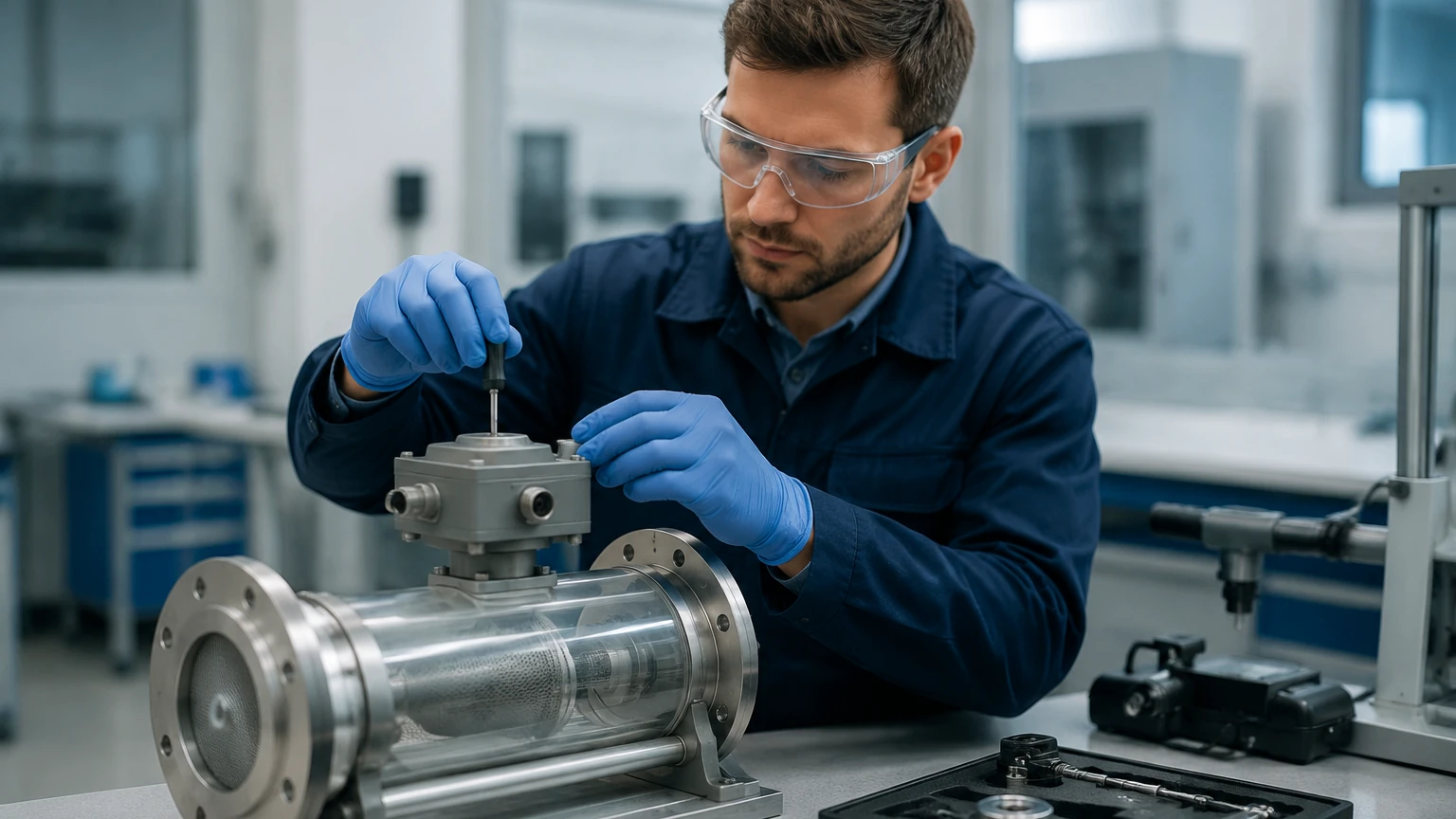
Calibration is only valid if the meter is installed correctly in the field. Even the most precisely calibrated air flow meter will provide erroneous readings if the installation environment does not match the conditions required for stable flow. Engineers should consult the Main Page of their equipment provider for specific installation manuals, but general guidelines include:
* Straight Pipe Runs: Most air flow meters require a minimum of 10 to 20 diameters of straight pipe upstream and 5 diameters downstream to ensure a fully developed, non-turbulent flow profile.
* Flow Conditioners: If straight runs are not possible due to space constraints, flow conditioners (perforated plates or vane-type) can be used to eliminate swirls and eddies.
* Orientation: For thermal mass meters, the orientation of the probe is critical. Misalignment by even a few degrees can change the cooling effect on the sensor and lead to significant errors.
* Moisture and Particulates: Air flow meters should be installed in locations where the air is dry and filtered. Condensed water droplets hitting a thermal sensor can cause "spikes" in flow readings that do not reflect actual air movement.
Limitations and Common Risks
While air flow meter calibration services are essential, there are inherent limitations that users must recognize:
1. Gas Composition Changes: Most air flow meters are calibrated using dry, clean air. If the actual process gas contains varying levels of CO2, nitrogen, or humidity, the calibration curve may no longer be accurate. This is particularly true for thermal mass meters.
2. Turndown Ratio Limits: Every meter has a minimum and maximum flow rate it can measure accurately. Calibration should always be performed across the specific range where the meter will operate in the field.
3. Pressure and Temperature Extremes: If a meter is calibrated at 20°C and 101.3 kPa (standard conditions) but operates at 150°C and 800 kPa, the calibration laboratory must use mathematical compensation or, ideally, simulate the operating conditions during the test.
Frequently Asked Questions (FAQs)
How often should I calibrate my air flow meter?
Most manufacturers recommend annual calibration. However, the frequency should be determined by the criticality of the process and the history of the instrument's stability. In harsh environments with high dust or moisture, semi-annual checks may be necessary.
What is the difference between a "Calibration" and a "Validation"?
Calibration is the process of comparing the instrument to a standard and adjusting it so that its output matches the standard. Validation (or verification) is simply checking the instrument against a standard to see if it is still within its specified accuracy limits without making adjustments.
Can I calibrate an air flow meter using water?
No. Because air is compressible and water is not, the Reynolds numbers and fluid dynamics are entirely different. An instrument calibrated on water will not provide accurate readings for air flow unless it is a purely mechanical device with a known conversion factor, and even then, the uncertainty is very high.
What documentation should I receive after a calibration service?
You should receive a Calibration Certificate that includes the model and serial number, the reference standards used (and their traceability), the environmental conditions during the test (temperature, pressure, humidity), the "As-Found" data, and the "As-Left" data.
Conclusion
Accurate air flow measurement is a cornerstone of modern industrial efficiency. By utilizing professional air flow meter calibration services, organizations ensure that their instrumentation—whether it be vortex, thermal, or ultrasonic—continues to operate within specified tolerances. For those managing complex systems involving both level and flow measurement, partnering with a comprehensive manufacturer like Welk ensures access to both high-quality hardware and the technical expertise required to maintain it. Proper calibration, combined with correct installation and a rigorous maintenance schedule, transforms a simple sensor into a reliable tool for process optimization and cost control.