Remote Tank Monitoring System
Remote Tank Monitoring System
In modern industrial operations, the transition from manual level checking to automated data acquisition is no longer a luxury but a necessity for operational efficiency and safety. A remote tank monitoring system integrates field-level sensing technology with telecommunications and software platforms to provide real-time visibility into inventory levels, regardless of the geographic location of the assets. For process engineers and facility managers, understanding the underlying measurement principles and the architecture of these systems is critical to selecting a solution that ensures data integrity and long-term reliability.
Core Measurement Principles for Remote Monitoring
Before a remote tank monitoring system can transmit data, the physical level of the substance—whether liquid, slurry, or solid—must be converted into an electrical signal. The choice of sensor technology is the foundation of the entire system. Welk provides several primary technologies, each suited to specific environmental conditions.
Radar Level Measurement
Radar level meters operate on the Time-of-Flight (ToF) principle. The device emits high-frequency electromagnetic waves (typically in the 26GHz or 80GHz range) toward the material surface. These waves reflect off the product and return to the sensor. By measuring the time interval between emission and reception, the system calculates the distance to the product surface.
Radar is highly preferred for remote systems because it is non-contact and largely unaffected by changes in temperature, pressure, or the presence of vapors and dust. High-frequency 80GHz radar is particularly effective in narrow tanks or tanks with internal obstructions due to its narrow beam angle.
Ultrasonic Level Sensing
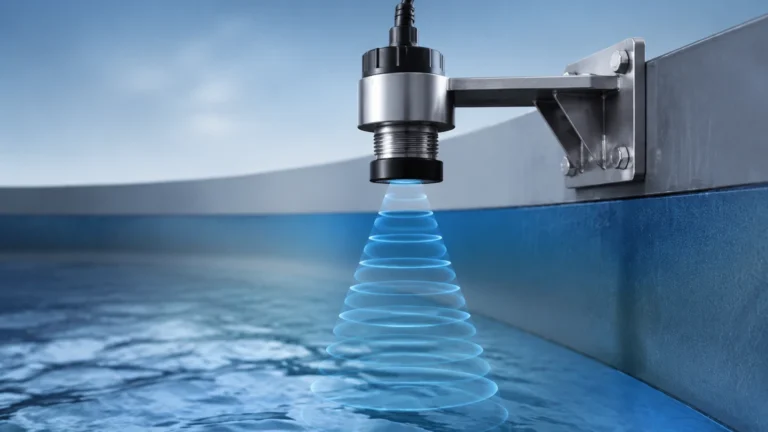
Similar to radar, ultrasonic sensors use the ToF principle but utilize sound waves instead of electromagnetic waves. A transducer emits an ultrasonic pulse that bounces off the liquid surface. The time taken for the echo to return determines the level.
Ultrasonic sensors are cost-effective solutions for water treatment and simple chemical storage. However, they are sensitive to air temperature fluctuations (which affect the speed of sound) and can be hindered by heavy foam or surface turbulence which absorbs or scatters the sound waves.
Hydrostatic Pressure Measurement
Hydrostatic transmitters measure the pressure exerted by the liquid column at the bottom of a tank. Based on the formula $P = \rho \cdot g \cdot h$ (where $P$ is pressure, $\rho$ is density, $g$ is gravity, and $h$ is height), the level can be accurately determined if the density of the fluid remains constant. This technology is robust and widely used in deep wells, reservoirs, and vented storage tanks.
Magnetic Level Gauges and Switches
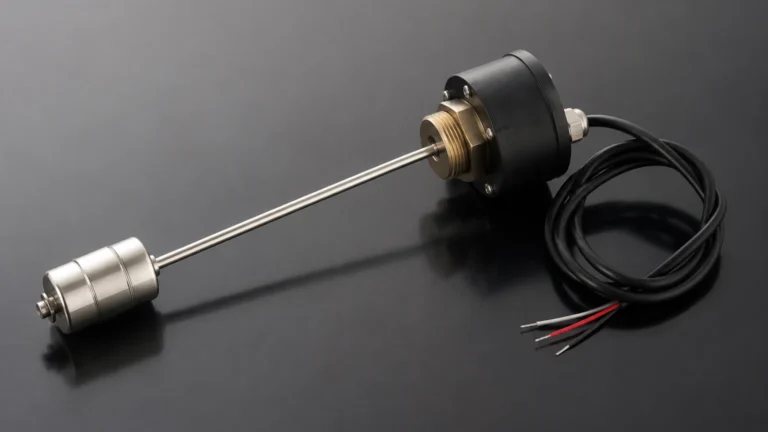
For high-pressure or high-temperature applications where direct visual confirmation is also required, magnetic level gauges are employed. A float containing a magnet moves with the liquid level, actuating external flags for visual display and a reed-chain transmitter for remote signal output. Level switches are often integrated into remote systems as redundant high-level alarms to prevent overfills.
Components of a Remote Tank Monitoring System
A complete remote tank monitoring system consists of three primary layers: the sensing layer, the transmission layer, and the application layer.
1. The Sensing Layer: This involves the physical hardware (radar, ultrasonic, or hydrostatic sensors) installed on the tank. These devices output standard industrial signals such as 4-20mA, Modbus RTU (RS485), or HART.
2. The Transmission Layer (Gateway): To move data from the field to a remote server, a gateway or RTU (Remote Terminal Unit) is required. Common connectivity options include:
* Cellular (4G/LTE/5G): Ideal for remote sites with mobile coverage.
* LoRaWAN: Low-power, long-range wireless technology suitable for large industrial complexes.
* Satellite: Used for extremely isolated assets (e.g., oil pipelines in remote deserts).
* Ethernet/Wi-Fi: Common for indoor factory environments.
3. The Application Layer (Software): This is the user interface where data is processed. It provides dashboards, trend analysis, automated reporting, and SMS/Email alerts when levels cross predefined thresholds.
Practical Selection Criteria
Selecting the right technology for a remote tank monitoring system requires a detailed analysis of the process media and the physical environment. The following table provides a comparison of common technologies used in these systems.
Technology Comparison Table
| Feature | Radar (80GHz) | Ultrasonic | Hydrostatic | Magnetic Gauge |
| :— | :— | :— | :— | :— |
| Measurement Type | Non-contact | Non-contact | Contact (Pressure) | Contact (Float) |
| Typical Accuracy | ±2 mm | ±0.25% of range | ±0.1% to ±0.5% | ±5 mm |
| Max Range | Up to 120 m | Up to 15 m | Up to 200 m | Up to 6 m (standard) |
| Pressure Limit | Up to 160 bar | Atmospheric | N/A (Submersible) | Up to 320 bar |
| Temp. Limit | -40°C to +250°C | -40°C to +80°C | -20°C to +80°C | -196°C to +450°C |
| Media Type | Liquids & Solids | Liquids | Clean Liquids | Liquids |
| Cost | High | Medium | Low to Medium | Medium to High |
Installation and Integration Considerations
The reliability of a remote tank monitoring system is heavily dependent on proper installation. Even the most advanced radar sensor will provide inaccurate data if mounted incorrectly.
Mounting Position
For non-contact sensors (Radar and Ultrasonic), the device should be mounted away from the tank wall to avoid signal interference from wall reflections. Typically, the sensor should be placed at 1/4 to 1/3 of the tank diameter from the wall. It must also be positioned away from the filling inlet to prevent the incoming stream from interfering with the signal.
Dead Zones (Blocking Distance)
Every ToF sensor has a "dead zone" directly beneath the transducer where measurements cannot be taken. For ultrasonic sensors, this might be 0.2m to 0.5m; for radar, it is often much smaller (e.g., 0.05m). Engineers must ensure the maximum possible liquid level does not enter this zone, or use a mounting nozzle (standpipe) to raise the sensor.
Signal Integration
When integrating sensors into a remote system, the output signal must match the gateway's input. While 4-20mA is universal, digital protocols like Modbus RS485 are preferred for remote monitoring because they allow for the transmission of diagnostic data (e.g., signal strength, internal temperature) alongside the level measurement.

System Limitations and Environmental Factors
While a remote tank monitoring system provides significant advantages, certain physical limitations must be acknowledged:
* Dielectric Constant (εr): Radar sensors rely on the dielectric constant of the material to reflect the signal. Materials with very low εr (like certain oils or liquefied gases) reflect less energy, requiring high-sensitivity sensors or guided wave radar (GWR).
* Vapor and Condensation: While radar penetrates vapor, heavy condensation on an ultrasonic transducer face can "blind" the sensor. Some Welk sensors feature specialized coatings or self-cleaning designs to mitigate this.
* Power Management: In remote locations without mains power, the system often relies on batteries and solar panels. The frequency of data transmission (e.g., once per minute vs. once per hour) significantly impacts battery longevity.
* Signal Obstructions: Internal tank structures like agitators, heating coils, or ladders can create "false echoes." Advanced software typically allows for "false echo suppression," where the system learns to ignore static reflections from these objects.
Frequently Asked Questions (FAQ)
Q: How often does a remote tank monitoring system need calibration?
A: Most modern digital sensors, especially radar, are pre-calibrated at the factory and do not drift significantly over time. However, a yearly verification against a manual measurement is recommended as part of a standard maintenance schedule.
Q: Can one gateway monitor multiple tanks?
A: Yes. If the tanks are located within the same vicinity (e.g., a tank farm), multiple sensors can be wired to a single multi-channel gateway via Modbus or analog inputs, significantly reducing the cost per monitoring point.
Q: Is the data from these systems secure?
A: Industrial-grade remote monitoring systems use encrypted transmission protocols (such as TLS/SSL for MQTT or HTTPS) to ensure that inventory data is protected from unauthorized access during transit to the cloud.
Q: What happens if the cellular network goes down?
A: Quality gateways include local data logging capabilities. If the connection is lost, the device stores the timestamped level data internally and uploads it once the connection is restored, preventing data gaps.
Conclusion
Implementing a robust remote tank monitoring system requires a holistic approach that starts with selecting the correct sensing physics for the specific media and ends with a reliable data transmission architecture. By moving away from manual checks, enterprises can optimize their supply chains, reduce the risk of environmental incidents due to overfills, and ensure personnel safety by keeping operators away from hazardous tank tops. For detailed specifications on individual sensors and integrated monitoring solutions, engineers should Review product options and application support at the Welk Main Page to find the configuration that best fits their specific process requirements.