Trusted Stormwater Control Panels for Municipal Use Manufacturers Suppliers
Trusted Stormwater Control Panels for Municipal Use Manufacturers Suppliers
Municipal stormwater management is a critical pillar of urban infrastructure, designed to prevent flooding, protect water quality, and manage the discharge of runoff into natural water bodies. At the heart of these systems are stormwater control panels, which integrate complex electrical components with precise sensing technology to automate pumps, gates, and alarms. For municipal engineers and procurement officers, identifying trusted stormwater control panels for municipal use manufacturers suppliers is not merely about purchasing hardware; it is about ensuring long-term operational reliability and public safety.
Effective stormwater control relies heavily on accurate level measurement. Without precise data on water levels in sumps, retention basins, and culverts, even the most advanced control panel cannot function correctly. This article explores the engineering principles, selection criteria, and technical requirements for municipal-grade stormwater control solutions.
Core Principles of Level Measurement in Stormwater Systems
Before selecting a control panel or a supplier, it is essential to understand the measurement principles that drive the automation. In stormwater applications, level sensors provide the primary input signal (typically 4-20mA or Modbus) to the control panel's logic controller. The two most common technologies used are ultrasonic (non-contact) and hydrostatic (contact) level measurement.
Ultrasonic Level Measurement
Ultrasonic sensors operate on the "time-of-flight" principle. The sensor emits a high-frequency sound pulse that travels through the air, reflects off the water surface, and returns to the transducer. By measuring the time taken for the pulse to return, the system calculates the distance to the liquid.
In municipal stormwater applications, ultrasonic sensors are preferred for their non-contact nature, which reduces maintenance in environments where debris or corrosive chemicals might be present. However, they can be affected by heavy foam, extreme turbulence, or significant temperature gradients within the tank or well.
Hydrostatic Level Measurement
Hydrostatic transmitters measure the pressure exerted by the liquid column above the sensor. Based on the principle that pressure is proportional to the height of the liquid ($P = \rho gh$), these submersible sensors are placed at the bottom of a basin or sump.
This technology is highly reliable in deep wells or areas where surface foam would interfere with ultrasonic signals. Because they are in constant contact with the medium, hydrostatic sensors for stormwater must be constructed from robust materials like 316L stainless steel or specialized plastics to resist silt and debris buildup.
Essential Components of Municipal Stormwater Control Panels
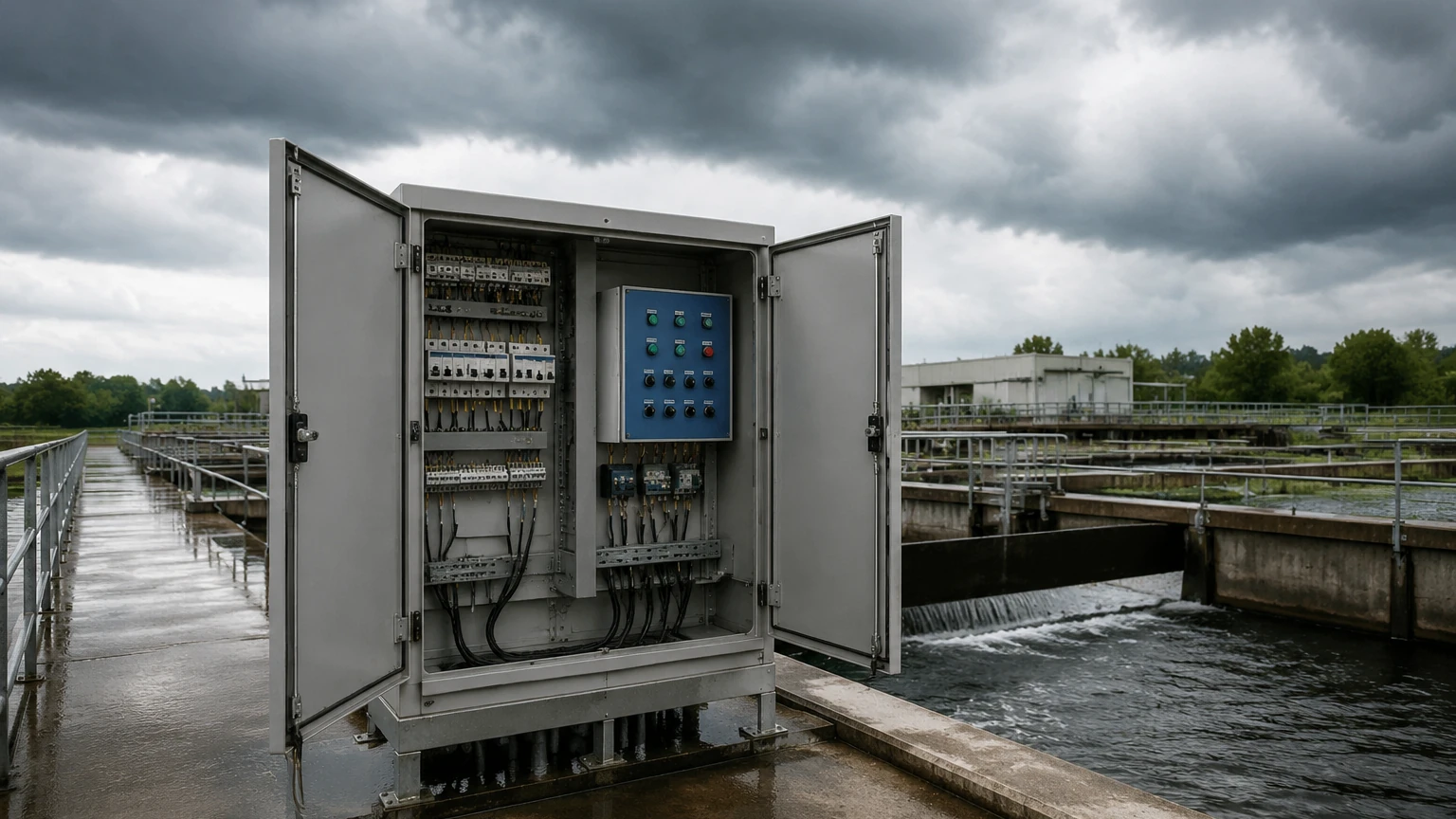
Trusted manufacturers provide panels that are more than just enclosures; they are integrated systems designed for harsh outdoor environments. A standard municipal stormwater control panel typically includes:
1. Programmable Logic Controller (PLC): The central processing unit that executes the control logic, such as lead/lag pump alternation and high-level alarm triggers.
2. Human-Machine Interface (HMI): A touchscreen or display that allows operators to view real-time levels, adjust setpoints, and acknowledge alarms.
3. Motor Starters and Variable Frequency Drives (VFDs): These manage the power delivered to stormwater pumps, allowing for soft starts or speed adjustments based on the rate of inflow.
4. Surge Protection: Essential for protecting sensitive electronics from lightning strikes and power fluctuations common in municipal field locations.
5. Telemetry and Communication: Modules that allow the panel to communicate with a central SCADA (Supervisory Control and Data Acquisition) system via cellular, radio, or Ethernet links.
For those seeking comprehensive instrumentation to pair with these panels, you can Review product options and application support to ensure the sensors and controllers are fully compatible.
Evaluating Trusted Manufacturers and Suppliers
When vetting trusted stormwater control panels for municipal use manufacturers suppliers, municipal departments should prioritize technical compliance and field-proven reliability over initial cost. Key evaluation criteria include:
* Certifications and Standards: Ensure the supplier adheres to UL 508A (Industrial Control Panels) and that enclosures meet NEMA 4X or IP66/67 ratings for weatherproofing and corrosion resistance.
* Customization Capabilities: Municipal sites often have unique requirements. A trusted supplier should offer OEM/ODM services to tailor the panel's logic and physical layout to specific site constraints.
* Technical Support and Documentation: Suppliers must provide detailed wiring diagrams, logic flowcharts, and calibration certificates for all integrated level instruments.
* Quality Control: Look for manufacturers who perform 100% functional testing before shipment, including simulated alarm states and load testing for motor circuits.
Selection Guide for Level Sensors in Stormwater Applications
The following table provides a comparison of common level measurement technologies integrated into stormwater control panels to help engineers choose the right sensor for their specific environment.
| Technology | Measurement Range | Best Use Case | Limitations |
| :— | :— | :— | :— |
| Ultrasonic | 0.3m to 15m (1ft to 49ft) | Open channels, non-contact needs | Affected by foam and heavy vapor |
| Hydrostatic | 1m to 200m (3.3ft to 656ft) | Deep sumps, turbulent water | Requires periodic cleaning of the diaphragm |
| Radar (80GHz) | 0.1m to 30m (0.3ft to 98ft) | High precision, narrow spaces | Higher initial cost compared to ultrasonic |
| Float Switches | Point Level Only | High/Low redundancy alarms | Prone to fouling from debris/grease |
Installation and Maintenance Best Practices
Even the highest quality control panel will fail if the peripheral sensors are incorrectly installed. For municipal stormwater systems, follow these engineering guidelines:
Sensor Positioning
* Avoid Dead Zones: Ensure ultrasonic sensors are mounted at a height where the maximum water level does not enter the "blanking distance" (the zone immediately below the sensor where measurement is impossible).
* Stilling Wells: In high-turbulence areas, such as near a pump intake, install hydrostatic or ultrasonic sensors inside a stilling well (a vertical pipe) to dampen surface waves and protect the sensor from physical debris.
* Mounting Stability: Control panels and sensors should be mounted on vibration-resistant structures to prevent signal noise and mechanical fatigue.
Wiring and Grounding
* Shielded Cabling: Use shielded twisted-pair cables for all analog signals (4-20mA) to prevent electromagnetic interference from high-voltage pump cables.
* Proper Grounding: Ensure the control panel and all metal sensor housings are tied to a common municipal ground to protect against surge damage.
Maintenance Schedules
* Sensor Cleaning: Hydrostatic sensors should be inspected every 6 months for silt accumulation. Ultrasonic transducers should be wiped down to remove spider webs or condensation buildup.
* Battery Backups: Test UPS (Uninterruptible Power Supply) systems annually to ensure the panel can still transmit alarm data during a power outage.
Common Challenges and Limitations in Municipal Stormwater Control
While modern control panels are highly advanced, they are not immune to environmental challenges. Understanding these limitations is key to robust system design.
* Debris and Silt: Stormwater is rarely clean. It carries trash, oils, and sediment that can coat sensors. Selecting "flush diaphragm" hydrostatic sensors or non-contact radar can mitigate these issues.
* Environmental Extremes: Panels installed in coastal areas face salt-spray corrosion, while those in northern climates must deal with freezing. Suppliers should provide internal heaters or cooling fans based on the local climate.
* Signal Interference: In deep concrete manholes, ultrasonic signals can bounce off the walls (multipath interference). In these cases, narrow-beam radar or hydrostatic pressure sensors are more effective.
Frequently Asked Questions (FAQs)
Q: Can one control panel manage multiple stormwater basins?
A: Yes. Modern PLCs can handle multiple analog inputs. However, the distance between the basins and the panel must be considered to avoid signal degradation. For distances over 100 meters (328 feet), digital communication like Modbus or wireless telemetry is recommended.
Q: What is the benefit of using a VFD in a stormwater panel?
A: A Variable Frequency Drive (VFD) allows the pump to match the rate of inflow. Instead of simple on/off cycling, which causes mechanical wear and electrical surges, the VFD maintains a steady level, extending the life of the pump and reducing energy consumption.
Q: How do I handle sensor failure in a critical flood zone?
A: Redundancy is the standard engineering practice. Trusted manufacturers often design panels with a primary analog sensor (e.g., ultrasonic) and a secondary redundant float switch. If the analog signal fails, the float switch acts as a mechanical backup to trigger the pumps.
Q: Are wireless level sensors reliable for municipal use?
A: Wireless sensors are increasingly common for remote retention ponds where trenching for cables is too expensive. When using wireless, ensure the system uses a secure, industrial-grade protocol (like LoRaWAN or WirelessHART) and has a clear line of sight for the antennas.
Conclusion
Selecting the right equipment from trusted stormwater control panels for municipal use manufacturers suppliers requires a balance of electronic sophistication and rugged mechanical design. By prioritizing accurate level measurement principles—whether ultrasonic, hydrostatic, or radar—and ensuring that control panels are built to recognized industrial standards, municipalities can build resilient infrastructure capable of handling the most demanding weather events. For detailed specifications on the sensors that drive these systems, engineers should consult with specialists who understand the nuances of industrial level measurement and automation.
Download Trusted Stormwater Control Panels for Municipal Use Manufacturers Suppliers as a PDF