Coriolis Effect Flow Meter
Coriolis Effect Flow Meter
In the landscape of industrial process control, the Coriolis effect flow meter stands as one of the most versatile and accurate instruments for measuring fluid flow. Unlike volumetric flow meters that measure the space a fluid occupies, a Coriolis meter measures mass flow directly. This distinction is critical in industries such as chemical processing, oil and gas, and food production, where the mass of a substance—rather than its volume—determines the value and chemical consistency of the product.
As an engineering reference, understanding the underlying physics, mechanical design, and application constraints of these meters is essential for ensuring long-term reliability and measurement integrity. This guide explores the technical foundations and practical implementation of Coriolis technology in modern industrial environments.
Measurement Principles of Coriolis Flow Meters
The operation of a Coriolis effect flow meter is based on the principles of motion and the Coriolis force. To understand how these meters work, one must first look at the internal mechanics of the device.
The Coriolis Force
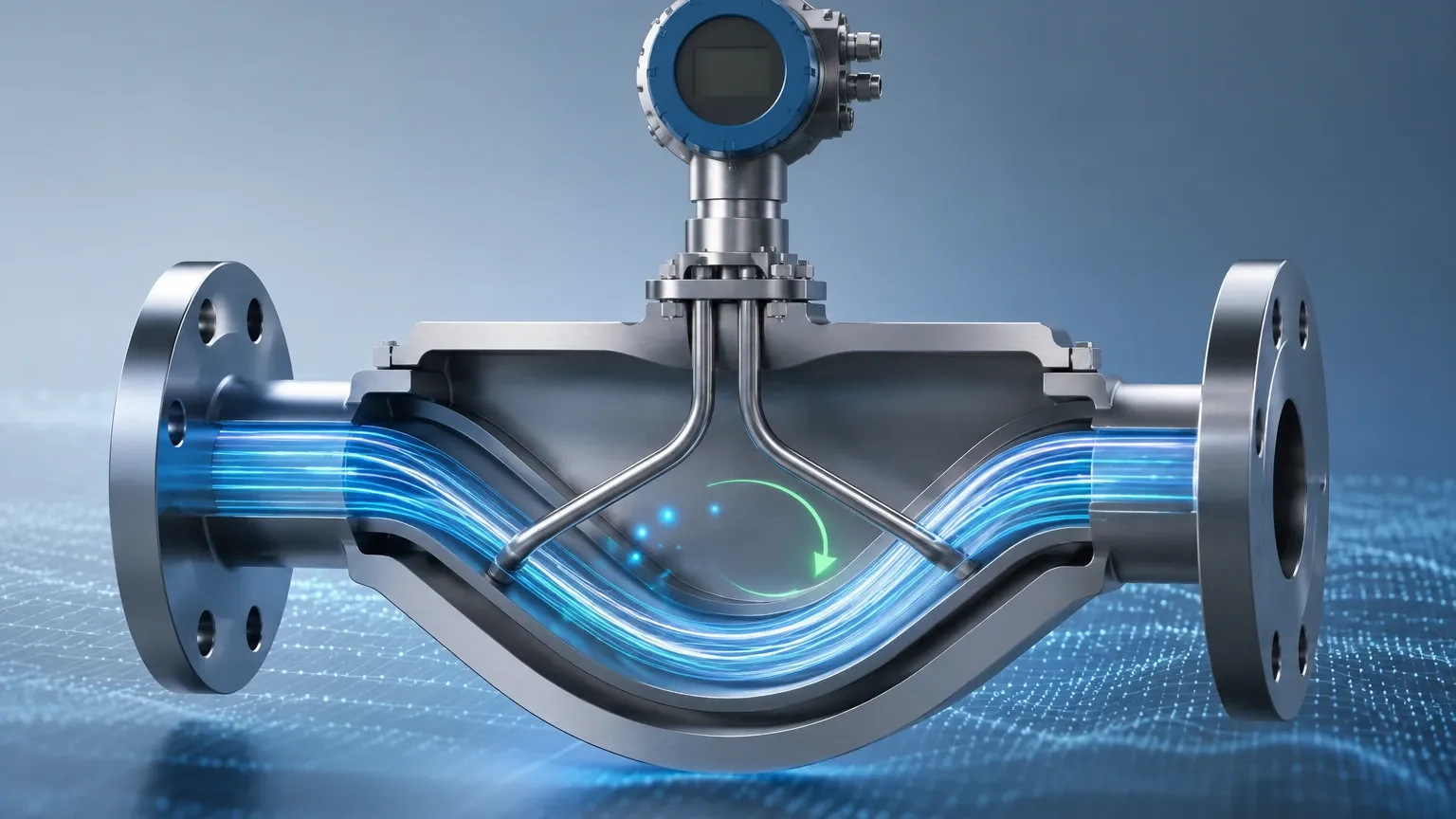
At the heart of the meter are one or more oscillating tubes, typically driven by an electromagnetic coil. When no fluid is flowing, the tubes vibrate in a uniform, symmetrical fashion. However, when a fluid (liquid or gas) enters the vibrating tubes, it is subjected to a Coriolis acceleration.
According to the laws of physics, an object moving within a rotating or oscillating frame of reference experiences a force perpendicular to the direction of motion and the axis of rotation. In a flow meter, this force causes the vibrating tubes to twist or experience a "phase shift." The inlet side of the tube resists the vibration, while the outlet side is pushed forward by the momentum of the fluid.
Mass Flow and Density Calculation
Sensors located at the inlet and outlet of the tubes detect this phase shift. The time difference (delta-T) between the two points is directly proportional to the mass flow rate. Because the measurement is based on mass, it is inherently independent of changes in fluid temperature, pressure, viscosity, or conductivity.
Simultaneously, the resonant frequency at which the tubes vibrate provides a direct measurement of the fluid's density. A denser fluid increases the mass of the tube assembly, causing it to vibrate at a lower frequency. By measuring both the phase shift and the frequency, the Coriolis effect flow meter can provide real-time data on mass flow, density, and temperature, from which volume flow and concentration can also be derived.
Technical Specifications and Selection Criteria
When selecting a Coriolis meter for a specific application, engineers must evaluate several parameters to ensure the device meets the process requirements. While these meters are highly accurate, they are also more complex and costly than many other flow technologies.
Accuracy and Repeatability
Coriolis meters are renowned for their high accuracy, often reaching ±0.1% or even ±0.05% for liquids, and ±0.5% for gases. This level of precision makes them ideal for custody transfer applications where financial transactions depend on exact measurements. Repeatability is typically within ±0.02% to ±0.05%.
Fluid Compatibility and Viscosity
Because the measurement is independent of the flow profile (laminar or turbulent), Coriolis meters can handle highly viscous fluids, such as resins, syrups, and crude oil. However, high-viscosity fluids may result in a higher pressure drop across the meter, which must be accounted for in the pump sizing and system design.
Operating Temperature and Pressure
Standard Coriolis meters can operate in temperatures ranging from -200°C to +350°C (-328°F to +662°F) and handle pressures up to 350 bar (5,076 psi). Specialized high-pressure models are available for hydrogen fueling and deep-sea oil extraction.
| Feature | Coriolis Flow Meter | Magnetic Flow Meter | Ultrasonic Flow Meter |
| :— | :— | :— | :— |
| Measurement Type | Direct Mass Flow | Volumetric Flow | Volumetric Flow |
| Accuracy (Liquid) | ±0.1% | ±0.25% to ±0.5% | ±0.5% to ±1.0% |
| Fluid Conductivity | Not Required | Required (>5 μS/cm) | Not Required |
| Moving Parts | No (Vibrating tubes) | No | No |
| Pressure Drop | Low to Moderate | Negligible | Negligible |
| Cost | High | Moderate | Moderate to High |
Design Variations: Straight vs. Bent Tubes
Coriolis meters generally fall into two design categories, each with specific advantages and limitations.
Bent Tube (U-Shape) Design
The U-shape or bent tube design is the most common. The curvature of the tubes allows for a greater degree of movement and a higher signal-to-noise ratio, which generally results in higher sensitivity and a wider turndown ratio. These meters are easier to calibrate for low flow rates but may be more susceptible to trapping air bubbles or solids in the bend of the tube.
Straight Tube Design
Straight tube Coriolis meters are designed for applications where fluid hygiene or low pressure drop is a priority. They are easier to drain and clean (CIP/SIP), making them popular in the pharmaceutical and food industries. However, they require more energy to vibrate and are generally more sensitive to external mechanical stress and temperature fluctuations.
Installation Considerations and Best Practices
To maintain the high accuracy of a Coriolis effect flow meter, proper installation is paramount. Unlike magnetic or ultrasonic meters, Coriolis meters do not require long straight runs of pipe before or after the meter, but they are sensitive to external vibrations.
1. Vibration Isolation: The meter should be mounted on a rigid support system. If the surrounding piping vibrates at a frequency close to the meter's resonant frequency, it can cause significant measurement errors. Flexible couplings may be used to isolate the meter from pump vibrations.
2. Orientation: For liquid applications, the meter should ideally be installed with the tubes pointing downward (in a "U" orientation) to prevent air from becoming trapped. For gas applications, the tubes should point upward to prevent condensate buildup. In vertical installations, the flow should always be upward to ensure the tubes remain full.
3. Zero Calibration: Once installed and under full process pressure and temperature, a "zero-point" calibration must be performed. This involves stopping the flow completely while ensuring the meter remains full of fluid, then setting the meter’s zero reference.
4. Stress-Free Mounting: The meter should not be used to support the weight of the piping. Mechanical stress on the meter body can distort the tube geometry and affect accuracy.
Limitations and Common Risks
Despite their versatility, Coriolis meters are not a "one-size-fits-all" solution. Engineers should be aware of the following risks:
* Entrained Air: The presence of gas bubbles in a liquid stream (slug flow) can dampen the tube vibration, leading to measurement instability or "stalling" of the meter. While modern digital signal processing (DSP) can mitigate this, high levels of entrained air remain a challenge.
* Initial Cost: The capital expenditure for a Coriolis meter is significantly higher than for a turbine or vortex meter. The ROI must be justified by the need for mass flow accuracy, density data, or reduced maintenance.
* Physical Size: For large pipe diameters (above 10 inches or 250mm), Coriolis meters become extremely heavy and bulky, often requiring specialized structural supports.
Relationship with Level Measurement
While the Coriolis meter focuses on flow, its ability to measure density provides a critical link to industrial level measurement. In many chemical tanks, knowing the exact density of the fluid is necessary to convert hydrostatic pressure into an accurate level reading. For comprehensive process monitoring, integrating high-quality flow data with reliable level instrumentation is standard practice. For those seeking advanced measurement solutions, you can Review product options and application support to see how mass flow and level data integrate within a process control loop.
Frequently Asked Questions (FAQ)
Q: Can a Coriolis meter measure steam?
A: While Coriolis meters can measure gas, steam is particularly challenging due to high temperatures and the potential for two-phase flow (condensate). Specialized high-temperature models are required, and the meter must be carefully sized to handle the low density of steam.
Q: Does the viscosity of the fluid affect the accuracy?
A: No, the Coriolis effect is independent of viscosity. However, high viscosity increases the pressure drop across the meter. It is important to verify that the system pumps can handle the additional resistance.
Q: How often does a Coriolis meter need calibration?
A: Because there are no wearing parts (like bearings in a turbine meter), Coriolis meters are exceptionally stable. Many facilities perform a verification check annually, but full laboratory recalibration may only be necessary every 3 to 5 years, depending on regulatory requirements.
Q: Can it measure the flow of solids?
A: Coriolis meters can measure slurries (liquids with suspended solids), provided the solids are small enough to pass through the tubes without causing erosion or blockages. They cannot measure dry, bulk solids.
Conclusion
The Coriolis effect flow meter remains the gold standard for mass flow measurement in the B2B industrial sector. By providing direct mass flow, density, and temperature in a single device, it simplifies process architecture and provides high-integrity data for critical applications. When implemented with a clear understanding of its mechanical principles and installation requirements, it offers a level of performance that volumetric meters cannot match. For engineers looking to optimize their process control, selecting the right flow and level measurement technology is the first step toward operational excellence.