Operations Level Responders May Perform Leak Control By
Operations Level Responders May Perform Leak Control By
In industrial environments where hazardous materials are processed or stored, the ability to manage accidental releases is critical for environmental protection and personnel safety. Operations level responders play a pivotal role in this ecosystem. Unlike technician-level responders who may enter the "hot zone" to plug or patch a container, operations level responders focus on defensive actions. Understanding that operations level responders may perform leak control by implementing specific containment and diversion strategies is essential for any facility manager or safety engineer.
Central to these defensive strategies is the use of reliable instrumentation. Accurate level measurement allows responders to monitor the status of a leak from a safe distance, providing the data necessary to determine if containment efforts are succeeding. This article explores the technical principles of level measurement, how these tools support defensive leak control, and the specific actions operations level responders take during an incident.
Principles of Level Measurement in Industrial Safety
Before detailing leak control maneuvers, it is important to understand the measurement principles that provide responders with situational awareness. To effectively manage a spill, one must first understand the volume of the material involved and the rate at which it is escaping. Welk provides several technologies suited for these high-stakes applications.
Radar Level Measurement
Radar level meters operate on the principle of Time Domain Reflectometry (TDR) or Frequency Modulated Continuous Wave (FMCW). In a defensive leak scenario, non-contact radar is often preferred. The sensor emits a high-frequency signal (typically 26GHz or 80GHz) that reflects off the surface of the liquid. By measuring the time it takes for the signal to return, the device calculates the distance to the product. Because radar is unaffected by temperature fluctuations or vapor clouds, it remains reliable even during a volatile chemical release.
Ultrasonic Level Sensors
Ultrasonic sensors use sound waves to determine liquid levels. The transducer emits an ultrasonic pulse that travels through the air, hits the liquid surface, and returns. While cost-effective for water treatment and non-volatile chemicals, ultrasonic sensors can be affected by heavy vapors or extreme turbulence, which are common during high-pressure leaks. However, for secondary containment monitoring (such as dikes or sumps), they provide an excellent early warning system.
Hydrostatic Level Transmitters
Hydrostatic measurement relies on the relationship between pressure and liquid height. The pressure at the bottom of a tank is directly proportional to the height of the liquid column and its density ($P = \rho \cdot g \cdot h$). In a leak control scenario, hydrostatic sensors installed in storage tanks can detect a rapid drop in pressure, signaling a breach even before a visual inspection is possible. These are often integrated into automated emergency shutdown systems (ESD).
Operations Level Responders May Perform Leak Control By Defensive Actions
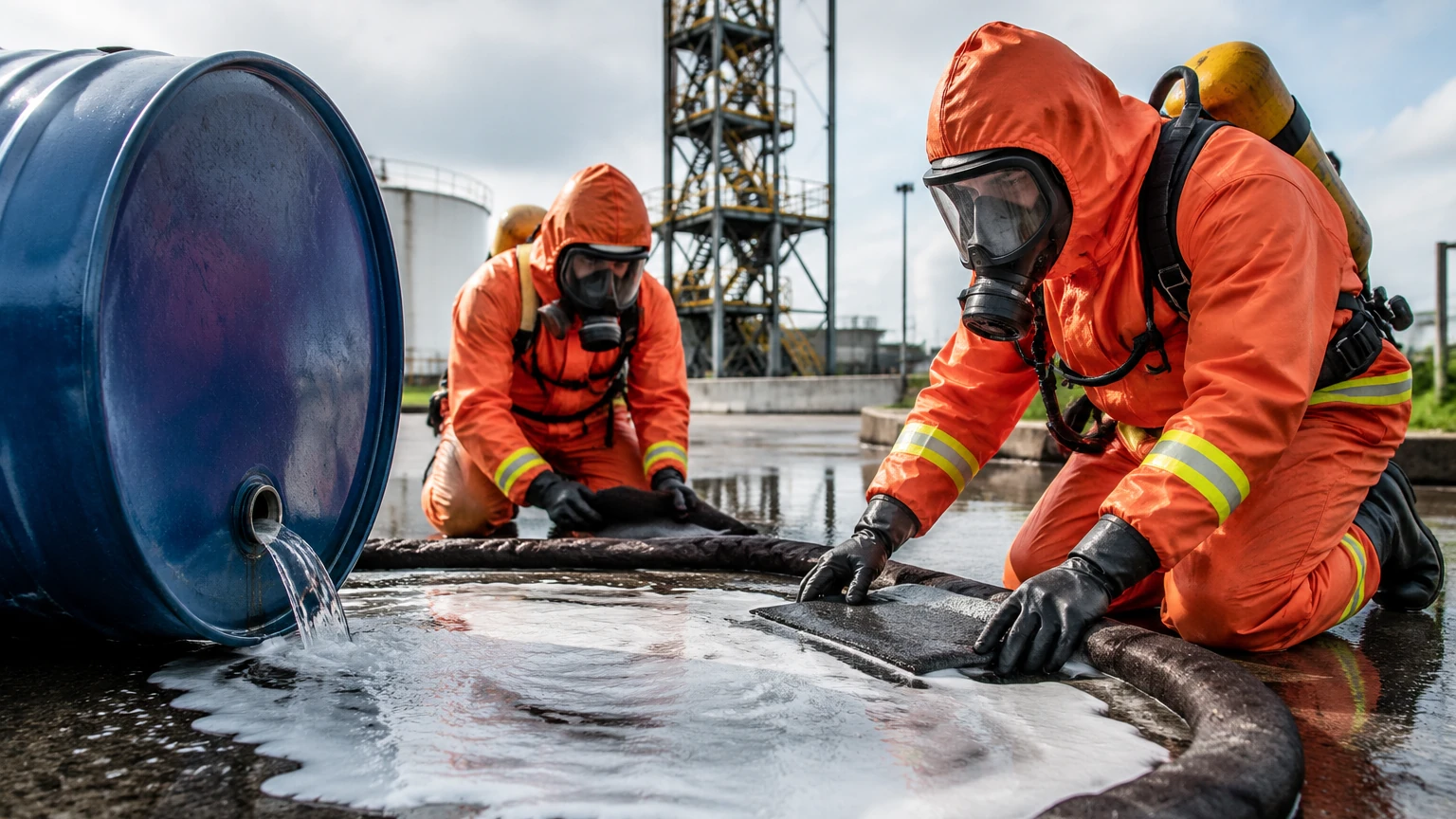
Operations level responders are trained to act defensively to prevent the spread of a spill and to keep the material from entering sensitive areas like drains or waterways. According to standard safety protocols, operations level responders may perform leak control by the following methods:
1. Remote Valve Activation
One of the most effective ways to control a leak without entering the immediate danger zone is through remote shutoff. If a storage tank equipped with a Welk level transmitter shows a sudden decrease in volume, an operations level responder can use the facility's control interface to close automated valves. This isolates the leaking section of the piping or the tank itself, effectively stopping the source of the release from a safe distance.
2. Diking and Damming
When a liquid has already escaped its primary container, responders focus on containment. Diking involves creating a barrier of earth, sandbags, or specialized absorbent booms to prevent the liquid from spreading across a flat surface. Damming is used when the liquid has entered a moving stream or drainage ditch. By monitoring the level of the contained liquid within the dike using portable ultrasonic sensors or visual gauges, responders can estimate how much time they have before the containment is breached.
3. Diverting and Retention
If a leak cannot be stopped immediately, responders may perform leak control by diverting the flow to a safer location, such as a lined retention pond or a secondary containment vessel. This requires a clear understanding of the facility's topography and the capacity of the destination vessel. Level meters on the destination tanks are critical here to ensure that the diversion does not result in a secondary overflow incident.
4. Vapor Suppression
For volatile liquids, leak control also involves managing the gaseous phase. Responders may apply foam blankets to suppress vapors. In these cases, non-contact radar level meters are invaluable because they can accurately measure the liquid level beneath the foam layer, allowing responders to track the actual volume of the spilled product without being misled by the foam's height.
Technical Selection for Leak Monitoring Systems
Choosing the right instrument is vital for supporting operations level responders. The following table compares common technologies used in safety and leak detection applications.
| Technology | Measurement Principle | Ideal Application | Limitations |
| :— | :— | :— | :— |
| Non-Contact Radar | FMCW / Pulse Radar | Volatile chemicals, tall tanks, foam-prone liquids | Higher initial cost |
| Ultrasonic | Sound Waves | Water, acids, open channels, sumps | Affected by wind, vapor, and vacuum |
| Hydrostatic | Pressure ($P=\rho gh$) | Deep tanks, underground storage | Requires contact with fluid; density must be known |
| Magnetic Gauge | Buoyancy & Magnetism | High-pressure tanks, visual confirmation | Mechanical parts can stick if fluid is viscous |
| Level Switch | Vibration / Float | Overfill prevention, pump protection | Point measurement only (on/off) |
For comprehensive technical specifications and to explore the full range of industrial sensors, professionals should consult the Main Page for detailed product data sheets.
Installation and Maintenance for Emergency Readiness
To ensure that level measurement systems are ready when operations level responders need them, strict installation and maintenance guidelines must be followed.
Installation Considerations
* Dead Zones: Every sensor has a "dead zone" or "blocking distance" near the transducer where measurement is impossible. For leak detection in sumps, sensors must be mounted high enough so that the liquid does not enter the dead zone before an alarm is triggered.
* Mounting Position: Sensors should be mounted away from inlet pipes to avoid turbulence and false readings. For radar and ultrasonic units, the beam must have a clear path to the liquid surface, free of internal tank obstructions like ladders or agitators.
* Redundancy: In safety-critical applications, using two different technologies (e.g., a radar meter and a hydrostatic transmitter) provides redundancy. If one fails due to specific environmental conditions (like heavy steam), the other remains operational.
Maintenance and Calibration
Regular calibration is essential. For hydrostatic sensors, this involves verifying the pressure reading against a known height. For radar units, it often involves checking for signal interference or "ghost echoes" caused by buildup on the antenna. Operations level responders rely on the accuracy of these systems to make split-second decisions; therefore, a documented maintenance schedule is a prerequisite for any industrial safety plan.
Limitations of Operations Level Leak Control
It is important to recognize the boundaries of the operations level role. While operations level responders may perform leak control by defensive means, they are prohibited from:
* Plugging or Patching: They should not attempt to stop a leak by applying a patch directly to a breached pressurized vessel.
* Entering High-Concentration Zones: Without technician-level training and Level A fully encapsulated suits, entering areas with high chemical concentrations is unsafe.
* Direct Neutralization: While they may assist in cleanup, the active neutralization of concentrated hazardous acids usually falls under the technician or specialist level.
Frequently Asked Questions (FAQ)
Q: Can operations level responders use level meters to calculate the rate of a leak?
A: Yes. By observing the change in level over a specific period (e.g., millimeters per minute), responders can calculate the flow rate of the leak, which helps in determining the required size of containment dikes.
Q: Why is radar preferred over ultrasonic for chemical leak monitoring?
A: Chemical leaks often involve temperature changes and the release of vapors. Sound waves (ultrasonic) change speed based on air density and temperature, leading to errors. Radar waves are electromagnetic and travel at the speed of light, remaining unaffected by the gas composition above the liquid.
Q: How do level switches differ from continuous level meters in leak control?
A: A level switch provides a binary signal (e.g., "tank is full" or "sump is empty"). Continuous level meters provide a real-time percentage or volume reading. For operations level responders, continuous measurement is superior because it shows trends rather than just a single state.
Q: What is the maximum range for these sensors?
A: Most industrial radar level meters can measure up to 30 meters (approx. 100 feet), while specialized long-range units can reach 70 meters (approx. 230 feet) or more, allowing for monitoring of very large storage silos or deep reservoirs.
By integrating advanced measurement technology from providers like Welk with rigorous training, industrial facilities can ensure that when a crisis occurs, operations level responders have the tools and information necessary to perform leak control effectively and safely. For more information on selecting the right instrumentation for your safety protocols, visit the Main Page to review product options and application support.
Download Operations Level Responders May Perform Leak Control By as a PDF