Pressure Transducer to Measure Water Level
Pressure Transducer to Measure Water Level
In industrial automation and water management, the use of a pressure transducer to measure water level is one of the most reliable and cost-effective methods available. This technique, often referred to as hydrostatic level measurement, leverages the physical relationship between the height of a liquid column and the pressure it exerts at a specific depth. For engineers and facility managers, understanding the nuances of sensor selection, installation, and calibration is essential for maintaining process efficiency and equipment longevity.
As a professional manufacturer, Welk provides a range of industrial instruments designed for these specific challenges. Whether the application involves a deep groundwater well, a municipal water tank, or a pressurized chemical vessel, selecting the correct pressure transducer requires a deep dive into the physics of the application and the environment in which the sensor will operate.
The Fundamental Principle of Hydrostatic Level Measurement
The operation of a pressure transducer to measure water level is based on the hydrostatic pressure principle. In a static liquid, the pressure at any given point is determined by the weight of the liquid column above it. This relationship is mathematically expressed by the formula:
P = ρ × g × h
Where:
* P is the hydrostatic pressure (Pa or bar).
* ρ (rho) is the density of the liquid (kg/m³). For pure water at 4°C, this is approximately 1,000 kg/m³.
* g is the acceleration due to gravity (approximately 9.81 m/s²).
* h is the height of the liquid column (meters).
Because gravity is constant and the density of water is relatively stable under consistent temperatures, the pressure measured by the transducer is directly proportional to the water level. For example, a water column of 10 meters (approximately 32.8 feet) exerts a pressure of roughly 1 bar (14.5 psi) at the base. By measuring this pressure, the transducer converts the mechanical force into an electrical signal, such as 4-20mA or RS485 Modbus, which can be interpreted by a PLC or display unit as a level reading.
Types of Pressure Transducers for Water Level
When implementing a pressure transducer to measure water level, there are two primary configurations used in industrial settings: submersible transmitters and externally mounted sensors.
1. Submersible Level Transmitters
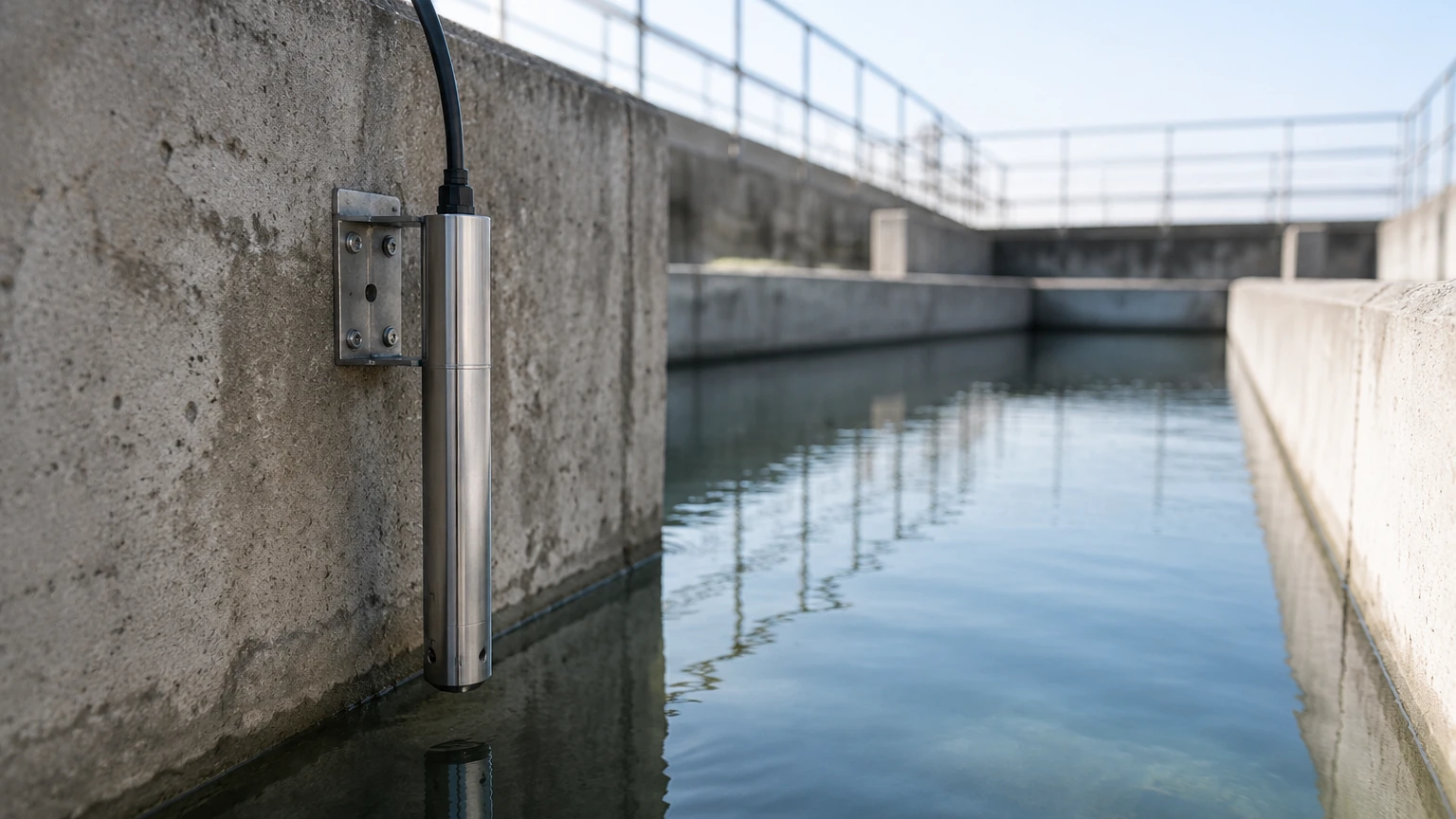
These sensors are designed to be lowered directly into the liquid. They feature a sealed housing containing the sensing element and are connected to a specialized cable that includes a vent tube. This vent tube is critical as it allows the sensor to compensate for changes in atmospheric pressure, ensuring that the measurement only reflects the weight of the water.
2. External Pressure Transducers
Commonly used in tanks with bottom or side-mounted ports, these sensors are threaded directly into the piping or the vessel wall. They are ideal for applications where the sensor needs to be accessible for maintenance without draining the tank or where the liquid might be too turbulent for a suspended submersible probe.
For a broader look at how these sensors integrate into larger control systems, professionals often visit the Main Page to evaluate different housing materials and output protocols.
Practical Selection Criteria
Choosing the right pressure transducer to measure water level involves more than just matching a pressure range. Engineers must consider several technical factors to ensure long-term accuracy.
Pressure Range and Overpressure Protection
The selected range should closely match the maximum expected water level to maximize resolution. However, it must also account for potential pressure spikes (water hammer) or accidental overfilling. A sensor with an overpressure rating of at least 2x the nominal range is standard for industrial safety.
Material Compatibility
While 304 or 316L stainless steel is sufficient for clean water, wastewater or chemical-laden water may require specialized materials like Hastelloy, Titanium, or PTFE-coated housings to prevent corrosion. The cable material for submersible units (PUR, PE, or FEP) must also be compatible with the fluid.
Signal Output
* 4-20mA: The industry standard for long-distance transmission with high noise immunity.
* 0-10V: Suitable for short distances and simple controller interfaces.
* Modbus RTU: Ideal for digital integration and multi-sensor networks, providing additional data such as temperature.
Technical Selection Table
The following table provides a general guideline for selecting a pressure transducer to measure water level based on common application scenarios.
| Application Type | Recommended Sensor Type | Typical Range | Key Feature Required |
| :— | :— | :— | :— |
| Groundwater Well | Submersible Borehole Probe | 0–200m | Slim diameter, high-strength cable |
| Open Storage Tank | Submersible Transmitter | 0–10m | Atmospheric vent tube, IP68 rating |
| Pressurized Vessel | Differential Pressure Transducer | Variable | High static pressure compensation |
| Wastewater Sump | Clog-resistant Submersible | 0–5m | Large flush diaphragm, chemical resistance |
| Irrigation Canal | Low-pressure External Sensor | 0–2m | High accuracy at low head pressures |
Installation Considerations
Correct installation is the most significant factor in the performance of a pressure transducer to measure water level. Even the highest quality sensor will provide inaccurate data if installed poorly.
1. Atmospheric Venting: For submersible sensors, the vent tube in the cable must remain unobstructed and protected from moisture. A desiccant filter or a specialized junction box is often used to prevent condensation from forming inside the tube, which could lead to measurement drift.
2. Positioning: The sensor should be located away from inlets or agitators where turbulence and high-velocity flow can create localized pressure fluctuations (Bernoulli effect), leading to false readings.
3. Protection from Debris: In silty or high-solids environments, the sensor should be housed in a stilling well (a perforated pipe) to protect the diaphragm from physical damage and to dampen surface waves.
4. Cable Support: For deep wells, the weight of the cable should be supported by a separate strain-relief wire or clamp to prevent the internal conductors from stretching over time.
Limitations and Challenges
While highly effective, using a pressure transducer to measure water level has specific limitations that must be managed:
* Density Changes: Since the measurement relies on the weight of the water, changes in density (caused by temperature fluctuations or varying salinity) will affect the reading. If the water temperature varies significantly, a sensor with integrated temperature compensation or a secondary temperature probe may be required to correct the level calculation.
* Atmospheric Pressure: In non-vented systems, changes in barometric pressure can be mistaken for changes in water level. A 10 mbar change in atmospheric pressure equates to approximately 10 cm of water level error. This is why vented cables or differential pressure sensors are used in high-precision applications.
* Sediment Buildup: In wastewater applications, grease or silt can accumulate on the sensing diaphragm. Regular maintenance and the use of flush-diaphragm designs can mitigate this risk.
Frequently Asked Questions (FAQs)
Q: How often should a pressure transducer used for water level be calibrated?
A: For most industrial applications, an annual calibration check is recommended. However, in critical infrastructure or high-fouling environments, bi-annual checks may be necessary to ensure the sensor hasn't drifted due to diaphragm fatigue or sediment buildup.
Q: Can I use a standard pressure transducer for water level if the tank is pressurized?
A: No. A standard gauge pressure transducer will measure the sum of the liquid head and the gas pressure above the liquid. For pressurized tanks, a differential pressure (DP) transmitter is required, which measures the difference between the bottom pressure and the top gas pressure.
Q: What is the maximum depth a submersible pressure transducer can measure?
A: Modern sensors can be designed for depths exceeding 500 meters. The limiting factors are the structural integrity of the sensor housing and the tensile strength of the vented cable.
Q: Does the length of the cable affect the signal accuracy?
A: If using a 4-20mA current loop, the signal is highly resistant to voltage drops over long distances (up to several hundred meters). For voltage-based signals (0-5V/0-10V), cable length is a concern due to resistance, and digital or current signals are preferred.
Conclusion
Utilizing a pressure transducer to measure water level remains a cornerstone of industrial fluid management due to its simplicity and reliability. By understanding the hydrostatic principle and carefully selecting a sensor based on the specific environmental conditions—such as chemical composition, depth, and pressure—operators can achieve precise and long-lasting measurements.
Welk continues to innovate in this field, providing robust solutions for water treatment, industrial automation, and oil and gas sectors. For those seeking to optimize their level measurement systems, exploring the technical resources on the Main Page is a recommended next step to ensure the selected technology aligns with the project's engineering requirements.
Download Pressure Transducer to Measure Water Level as a PDF