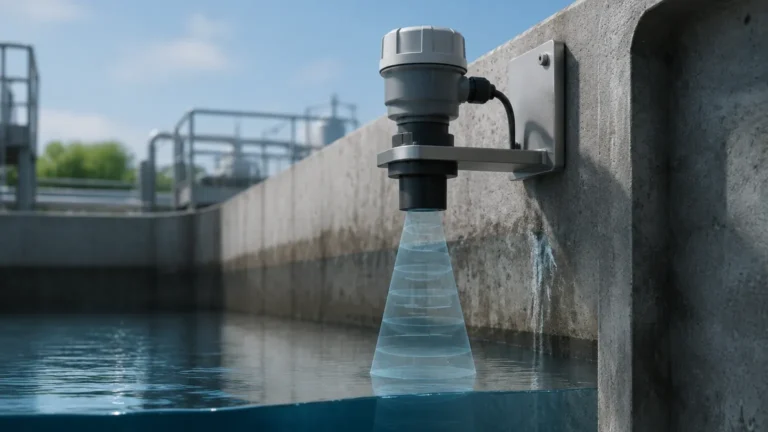
Ultrasonic Level Sensor for Tanks
Ultrasonic Level Sensor for Tanks: A Practical Engineering Guide
In modern industrial automation, the ability to monitor liquid levels accurately and reliably is fundamental to process safety, inventory management, and operational efficiency. Among the various technologies available, Ultrasonic Level Meters have emerged as a preferred solution for a wide range of tank applications. This guide explores the technical principles, selection criteria, and installation best practices for deploying an ultrasonic level sensor for tanks in industrial environments.
Understanding the Measurement Principle
Before selecting a sensor, it is essential to understand the physics governing ultrasonic measurement. Ultrasonic level sensors operate on the "Time-of-Flight" (ToF) principle.
How It Works
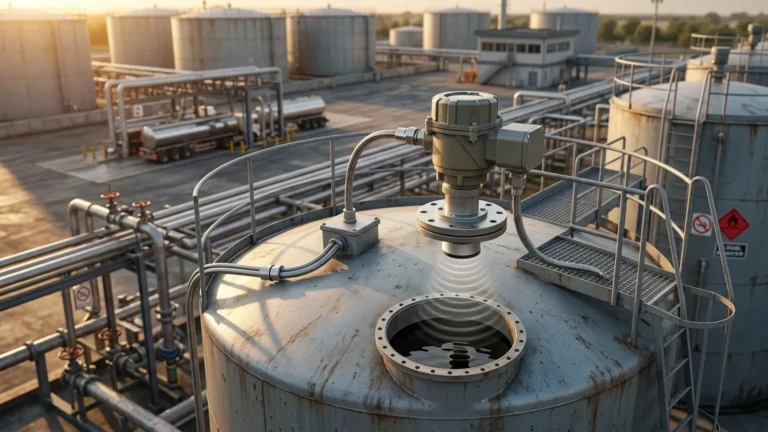
The sensor’s transducer emits high-frequency sound pulses, typically in the range of 20 kHz to 70 kHz. These sound waves travel through the air gap in the tank, hit the surface of the liquid or solid medium, and reflect back to the transducer. The sensor’s internal electronics measure the time interval between the emission of the pulse and the reception of the echo.
Using the known speed of sound in air—approximately 343 meters per second (1,125 feet per second) at 20°C—the device calculates the distance to the material surface using the formula:
Distance = (Speed of Sound × Time) / 2
Once the distance is determined, the sensor subtracts this value from the total tank height (programmed during setup) to provide the actual level or volume of the contents. Because this is a non-contact method, the sensor is not subject to corrosion or fouling by the process media, which significantly reduces maintenance requirements compared to contact-based probes.
Why Choose an Ultrasonic Level Sensor for Tanks?
For many B2B applications in water treatment, chemical processing, and oil and gas, the Ultrasonic Level Meters offered by manufacturers like Welk provide a balanced combination of performance and cost-effectiveness.
Key benefits include:
* Non-Contact Measurement: Ideal for corrosive, viscous, or sticky liquids that would damage or cling to submerged sensors.
* Low Maintenance: With no moving parts and no contact with the media, wear and tear are virtually non-existent.
* Versatility: Capable of measuring both liquids and certain types of bulk solids in various tank geometries.
* Ease of Integration: Most modern units provide standard industrial outputs such as 4-20mA, HART, or RS485 Modbus for seamless connection to PLCs and SCADA systems.
Key Evaluation Criteria for Selection
Selecting the right ultrasonic level sensor for tanks requires a detailed analysis of the application environment. Engineers should confirm the following parameters before procurement:
1. Measuring Range and Dead Zone
Every ultrasonic sensor has a maximum range (e.g., 5m, 10m, or 15m) and a minimum "dead zone" (also known as the blocking distance). The dead zone is the area immediately below the transducer where the sensor cannot accurately process echoes because the pulse is still being emitted. If the liquid level enters this zone, the reading will become erratic or fixed at the maximum value.
2. Process Temperature and Pressure
The speed of sound varies with air temperature. Most high-quality industrial sensors include integrated temperature compensation. However, extreme temperatures (typically above 80°C) or high pressures can significantly alter sound wave propagation, making standard ultrasonic sensors unsuitable.
3. Surface Conditions
Ultrasonic waves require a clear reflection. If the tank contains heavy foam, the sound waves may be absorbed rather than reflected. Similarly, extreme turbulence or boiling surfaces can scatter the signal. In such cases, a stilling well or a change to radar technology might be necessary.
4. Tank Geometry and Internal Obstructions
Tanks with internal ladders, agitators, or heating coils can create "false echoes." Advanced sensors feature software algorithms to map out these obstructions, but proper placement remains the primary defense against signal interference.
Practical Selection Table
The following table provides a general guideline for matching ultrasonic sensor specifications to common tank applications.
| Application Type | Recommended Range | Typical Media | Key Consideration |
| :— | :— | :— | :— |
| Small Chemical Tote | 0.25m – 3m | Acids, Bases | Chemical compatibility of the transducer face (e.g., PVDF/PTFE). |
| Wastewater Wet Well | 0.5m – 10m | Sewage, Water | IP68 rating for flooding protection and condensation resistance. |
| Fuel Storage Tank | 1m – 15m | Diesel, Oil | Explosion-proof (Ex-rated) certification required. |
| Open Buffer Tank | 0.2m – 5m | Process Water | Simple mounting; focus on cost-to-performance ratio. |
| Silo (Bulk Solids) | 1m – 10m | Plastic Pellets | Dust compensation and beam angle narrowness are critical. |
Installation Guidelines and Best Practices
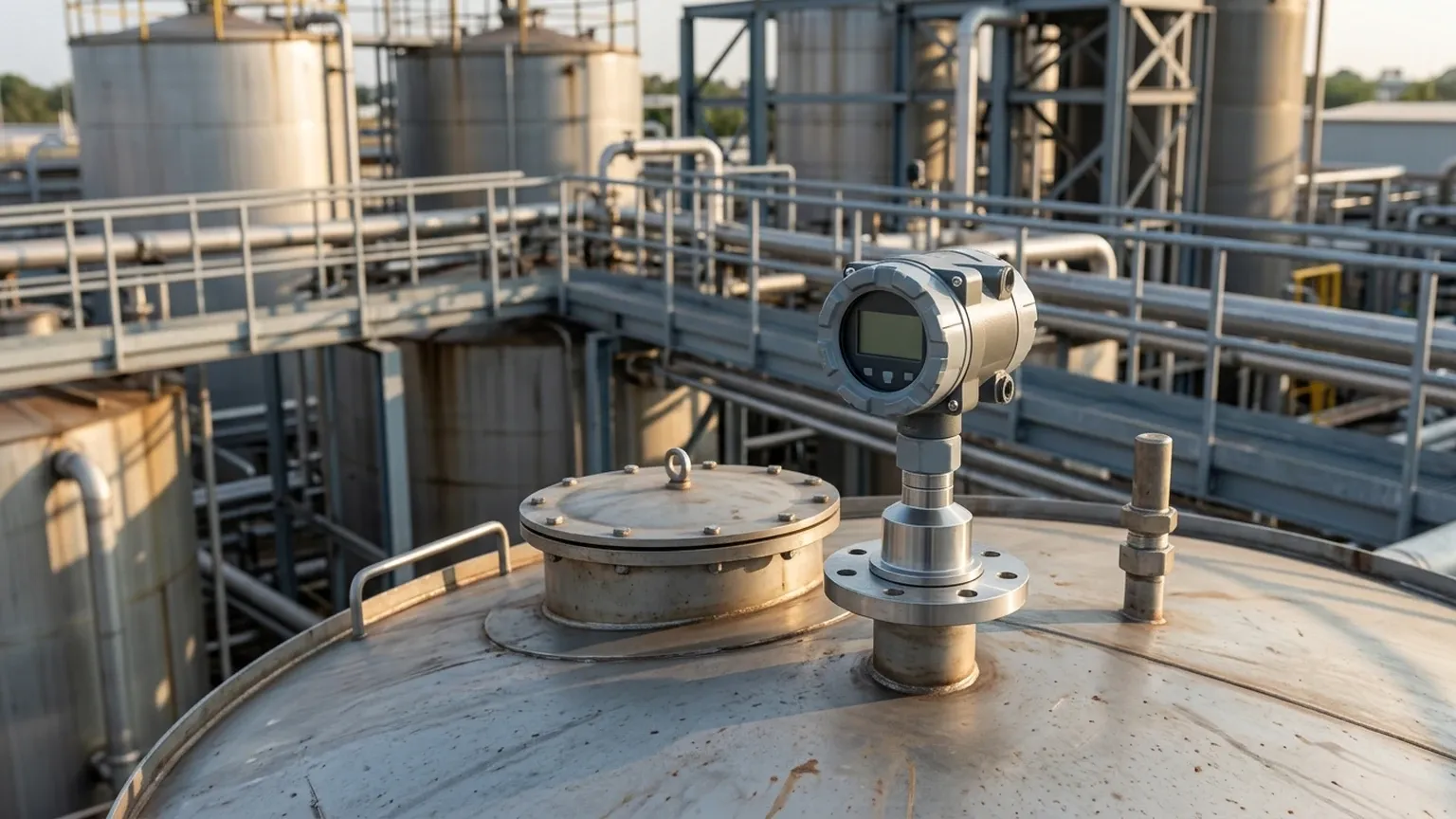
Even the most advanced ultrasonic level sensor for tanks will fail if installed incorrectly. Adhering to these engineering principles ensures long-term reliability.
Proper Positioning
* Avoid the Center: In cylindrical tanks with domed tops, mounting the sensor in the exact center can cause "parabolic focalization," where multiple echoes converge, leading to false readings.
* Avoid the Wall: Stay away from the tank wall to prevent the ultrasonic beam from hitting the side or catching on weld seams. A general rule is to maintain a distance from the wall equal to 1/6th of the tank diameter.
* Clear Path: Ensure the beam path is free of fill streams, pipes, and internal supports. The sensor should never be mounted directly above the inlet pipe.
Mounting Alignment
The transducer face must be perfectly parallel to the liquid surface. A tilt of even a few degrees can cause the reflected signal to miss the receiver, especially at longer distances. For tanks with angled roofs, use a flange or an adjustable mounting bracket to correct the alignment.
Managing the Dead Zone
If the tank must be filled to the very top, mount the sensor on a nozzle or a stand-pipe. This raises the sensor higher, ensuring the maximum liquid level remains below the dead zone. However, the nozzle must be wide enough and have a smooth interior to prevent internal reflections.
Limitations and Common Risks
While highly versatile, ultrasonic technology is not a universal solution. Engineers should be aware of the following limitations:
1. Vacuum Applications: Sound waves require a medium (air or gas) to travel. Ultrasonic sensors will not function in a vacuum.
2. Vapor and Gas Layers: If the tank contains heavy vapors (like certain solvents) or gases that are significantly denser or lighter than air, the speed of sound will change, leading to significant measurement errors unless calibrated for that specific gas mixture.
3. Acoustic Noise: High-frequency noise from nearby machinery or pneumatic filling can occasionally interfere with the sensor’s signal processing.
4. Heavy Dust: In solids applications, extremely thick dust clouds can attenuate the signal, though many Welk sensors are designed with high-gain pulses to overcome moderate dust.
Frequently Asked Questions (FAQs)
Q: Can I use an ultrasonic sensor for boiling liquids?
A: It is generally not recommended. Boiling creates both surface turbulence and steam/vapor layers, both of which degrade the ultrasonic signal. Radar level meters are usually a better fit for boiling processes.
Q: How do I handle condensation on the sensor face?
A: Many industrial sensors feature a self-cleaning effect through the vibration of the transducer. However, in high-humidity environments, choosing a sensor with a curved or PTFE-coated face can help moisture bead off more effectively.
Q: What is the typical lifespan of an ultrasonic level meter?
A: When installed within its specified temperature and chemical limits, a high-quality sensor like those in the Welk range can last 7 to 10 years or more, as there are no moving parts to wear out.
Q: Is it possible to measure the volume of a horizontal cylindrical tank?
A: Yes. Most modern transmitters include built-in linearization tables or math functions where you can input the tank dimensions, and the sensor will automatically convert the level measurement into a volume output (e.g., Liters or Gallons).
Conclusion
The use of an ultrasonic level sensor for tanks offers a reliable, non-invasive, and cost-effective method for monitoring industrial fluids. By understanding the ToF principle and carefully accounting for environmental factors like foam, temperature, and tank geometry, project managers can ensure precise inventory control and process safety.
For those seeking specific hardware specifications or customized OEM/ODM solutions, exploring the technical data for Ultrasonic Level Meters is the recommended next step to match a device to your unique process requirements. Always confirm the chemical compatibility of the wetted materials and the required hazardous area certifications before finalizing a system design.