Ultrasonic Level Sensor Hc Sr04
Ultrasonic Level Sensor HC-SR04 vs. Industrial Ultrasonic Level Meters: A Technical Comparison
In the field of distance and level measurement, ultrasonic technology has become one of the most versatile and cost-effective methods for non-contact sensing. From small-scale robotics projects to massive industrial chemical tanks, the underlying principle of using sound waves to determine distance remains the same. However, the hardware required to perform these tasks varies significantly depending on the environment.
One of the most recognized components in the electronics prototyping world is the ultrasonic level sensor hc sr04. While this module is an excellent tool for learning and basic automation, industrial applications require the robustness and precision of professional Ultrasonic Level Meters. This article provides a comprehensive technical guide into the measurement principles, the limitations of entry-level sensors, and the selection criteria for industrial-grade instrumentation.
Understanding the Measurement Principle
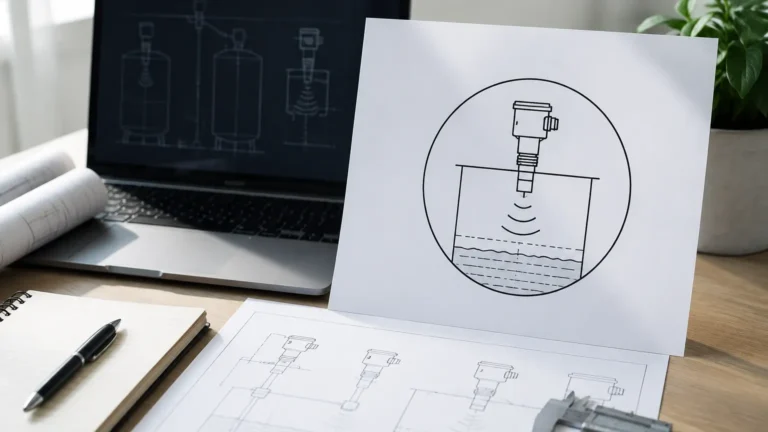
Both the hobbyist-grade HC-SR04 and professional industrial sensors operate on the "Time of Flight" (ToF) principle. This method involves emitting a high-frequency sound pulse and measuring the time it takes for the echo to return after bouncing off a target surface.
The Physics of Sound
The sensor's transducer acts as both a transmitter and a receiver (or uses a pair of dedicated transducers). It emits an ultrasonic pulse—typically at a frequency of 40 kHz for basic sensors or ranging from 20 kHz to 80 kHz for industrial units. This pulse travels through the air at the speed of sound.
The distance ($D$) is calculated using the following formula:
$$D = \frac{t \times v}{2}$$
Where:
* $t$ is the time elapsed between transmission and reception.
* $v$ is the velocity of sound in the medium (approximately 343 meters per second in dry air at 20°C).
Because the sound must travel to the object and back, the total distance is divided by two to find the level of the material or the distance to the surface.
The Role of the Ultrasonic Level Sensor HC-SR04
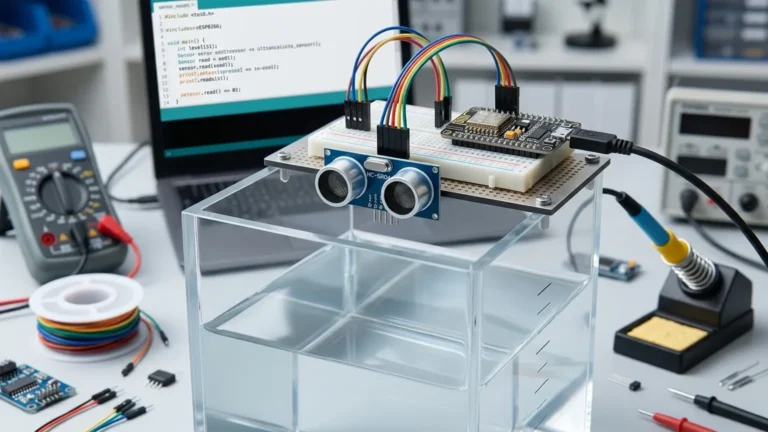
The ultrasonic level sensor hc sr04 is a staple in the world of Arduino, Raspberry Pi, and DIY electronics. It is a low-cost module designed for indoor environments where conditions are stable and the targets are hard, flat surfaces.
Technical Specifications of the HC-SR04
* Operating Voltage: 5V DC.
* Ranging Distance: 2 cm to 400 cm (approximately 0.02m to 4m).
* Measuring Angle: 15 degrees.
* Interface: 4-pin (VCC, Trigger, Echo, Ground).
* Frequency: 40 kHz.
Limitations in Industrial Contexts
While the HC-SR04 is highly effective for obstacle avoidance in small robots or simple liquid level demonstrations in a lab, it lacks the necessary features for process automation. It has no protection against moisture (IP rating), no temperature compensation, and its TTL (Transistor-Transistor Logic) output is susceptible to electromagnetic interference (EMI) over long cable runs. Furthermore, it cannot handle the corrosive vapors often found in industrial tanks.
Industrial-Grade Ultrasonic Level Meters: Features and Capabilities
For professional engineering applications, such as water treatment, chemical processing, and oil and gas storage, Ultrasonic Level Meters are engineered to withstand harsh environments while providing high-accuracy data integration.
Advanced Signal Processing
Unlike the raw pulse output of an HC-SR04, industrial meters utilize sophisticated Digital Signal Processing (DSP). This allows the device to filter out "false echoes" caused by internal tank obstructions like ladders, agitators, or structural beams. This capability is known as False Echo Suppression or Echo Mapping.
Environmental Durability
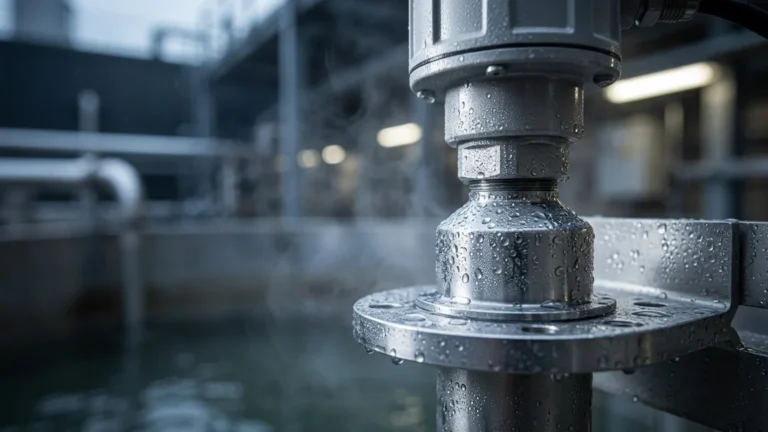
Industrial sensors are housed in rugged materials such as PVDF, PTFE, or stainless steel to resist chemical corrosion. They typically carry IP66, IP67, or IP68 ratings, ensuring they remain functional even when exposed to high-pressure washdowns or temporary submersion.
Integration and Communication
In a B2B environment, data must be transmitted to a PLC (Programmable Logic Controller) or a SCADA system. Industrial meters provide standard outputs including:
* 4-20mA Analog Signals: Ideal for long-distance transmission with minimal signal loss.
* HART Protocol: For digital communication over analog wires.
* RS485/Modbus: For networked sensor arrays.
* Relay Outputs: For direct pump or alarm control.
Technical Comparison: Prototyping vs. Process Control
The following table highlights the critical differences between the ultrasonic level sensor hc sr04 and professional industrial solutions.
| Feature | HC-SR04 (Hobbyist) | Industrial Ultrasonic Level Meter |
| :— | :— | :— |
| Measurement Range | 0.02m – 4m | 0.3m – 30m+ |
| Accuracy | ~3mm (in ideal conditions) | 0.2% to 0.5% of full scale |
| Housing Material | Exposed PCB / Aluminum | PVDF, PP, or Stainless Steel |
| Ingress Protection | None (Indoor use only) | IP66 / IP67 / IP68 |
| Operating Temp | 0°C to 70°C | -40°C to +80°C (standard) |
| Output Signal | TTL Pulse (Digital High/Low) | 4-20mA, Modbus, HART, Relays |
| Temperature Comp. | None (Manual calculation) | Automatic (Built-in thermistor) |
| Hazardous Areas | Not Rated | ATEX / Ex-proof options available |
Selection Criteria for Industrial Applications
When transitioning from a prototype using an ultrasonic level sensor hc sr04 to a permanent industrial installation, engineers must evaluate several key factors to ensure reliability.
1. The "Dead Zone" or Blocking Distance
Every ultrasonic sensor has a minimum distance it cannot measure, known as the dead zone. This occurs because the transducer needs a fraction of a millisecond to stop vibrating from the transmission before it can begin listening for the echo. For industrial units, this is typically between 0.25m and 0.5m. The tank should never be filled into this zone.
2. Beam Angle and Tank Geometry
The beam angle determines how much the sound wave spreads as it travels. A wider beam angle is more likely to hit the sides of a narrow tank or internal pipes. Industrial sensors often offer narrower beam angles (e.g., 5 to 10 degrees) compared to the 15-degree spread of the HC-SR04, allowing for installation in tighter spaces.
3. Chemical Compatibility
If the application involves acids, bases, or solvents, the sensor face must be compatible. PVDF (Polyvinylidene fluoride) is a common choice for corrosive liquids, whereas standard ABS or aluminum found on hobbyist sensors would degrade rapidly.
4. Temperature and Pressure
The speed of sound changes with air temperature ($v \approx 331.5 + 0.6T$). Industrial meters include internal temperature sensors to automatically adjust the distance calculation in real-time. Additionally, ultrasonic sensors are generally limited to atmospheric pressure applications, as high pressure significantly alters the acoustic impedance of the air.
Installation Best Practices and Avoiding Common Errors
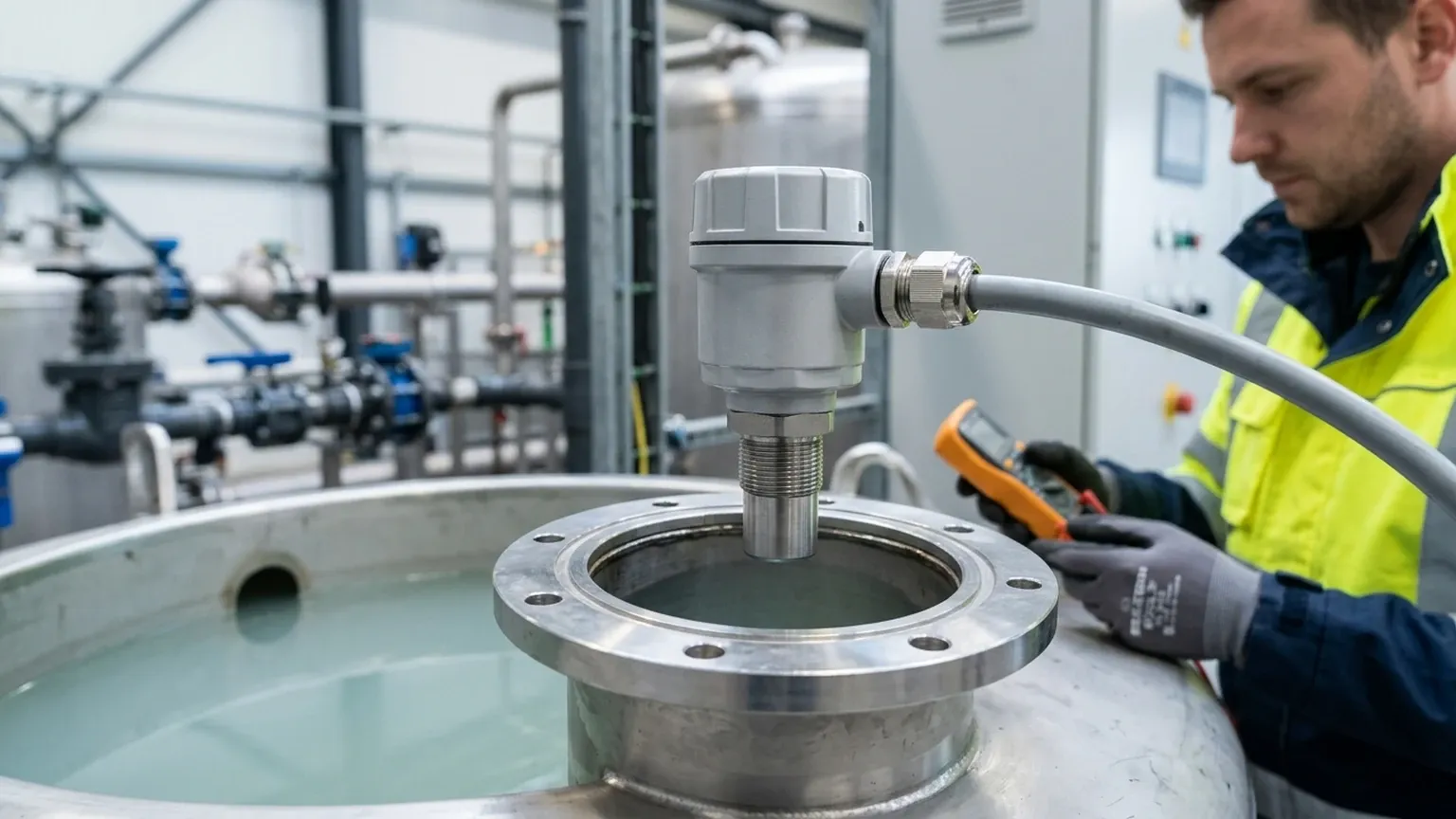
Proper installation is critical for the performance of any ultrasonic level meter. Even the most advanced sensor will fail if positioned incorrectly.
* Perpendicular Mounting: The sensor must be mounted perfectly perpendicular to the liquid surface. If the sensor is tilted, the sound wave will bounce off the surface at an angle and may not return to the receiver.
* Avoid the Center of Domed Tanks: In tanks with domed tops, mounting the sensor in the exact center can create a "parabolic mirror" effect, amplifying noise and false echoes. An off-center position is usually preferred.
* Clearance from Inlets: Do not install the sensor directly above the point where liquid enters the tank. The resulting turbulence and splashing will create significant signal noise.
* Standpipe Usage: In cases where heavy foam or extreme turbulence is present, a stilling well or standpipe can be used to provide a calm surface for the ultrasonic pulse to hit.
Limitations of Ultrasonic Technology
While highly effective, ultrasonic technology is not a universal solution. Engineers should be aware of the following physical limitations:
1. Vacuum Conditions: Sound cannot travel through a vacuum. If a process involves a vacuum, radar level meters are required.
2. Heavy Foam: Thick, dense foam can absorb the ultrasonic pulse rather than reflecting it, leading to a "Loss of Echo" error.
3. Heavy Dust or Vapor: While light dust is manageable, extremely dense dust (in grain silos) or heavy steam can scatter the sound waves, reducing the effective range.
4. High Temperatures: Beyond 80°C to 100°C, the air density gradients can cause the sound wave to refract, leading to inaccuracies.
Frequently Asked Questions (FAQs)
Q: Can I use an HC-SR04 to measure the level of a water tank in my garden?
A: Yes, for a basic DIY project. However, you must protect the sensor from humidity and rain using a specialized enclosure, and be aware that its accuracy will drift as the outdoor temperature changes.
Q: Why is 4-20mA preferred over the digital pulse of the HC-SR04?
A: 4-20mA is a current loop standard. Unlike voltage-based signals (like TTL), current is not affected by the resistance of long wires or electromagnetic noise from nearby motors, making it the standard for industrial reliability.
Q: How do I handle a tank with an agitator?
A: Professional ultrasonic level meters allow you to program a "mask" or use false echo suppression to tell the software to ignore the specific distance where the agitator blades are located.
Q: What is the maximum range for industrial ultrasonic sensors?
A: Most standard industrial units reach up to 15 or 20 meters. Specialized high-power transducers can extend this range to 30 or 40 meters for large silos or open-channel flow measurement.
Conclusion
The ultrasonic level sensor hc sr04 serves as an excellent entry point for understanding the mechanics of acoustic ranging. However, for B2B applications where downtime is costly and accuracy is paramount, professional Ultrasonic Level Meters are the necessary choice. By providing integrated temperature compensation, ruggedized housings, and industry-standard communication protocols, these instruments ensure that process industries can maintain safe and efficient operations. When selecting a solution, always consider the chemical environment, the physical dimensions of the vessel, and the required integration with existing control systems.