Ultrasonic Level Sensing
Ultrasonic Level Sensing: A Practical Engineering Guide to Non-Contact Measurement
In the landscape of industrial automation, the ability to accurately monitor fluid and solid levels without physical contact is a significant operational advantage. Ultrasonic level sensing has emerged as one of the most versatile and cost-effective technologies for this purpose. By utilizing high-frequency sound waves, these systems provide reliable data in diverse environments, ranging from municipal water treatment to complex chemical processing. This guide explores the fundamental principles, selection criteria, and installation best practices for implementing ultrasonic technology in industrial workflows.
Understanding the Principles of Ultrasonic Level Sensing
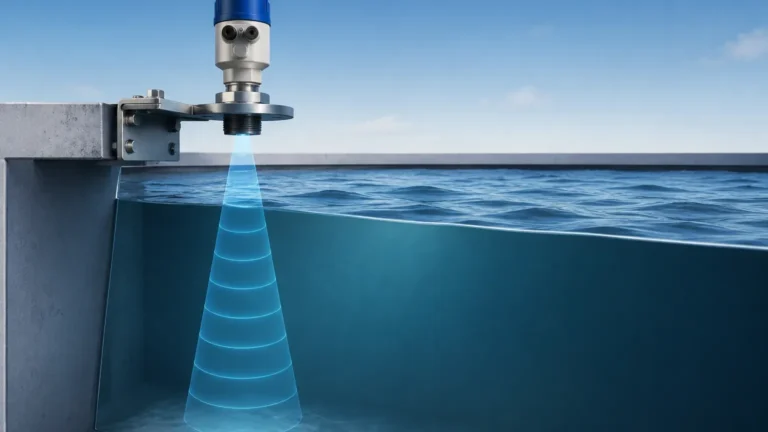
Ultrasonic level sensing operates on the "Time-of-Flight" (ToF) principle. The process begins with an ultrasonic transducer, which contains a piezoelectric crystal. When energized, this crystal vibrates at a specific frequency, emitting a burst of sound waves—typically between 20 kHz and 200 kHz—directed toward the surface of the material being measured.
The Measurement Cycle
1. Emission: The transducer sends out a sonic pulse.
2. Reflection: The pulse travels through the air gap, hits the surface of the medium (liquid or solid), and reflects back as an echo.
3. Detection: The transducer receives the returning echo and converts the mechanical vibration back into an electrical signal.
4. Calculation: The integrated electronics calculate the time elapsed between emission and reception.
The distance ($D$) from the sensor to the material surface is determined by the formula:
D = (c × t) / 2
Where:
* c is the speed of sound in the medium (usually air).
* t is the total time for the pulse to travel to the surface and back.
By knowing the total height of the tank or vessel, the system subtracts the measured distance from the total height to provide the actual level or volume of the material. Because sound velocity is affected by air temperature, modern Ultrasonic Level Meters incorporate internal temperature sensors to automatically compensate for these changes, ensuring accuracy remains within tight tolerances.
Key Advantages of Non-Contact Sensing
Transitioning to ultrasonic level sensing offers several benefits over traditional contact-based methods like floats or pressure transmitters:
* Zero Contamination: Since the sensor never touches the medium, there is no risk of contaminating food-grade liquids or corrosive chemicals reacting with the instrument.
* Reduced Maintenance: No moving parts means there is no mechanical wear and tear, significantly lowering the Total Cost of Ownership (TCO).
* Versatility: The technology is effective for both liquids and coarse solids, provided the surface is reflective enough to return an echo.
* Ease of Retrofitting: Sensors can often be installed on top of existing tanks without the need for side-wall penetrations or emptying the vessel.
Selection Criteria for Ultrasonic Instruments
Selecting the correct instrument requires a thorough understanding of the application environment. Engineers must evaluate the following parameters to ensure the chosen device meets the operational demands.
Material Characteristics
Liquids with calm surfaces are the ideal medium for ultrasonic sensing. However, if the liquid is agitated or has a layer of foam, the sound waves may be scattered or absorbed. For solids, the grain size and the angle of repose affect how the signal reflects back to the transducer.
Measurement Range
Ultrasonic sensors have both a maximum range and a minimum "dead zone" (also known as the blocking distance). The maximum range is determined by the power of the transducer, while the dead zone is the area immediately below the sensor where it cannot accurately process a return signal because the transducer is still vibrating from the initial pulse.
Environmental Conditions
* Temperature: Standard sensors typically operate between -20°C and +60°C (-4°F to 140°F). Extreme temperatures can alter the speed of sound beyond the compensation limits of the device.
* Pressure: Ultrasonic waves require a medium (gas/air) to travel. They do not work in a vacuum and may struggle in high-pressure environments where the density of the air changes significantly.
* Vapor and Dust: Heavy steam or thick dust can attenuate the sonic signal, reducing the effective range of the sensor.
Practical Selection Table
| Feature | Standard Liquid Application | Solids/Aggregates Application | Corrosive Chemical Application |
| :— | :— | :— | :— |
| Typical Range | 0.3m to 15m (1ft to 49ft) | 0.5m to 10m (1.6ft to 33ft) | 0.2m to 8m (0.6ft to 26ft) |
| Transducer Material | ABS / PVC | Reinforced Polymer | PVDF / PTFE |
| Beam Angle | 8° to 12° | 5° to 10° (Narrower is better) | 10° to 12° |
| Output Signal | 4-20mA, Modbus RTU | 4-20mA, HART | 4-20mA, RS485 |
| Accuracy | ±0.25% of range | ±0.5% of range | ±0.25% of range |
Installation Considerations and Best Practices
Proper installation is critical to the performance of ultrasonic level sensing. Even the most advanced sensor will fail if it is poorly positioned.
1. Avoiding the Dead Zone
The sensor must be mounted at a height where the maximum liquid level never enters the dead zone. If the liquid reaches this area, the sensor may report a false "full" or "empty" reading. Typically, the dead zone ranges from 0.2m to 0.5m (8in to 20in) depending on the model.
2. Beam Path Obstructions
The ultrasonic pulse spreads out in a cone shape (the beam angle). Any internal tank structures—such as ladders, pipes, or agitators—that enter this cone will create parasitic echoes.
* Rule of Thumb: Install the sensor at a distance from the tank wall that is at least 10% of the tank height to avoid wall-interference.
* Orientation: The transducer face must be perfectly parallel to the liquid surface. A tilt of even a few degrees can cause the reflected signal to miss the receiver entirely.
3. Mounting Location
Avoid mounting the sensor directly above the fill inlet. The turbulence of the incoming fluid and the resulting splashing can create signal noise. Furthermore, if the sensor is mounted in a standpipe, the pipe's interior must be smooth and free of burrs or joints that could cause reflections.
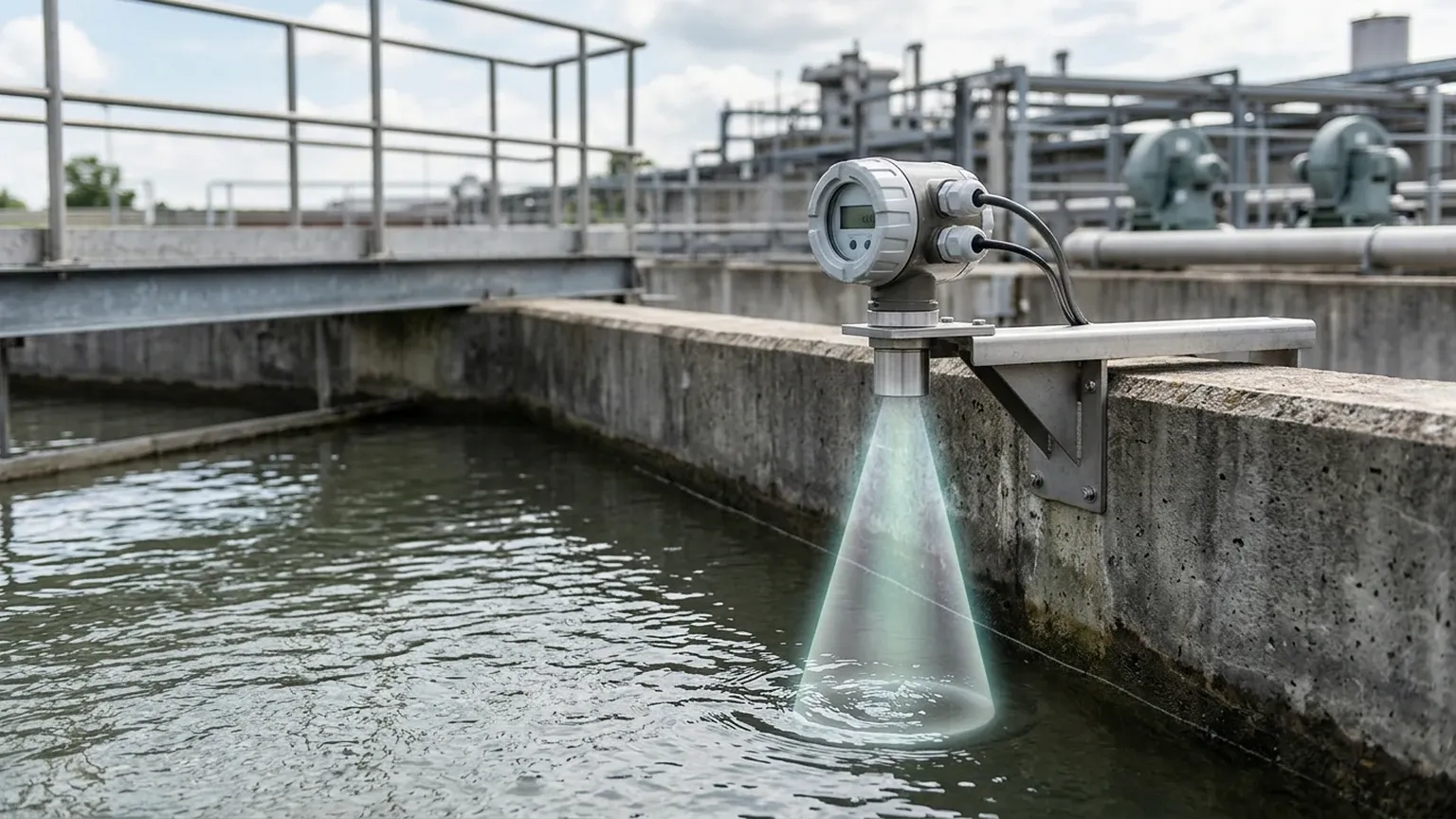
Limitations and Technology Boundaries
While highly effective, ultrasonic level sensing is not a universal solution. Engineers should be aware of the following limitations:
* Vacuum Conditions: Sound waves cannot travel through a vacuum. For vacuum tanks, guided wave radar or hydrostatic pressure sensors are required.
* Heavy Foam: Certain types of dense, acoustic-absorbing foam will soak up the ultrasonic pulse, preventing an echo. In these cases, the sensor may report a "Loss of Echo" (LOE) error.
* High-Pressure Gases: In environments with gases other than air (e.g., Nitrogen or Carbon Dioxide), the speed of sound differs. Unless the sensor allows for manual sound velocity entry, the readings will be inaccurate.
* Extreme Turbulence: Rapidly swirling liquids can disperse the sound waves. Using a stilling well can mitigate this issue by providing a calm surface for measurement.
Maintenance and Troubleshooting
One of the primary reasons for choosing ultrasonic technology is the minimal maintenance required. However, periodic checks are recommended:
* Transducer Cleaning: In high-humidity or dusty environments, condensation or buildup may occur on the transducer face. Wiping it with a soft, damp cloth is usually sufficient.
* Signal Strength Monitoring: Most modern digital meters provide a signal-to-noise ratio. A steady decline in signal strength may indicate a change in the process environment or a need for cleaning.
* Firmware Updates: For smart sensors, ensuring the latest signal processing algorithms are active can help filter out new obstructions that may have been introduced to the tank.
Frequently Asked Questions (FAQ)
Q: Can ultrasonic sensors measure the level of solids like grain or sand?
A: Yes, but with caveats. Solids often have uneven surfaces that scatter sound. It is recommended to use a sensor with a higher power output and a narrower beam angle for these applications. The effective range is usually reduced by 50% compared to liquid measurements.
Q: How does wind affect the measurement in outdoor tanks?
A: Strong winds can "blow" the ultrasonic pulse away, especially over long distances (greater than 10m). For outdoor applications, using a protective sunshade or a sensor with a higher acoustic power can help stabilize the reading.
Q: What is the difference between an ultrasonic transmitter and an ultrasonic switch?
A: An ultrasonic transmitter provides a continuous measurement (e.g., 0-100% level) via a 4-20mA or digital signal. An ultrasonic switch is a point-level device that only triggers a relay when the material reaches a specific height.
Q: Can I use an ultrasonic sensor in a tank with an agitator?
A: Yes, provided the sensor’s software includes "false echo suppression." This allows the user to map out the fixed position of the agitator blades so the sensor ignores those specific reflections. It is also best to mount the sensor as far from the agitator shaft as possible.
Conclusion
Ultrasonic level sensing remains a cornerstone of industrial process control due to its reliability, non-intrusive nature, and cost-effectiveness. By understanding the physics of sound propagation and adhering to strict installation guidelines, facilities can achieve precise level monitoring that enhances safety and operational efficiency. When selecting a system, always consider the specific chemical compatibility and physical constraints of your vessel to ensure long-term performance.