Ultrasonic Level Sensor Manufacturers in India
Ultrasonic Level Sensor Manufacturers in India: A Technical Selection Guide
In the rapidly expanding industrial landscape of India, accurate level measurement is a cornerstone of process efficiency, safety, and inventory management. From the massive wastewater treatment plants in Gujarat to the chemical processing hubs in Maharashtra and the food and beverage facilities in Punjab, the demand for reliable instrumentation is at an all-time high. Among the various technologies available, ultrasonic level measurement remains a preferred choice due to its non-contact nature and cost-effectiveness.
When searching for ultrasonic level sensor manufacturers in india, procurement officers and lead engineers must navigate a complex market filled with local assemblers, international distributors, and specialized manufacturers. Selecting the right partner requires a deep understanding of both the measurement technology and the specific environmental challenges of the Indian industrial sector, such as high ambient temperatures and varying humidity levels.
Understanding Ultrasonic Level Measurement Technology
Before evaluating specific Ultrasonic Level Meters, it is essential to understand the physical principles that govern their operation. This ensures that the selected device is appropriate for the intended medium and vessel geometry.
The Time-of-Flight (ToF) Principle
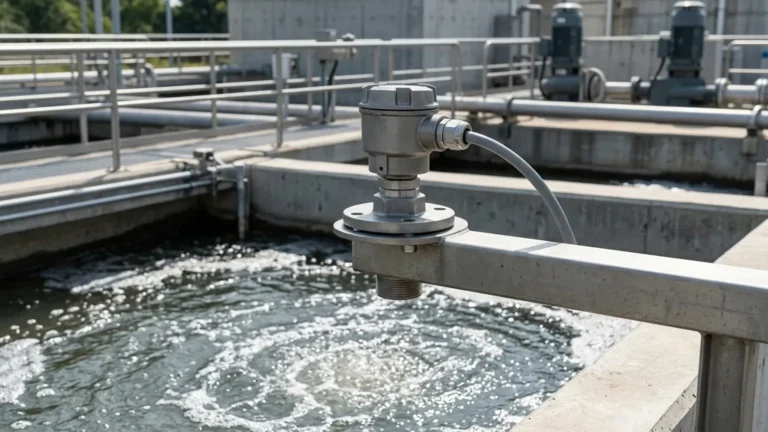
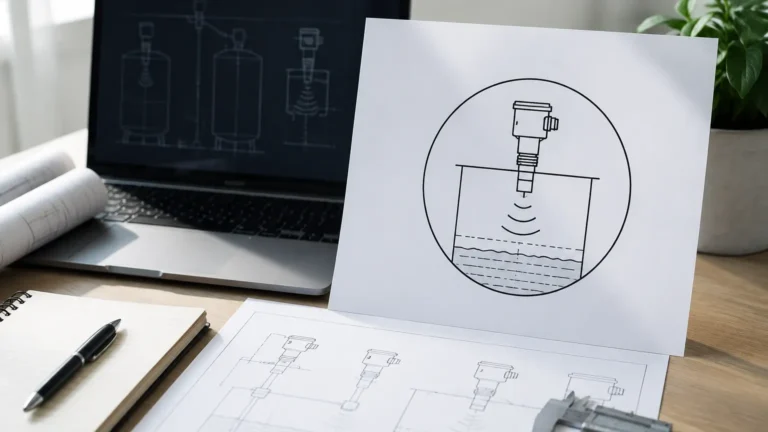
Ultrasonic sensors operate on the Time-of-Flight principle. The sensor’s transducer emits a high-frequency acoustic pulse—typically between 20 kHz and 200 kHz—that travels through the air toward the material surface. When the pulse hits the surface, it reflects back as an echo to the transducer.
The distance ($D$) between the sensor and the material surface is calculated using the formula:
$$D = \frac{c \times t}{2}$$
Where:
* $c$ is the speed of sound in the medium (usually air).
* $t$ is the time elapsed between emission and reception.
Because the speed of sound is affected by air temperature, modern sensors include an integrated temperature probe to compensate for these changes, ensuring accuracy even as the ambient temperature fluctuates.
Integrated vs. Remote Systems
Manufacturers typically offer two configurations:
1. Compact/Integrated: The transducer and electronics are housed in a single unit. This is ideal for standard tanks where space is not a constraint and the environment is not excessively harsh for the electronics.
2. Split/Remote: The transducer is mounted at the measurement point, while the transmitter (display and control unit) is installed at a distance (e.g., in a control room or at eye level). This is preferred for high-temperature applications or where the sensor is difficult to access for maintenance.
Key Considerations for Selecting Ultrasonic Level Sensor Manufacturers in India
India’s market is unique, and choosing a manufacturer involves more than comparing spec sheets. Engineers must look for partners who provide a balance of advanced technology and local support.
1. Technical Expertise and Customization
Many ultrasonic level sensor manufacturers in india act as distributors for global brands or assemble components locally. It is vital to confirm if the manufacturer can customize the sensor’s beam angle, frequency, and housing materials (such as PVDF for corrosive acids or Stainless Steel for hygienic applications). A manufacturer with strong R&D capabilities can provide tailored solutions for challenging geometries like narrow silos or tanks with internal obstructions.
2. Certification and Compliance
For industries like oil and gas or chemical processing, compliance with international safety standards is non-negotiable. Look for manufacturers whose products carry:
* ATEX/IECEx: For hazardous, explosive environments.
* CE/RoHS: Ensuring electromagnetic compatibility and environmental safety.
* IP Ratings: At least IP66 or IP67 for outdoor installations prone to heavy monsoon rains.
3. After-Sales Support and Calibration
Level sensors require periodic calibration and occasional troubleshooting. Selecting a manufacturer with a strong service network across major Indian industrial zones ensures that downtime is minimized. Verify if they offer on-site calibration services or have a local laboratory for repair and certification.
Technical Selection Criteria and Comparison Table
When evaluating different models, use the following technical parameters to narrow down your choices. The application's physical constraints should always dictate the sensor's specifications.
Selection Table: Ultrasonic Level Meter Configurations
| Feature | Standard Compact | High-Range Split | Explosion-Proof Series |
| :— | :— | :— | :— |
| Measurement Range | 0.4m to 10m | 0.5m to 30m | 0.4m to 15m |
| Accuracy | ±0.25% to 0.5% of span | ±0.25% of span | ±0.25% of span |
| Output Signal | 4-20mA / RS485 | 4-20mA / HART / RS485 | 4-20mA / HART |
| Power Supply | 24V DC / 220V AC | 24V DC / 220V AC | 24V DC |
| Operating Temp. | -20°C to +60°C | -40°C to +80°C | -20°C to +70°C |
| Beam Angle | 9° to 12° | 6° to 9° | 9° to 12° |
| Best Use Case | Water tanks, sumps | Deep wells, large silos | Chemical storage, fuel |
Installation Best Practices for Industrial Applications
Even the most advanced sensor from top-tier ultrasonic level sensor manufacturers in india will fail if installed incorrectly. Proper positioning is the most critical factor in achieving reliable data.
1. The "Dead Zone" (Blocking Distance)
Every ultrasonic sensor has a "dead zone" immediately below the transducer face where it cannot measure. If the liquid level rises into this zone, the sensor will report an error or an incorrect maximum level. Always mount the sensor high enough so that the maximum liquid level never enters the blocking distance (typically 0.2m to 0.5m depending on the model).
2. Avoiding Obstructions
The ultrasonic beam spreads as it travels (the beam angle). If the beam hits a ladder, a pipe, or a cooling coil, it will create a "false echo."
* Rule of Thumb: Keep the sensor away from the tank wall (at least 200mm for every 1m of depth is a safe margin for wide-angle beams).
* Nozzle Height: If mounting on a nozzle, ensure the transducer face extends slightly past the bottom of the nozzle to prevent internal reflections.
3. Surface Conditions
Ultrasonic waves reflect best off a flat, calm surface.
* Turbulence: If the liquid is agitated, use a stilling well (a perforated pipe) to provide a calm surface for the sensor.
* Foam: Heavy foam absorbs sound waves, often leading to a "Loss of Echo" (LOE) signal. In such cases, radar technology or hydrostatic transmitters may be more appropriate.
Limitations and Environmental Factors
While ultrasonic technology is versatile, it is not a "one-size-fits-all" solution. Understanding its limitations prevents costly misapplications.
* Vacuum Conditions: Sound requires a medium (air or gas) to travel. Ultrasonic sensors cannot function in a vacuum.
* High Pressure: In high-pressure tanks, the density of the gas changes, which significantly alters the speed of sound. While some compensation is possible, ultrasonic sensors are generally limited to near-atmospheric pressure applications.
* Dust and Vapor: Heavy dust (in grain silos) or thick steam/vapors can attenuate the signal. For these environments, higher-powered transducers or low-frequency sensors are required to penetrate the atmosphere.
* Temperature Gradients: If there is a significant temperature difference between the sensor and the liquid surface, the sound speed compensation may become inaccurate. In such cases, a remote sensor with a separate temperature probe closer to the surface may be necessary.
Maintenance and Troubleshooting for Long-Term Reliability
Ultrasonic sensors are low-maintenance because they have no moving parts. However, in the dusty or humid environments common in Indian industrial zones, a basic maintenance schedule is recommended.
1. Transducer Cleaning: Periodically check the face of the transducer for condensation, dust buildup, or chemical scaling. Clean it gently with a soft cloth and water or a mild detergent. Avoid abrasive tools that could scratch the transducer surface.
2. Cable Integrity: Inspect cable entries and glands for signs of moisture ingress, especially after the monsoon season. Ensure that the "drip loop" is maintained to prevent water from running down the cable into the housing.
3. Signal Diagnostics: Most modern Ultrasonic Level Meters provide a signal strength or "echo confidence" metric. Monitoring this via RS485 or HART can provide early warning of potential failures before they result in process downtime.
Frequently Asked Questions (FAQ)
Q: Can ultrasonic sensors measure solids?
A: Yes, but with caveats. Solids like powders or grains do not reflect sound as efficiently as liquids and often have an uneven surface (angle of repose). You must select a sensor with a higher power rating and a narrower beam angle, and often de-rate the effective range by 50%.
Q: How does the Indian climate affect accuracy?
A: The primary factor is temperature. In regions where temperatures can swing from 10°C at night to 45°C during the day, the speed of sound changes by approximately 6%. An integrated temperature sensor is mandatory for any installation in India to maintain accuracy.
Q: What is the difference between a 2-wire and a 4-wire ultrasonic sensor?
A: A 2-wire sensor is loop-powered (the same two wires carry the power and the 4-20mA signal), which simplifies wiring but provides less power for the transducer. A 4-wire sensor has separate power and signal wires, allowing for a more powerful pulse, which is better for long ranges or dusty environments.
Q: Are ultrasonic sensors better than radar?
A: Not necessarily; they are different. Ultrasonic is more cost-effective and works well for most water-based applications. Radar is better for high-pressure, high-temperature, or vacuum applications, and is unaffected by foam or dust.
Conclusion
Selecting from the various ultrasonic level sensor manufacturers in india requires a technical approach that prioritizes application-specific needs over price alone. By understanding the ToF principle, respecting the installation constraints like the blocking distance, and accounting for environmental factors such as temperature and foam, engineers can implement a robust measurement solution. Whether you are managing a municipal water project or a complex chemical refinery, the right ultrasonic meter provides the data necessary to optimize operations and ensure safety across the board.
Download Ultrasonic Level Sensor Manufacturers in India as a PDF