Ultrasonic Level Sensor Manufacturers
Ultrasonic Level Sensor Manufacturers: A Guide to Selection and Engineering Standards
In the landscape of industrial automation, selecting the right instrumentation is critical for operational efficiency and safety. Among the various technologies available for liquid and solid level monitoring, ultrasonic measurement remains a cornerstone due to its non-contact nature and cost-effectiveness. However, as the market becomes saturated with various suppliers, identifying professional ultrasonic level sensor manufacturers requires a deep understanding of both the technology's principles and the manufacturer's engineering capabilities.
This guide provides a technical overview of ultrasonic level measurement, practical selection criteria, and the essential factors to consider when evaluating manufacturers for industrial applications.
Understanding the Measurement Principle
Before engaging with Ultrasonic Level Meters suppliers, it is vital to understand how these devices function. Ultrasonic level sensors operate on the "Time of Flight" (ToF) principle.
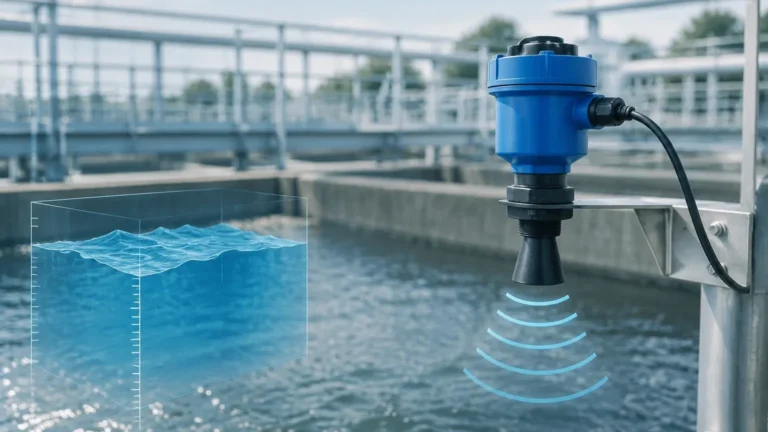
The sensor's transducer emits high-frequency sound waves (ultrasonic pulses) toward the target medium. These waves travel through the air, strike the surface of the material, and reflect back to the transducer. The sensor then calculates the distance based on the time interval between the emission and the reception of the echo, using the speed of sound in air (approximately 343 m/s at 20°C).
The Impact of Environmental Variables
Because the speed of sound is influenced by the medium it travels through, temperature fluctuations can significantly affect accuracy. Professional manufacturers integrate temperature compensation circuits—either via internal sensors or external probes—to adjust the calculations in real-time. This is a primary differentiator between entry-level consumer sensors and industrial-grade instruments provided by established ultrasonic level sensor manufacturers.
Key Criteria for Evaluating Ultrasonic Level Sensor Manufacturers
When sourcing instruments for water treatment, chemical processing, or oil and gas applications, procurement and engineering teams should evaluate manufacturers based on the following professional benchmarks:
1. R&D and Technical Innovation
Top-tier manufacturers invest heavily in signal processing algorithms. In industrial environments, false echoes caused by agitators, internal tank structures, or heavy turbulence can lead to inaccurate readings. Advanced manufacturers utilize "Auto-False Echo Suppression" software, which allows the meter to recognize and ignore fixed obstructions within the vessel.
2. Material Quality and Chemical Compatibility
The longevity of a sensor is often determined by its housing and transducer face material. While ABS plastic may suffice for clean water applications, chemical and industrial automation environments often require PVDF (Polyvinylidene Fluoride) or PTFE (Polytetrafluoroethylene) to resist corrosive vapors. Confirm that the manufacturer offers a range of material options suited for diverse pH levels and chemical concentrations.
3. Quality Control and Certifications
Reliable ultrasonic level sensor manufacturers adhere to strict quality management systems, such as ISO 9001. Furthermore, for specific industries, look for:
* Explosion-proof ratings: (ATEX, IECEx) for hazardous areas in oil and gas.
* Ingress Protection: Minimum IP66 or IP67 for outdoor or wash-down environments; IP68 for submersible requirements.
* Calibration Standards: Documentation proving that each unit has been factory-calibrated against traceable standards.
4. OEM and ODM Capabilities
Many industrial projects require customized solutions, such as specific mounting threads (G, NPT, or Flange), specialized cable lengths, or integrated communication protocols (HART, Modbus RS485, or 4-20mA). Manufacturers like Welk provide comprehensive OEM/ODM services, allowing for the integration of level measurement technology into larger proprietary systems.
Technical Selection and Comparison
To assist in the selection process, the following table outlines typical specifications found across professional-grade ultrasonic level meters. When reviewing product options and application support, use these parameters as a baseline.
Table 1: Standard Industrial Ultrasonic Level Meter Specifications
| Feature | Standard Specification | High-Performance Specification |
| :— | :— | :— |
| Measurement Range | 0.4m to 10m (1.3ft to 32.8ft) | Up to 30m or 40m (98ft to 131ft) |
| Accuracy | ±0.5% of full scale | ±0.2% to ±0.25% of full scale |
| Resolution | 3mm (0.12 in) | 1mm (0.04 in) |
| Beam Angle | 10° to 15° | 5° to 8° (Narrow beam) |
| Output Signal | 4-20mA | 4-20mA + HART, Modbus, Profibus |
| Power Supply | 24V DC (2-wire) | 24V DC or 220V AC (4-wire) |
| Operating Temp | -20°C to +60°C | -40°C to +80°C |
Installation Best Practices
Even the highest quality sensor from the most reputable ultrasonic level sensor manufacturers will fail if installed incorrectly. Engineers must consider the following physical constraints:
The Dead Zone (Blocking Distance)
Every ultrasonic sensor has a "dead zone" immediately below the transducer face (typically 0.2m to 0.5m depending on the frequency). The sensor cannot accurately measure level within this range. Installation must ensure that the maximum liquid level never enters this zone.
Mounting Orientation
The transducer face must be mounted perfectly parallel to the liquid surface. A tilt of even a few degrees can cause the reflected signal to bounce away from the transducer, resulting in a "Loss of Echo" (LOE) error.
Beam Path Clearance
The ultrasonic pulse spreads in a cone shape. Manufacturers specify a "beam angle." It is critical to ensure that no obstructions (ladders, pipes, or weld seams) enter this cone. If an obstruction is unavoidable, the use of a sensor with advanced software suppression or a narrower beam angle is required.
Limitations of Ultrasonic Technology
While versatile, ultrasonic level meters are not universal solutions. Factual engineering requires acknowledging the limitations of the technology. You should consult with your manufacturer if your application involves:
* Heavy Foam: Foam absorbs ultrasonic signals rather than reflecting them. In these cases, radar or hydrostatic transmitters are often preferred.
* Vacuum Conditions: Sound waves require a medium (air/gas) to travel. Ultrasonic sensors will not function in a vacuum.
* High Pressure/High Temperature: Extreme pressure changes the density of the air, affecting the speed of sound beyond the capabilities of standard compensation. High temperatures (above 80°C-100°C) can damage the transducer crystals.
* Dust and Vapor: While light dust is manageable, extremely dense dust or heavy steam can attenuate the signal.
The Strategic Value of Professional Manufacturers
Choosing between various ultrasonic level sensor manufacturers often comes down to the level of technical support and the reliability of the hardware in the field. A professional manufacturer does not just provide a device; they provide an application review to ensure the technology is fit for purpose.
For instance, in water treatment plants, ultrasonic sensors are preferred for open channel flow measurement and tank level monitoring due to their lack of moving parts and resistance to fouling. A manufacturer with deep industry experience will provide the necessary flumes and weirs equations pre-programmed into the meter's firmware, simplifying commissioning for the end-user.
Frequently Asked Questions (FAQs)
Q: Can ultrasonic level meters be used for solids?
A: Yes, but with caveats. Solids like grain or plastic pellets often have an angle of repose that reflects the signal away from the sensor. Manufacturers usually de-rate the effective range by 50% for solid applications and recommend sensors with higher power and lower frequencies.
Q: How does wind affect outdoor installations?
A: Strong wind can "blow" the ultrasonic pulse away or create turbulence that scatters the echo. For outdoor sumps or lagoons, manufacturers often recommend using a stilling well or a protective sunshade to stabilize the environment around the sensor.
Q: What is the difference between 2-wire and 4-wire sensors?
A: 2-wire sensors are loop-powered, meaning the power and the 4-20mA signal share the same pair of wires. They are easier to install but have less power for signal processing. 4-wire sensors have separate power and signal lines, allowing for higher-power transducers and more complex features like integrated relays or backlit displays.
Conclusion
Selecting from the available ultrasonic level sensor manufacturers requires a balance between technical specifications and the specific demands of the application environment. By prioritizing manufacturers that offer robust temperature compensation, advanced echo processing, and high-quality construction materials, engineers can ensure long-term accuracy and minimal maintenance.
For those evaluating current market offerings and seeking reliable measurement solutions, exploring the range of Ultrasonic Level Meters is a recommended step toward achieving precise process control. Whether for simple water storage or complex chemical dosing, the right manufacturer serves as a technical partner in industrial automation success.