Level Switch Endress and Hauser
Level Switch Endress and Hauser
In the landscape of industrial automation, point level detection serves as a critical safeguard for process integrity, environmental protection, and equipment safety. Among the most recognized names in this field is the level switch Endress and Hauser, a brand that has set significant benchmarks with its Liquiphant and Soliphant series. For process engineers and procurement specialists, understanding the technical nuances of these instruments—and how they compare to broader industry solutions like those offered by Welk—is essential for optimizing plant operations.
Level switches are discrete sensors designed to detect the presence or absence of a medium at a specific height within a vessel or pipe. Unlike continuous level transmitters that provide a constant data stream (e.g., 4-20mA or HART), a level switch provides a binary output. This output is typically used to trigger alarms, stop pumps to prevent dry running, or close valves to prevent overfilling.
Fundamental Measurement Principles
Before selecting a specific model, it is vital to understand the underlying physical principles that govern how different Level Switches operate. Each technology has distinct advantages and limitations based on the physical properties of the medium.
1. Vibration (Tuning Fork) Principle
This is perhaps the most common technology associated with the level switch Endress and Hauser line. A tuning fork is piezoelectrically energized and vibrates at its resonant frequency in the air. When the fork is covered by a liquid or solid, the frequency shifts or the amplitude is dampened. This change is detected by the internal electronics and converted into a switching signal.
* Pros: Unaffected by flow, turbulence, bubbles, foam, or vibrations. No calibration is required for different liquids.
* Cons: Not suitable for extremely high-viscosity media that might bridge the forks.
2. Capacitance Principle
Capacitive level switches operate by measuring the change in electrical capacitance between the sensor probe and the tank wall (or a reference electrode). As the medium displaces air, the dielectric constant changes, altering the capacitance.
* Pros: Good for aggressive media; can be used for interface detection between two liquids.
* Cons: Requires the dielectric constant ($ \epsilon_r $) of the medium to be significantly different from air. Buildup on the probe can cause false switching if the unit does not feature active buildup compensation.
3. Conductivity Principle
Used exclusively for conductive liquids, this principle involves two or more electrodes. When the liquid touches the electrodes, an electrical circuit is completed.
* Pros: Simple, cost-effective, and reliable for water-based applications.
* Cons: Cannot be used for oils, hydrocarbons, or pure distilled water.
4. Microwave Barrier and Ultrasonic Gap
Microwave barriers use a transmitter and receiver to detect blockage by the medium, often used for bulk solids in silos. Ultrasonic gap switches use a pair of crystals; when liquid fills the gap between them, ultrasonic energy is transmitted, triggering the switch.
Analyzing the Level Switch Endress and Hauser Portfolio
The reputation of the level switch Endress and Hauser brand is built on specific product families tailored to diverse industrial environments. Understanding these series helps in benchmarking performance requirements for any industrial project.
Liquiphant Series
The Liquiphant is the industry standard for liquid point level detection. It utilizes the vibrating fork principle. It is frequently specified for overfill prevention (SIL2/SIL3 rated) and pump dry-run protection. Its ability to operate in temperatures ranging from -60 °C up to 280 °C and pressures up to 100 bar makes it highly versatile.
Soliphant Series
Designed for bulk solids, the Soliphant uses a similar vibration principle but is optimized for powders, granules, and fine-grained solids. It is particularly effective in silos where dust explosions are a risk, as many models carry ATEX or IECEx certifications.
Liquipoint and Nivector
The Liquipoint series focuses on conductive limit detection, while the Nivector is a compact capacitive switch often used in the food and beverage industry for detecting powders or liquids in small pipes and tanks.
Engineering Selection Criteria
When evaluating Level Switches, whether from a premium brand like Endress+Hauser or a specialized manufacturer like Welk, engineers must confirm several technical parameters to ensure long-term reliability.
| Selection Factor | Consideration | Recommended Technology |
| :— | :— | :— |
| Media Type | Liquids, Slurries, or Bulk Solids | Vibration for most; Capacitive for solids |
| Viscosity | Does the medium flow easily or stick? | Capacitive with buildup compensation |
| Dielectric Constant | Is the medium conductive or insulating? | Conductive for water; Capacitive for oils |
| Process Temperature | Standard (-40 to 150 °C) vs. High Temp | Vibration (Liquiphant type) |
| Process Pressure | Vacuum to High Pressure (e.g., 100 bar) | Metal-sealed Vibration switches |
| Chemical Compatibility | Corrosive or aggressive media | PFA/ECTFE coated probes or Stainless Steel |
| Safety Integrity | Is it a safety-critical application? | SIL2/SIL3 certified devices |
Installation and Mounting Guidelines
Proper installation is as critical as device selection. Even a high-quality level switch Endress and Hauser unit will fail if mounted incorrectly. Below are the standard engineering practices for level switch installation.
Orientation
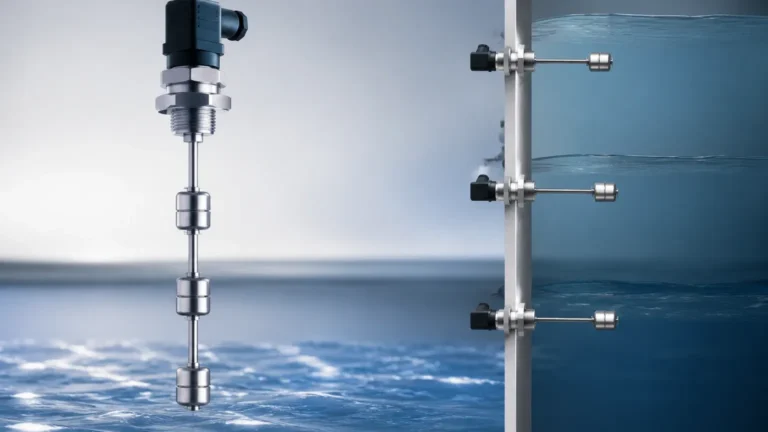
* Top Mounting: Usually involves a probe extension. Ideal for high-level alarms where the switch remains dry most of the time.
* Side Mounting: The most common for both high and low-level detection. For vibrating forks, the forks should be oriented so that liquid can drain off easily (usually with the tines vertical if the medium is viscous).
Avoiding Nozzle Interference
If a level switch is installed in a long nozzle, the medium may become trapped, leading to a "false full" reading even after the vessel has drained. The active part of the sensor (the forks or the capacitive tip) must extend at least 20 mm to 50 mm beyond the inner wall of the tank.
Turbulence and Agitators
In tanks with heavy agitation, mechanical guards or baffles should be installed to protect the probe from lateral forces. Alternatively, the switch should be located in a stilling well to provide a stable environment for measurement.
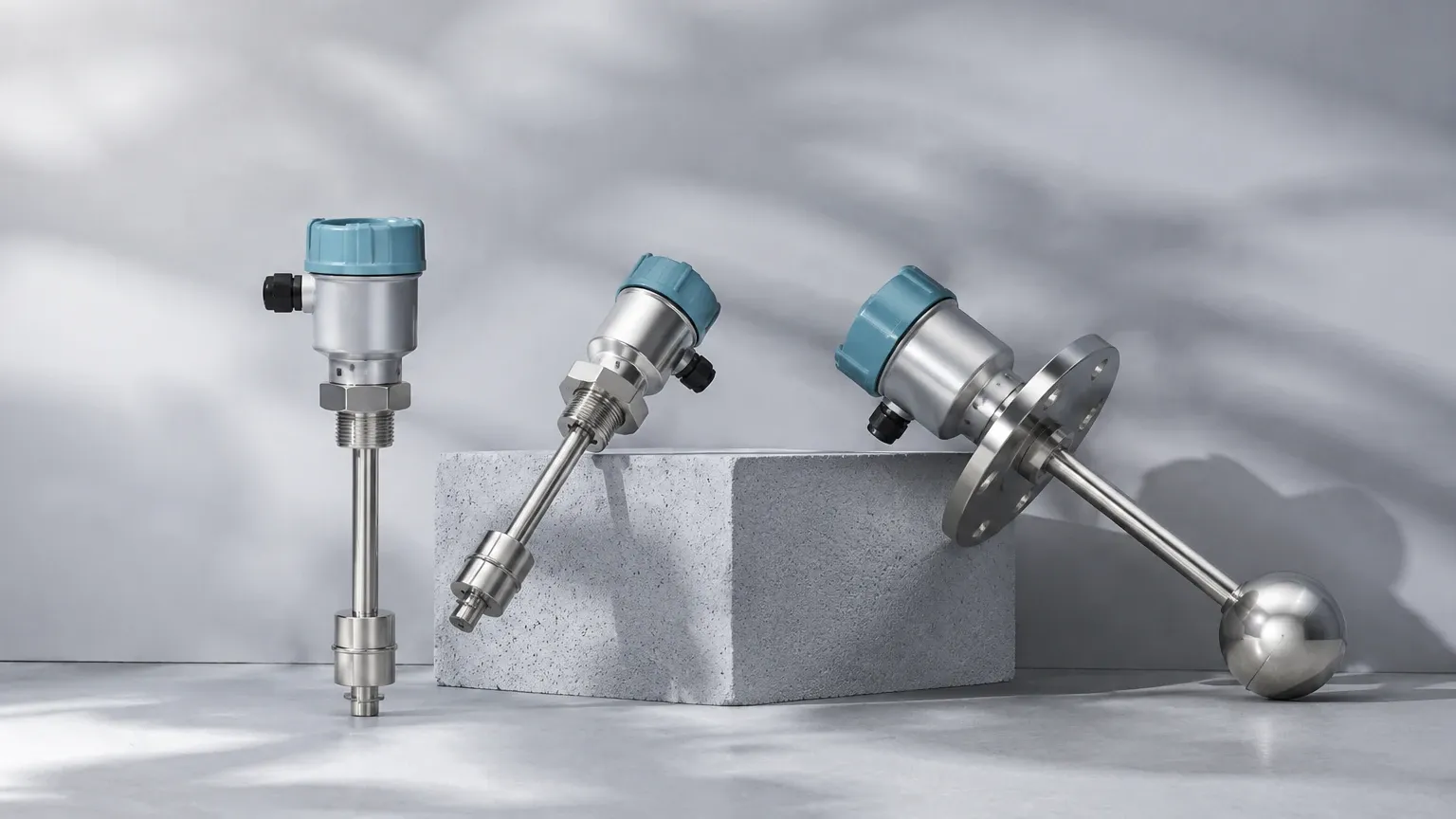
Limitations and Operational Risks
No technology is universal. Engineers must be aware of the following risks when deploying level switches:
1. Medium Buildup: In sticky applications (e.g., molasses, heavy crude oil, or wet powders), material can accumulate on the sensor. While vibrating forks are somewhat self-cleaning, excessive buildup can eventually dampen the vibration, causing a false signal. Capacitive sensors without "Active Shield" technology are particularly susceptible to this.
2. Foam Interference: Some technologies, like ultrasonic or certain capacitive switches, may struggle to distinguish between the liquid surface and a thick layer of foam. Vibrating forks are generally the best choice for ignoring foam and detecting only the liquid phase.
3. Dielectric Shifts: For capacitive sensors, if the moisture content of a solid or the composition of a liquid changes significantly, the dielectric constant may shift, requiring recalibration of the switch point.
4. Mechanical Wear: In abrasive bulk solids (like sand or gravel), the probe or forks can erode over time. In these cases, non-contact methods or heavy-duty reinforced probes are necessary.
Comparison: Welk vs. Global Brands
While the level switch Endress and Hauser provides a high degree of brand recognition and a vast global support network, manufacturers like Welk focus on providing highly accurate, cost-effective, and customizable solutions.
Welk’s range of Level Switches includes radar-based point detection, ultrasonic sensors, and robust magnetic gauges. For many industrial automation applications in water treatment and chemical processing, Welk provides the necessary technical specifications—such as high-pressure ratings and chemical-resistant materials—at a more competitive price point with shorter lead times, which is often a decisive factor for OEM and ODM projects.
Frequently Asked Questions (FAQ)
Q: Can a vibrating fork level switch be used in solids and liquids?
A: Not usually with the same device. While the principle is the same, the fork geometry and electronics are tuned differently. A Liquiphant (liquid) has thin forks for high sensitivity in fluids, while a Soliphant (solids) has a more robust design to handle the mechanical load of bulk materials.
Q: What is the difference between a PNP and NPN output in a level switch?
A: These refer to the type of transistor output. PNP (Positive-Negative-Positive) switches the positive side of the circuit, while NPN (Negative-Positive-Negative) switches the negative side. Most modern European and American PLC systems prefer PNP, while NPN is sometimes found in older or Asian-manufactured equipment.
Q: How often should a level switch be calibrated?
A: Vibrating fork switches generally do not require calibration; they are factory-set. Capacitive and conductive switches should be checked annually or whenever the process medium changes significantly.
Q: Is SIL certification necessary for all level switches?
A: No. SIL (Safety Integrity Level) certification is only required for Safety Instrumented Systems (SIS) where the failure of the switch could lead to a catastrophic event, such as a major chemical spill or tank explosion. For standard process control, a non-SIL rated switch is sufficient.
Conclusion
Selecting the right level switch involves a balance of physical principles, process conditions, and budgetary constraints. While the level switch Endress and Hauser remains a benchmark for high-spec, safety-critical applications, the broader market offers a variety of reliable alternatives. By focusing on the specific needs of the application—such as pressure, temperature, and media characteristics—engineers can select a solution that ensures both safety and efficiency. For those seeking reliable, industrial-grade alternatives with customized support, exploring the full range of Level Switches is the recommended next step in the procurement process.