Magnetic Level Switches
Magnetic Level Switches
In the landscape of industrial automation, ensuring the precise control of liquid levels is critical for operational safety, efficiency, and environmental compliance. Among the various technologies available, Level Switches remain a fundamental component in process control loops. Specifically, magnetic level switches offer a robust, reliable, and cost-effective solution for detecting point levels in tanks, sumps, and pressure vessels.
As a professional manufacturer, Welk provides high-performance magnetic level switches designed to withstand the rigors of chemical processing, water treatment, and oil and gas applications. This guide serves as a practical engineering reference for understanding the principles, selection, and installation of these essential instruments.
Measurement Principles of Magnetic Level Switches
The operation of magnetic level switches is based on the interaction between a permanent magnet and a sensing element, typically a reed switch or a Hall effect sensor. Unlike mechanical limit switches that require direct physical contact with an external actuator, magnetic switches operate through a hermetic seal, which significantly enhances their longevity in harsh environments.
The Reed Switch Mechanism
Most industrial magnetic level switches utilize a reed switch housed within a stationary stem. A reed switch consists of two ferromagnetic blades (reeds) encapsulated in a glass envelope filled with an inert gas. When a magnetic field—carried by a moving float—approaches the reeds, they become magnetized with opposite polarities and pull together, closing the electrical circuit. When the magnetic field is removed, the natural spring tension of the reeds causes them to separate, opening the circuit.
Magnetic Coupling and Buoyancy
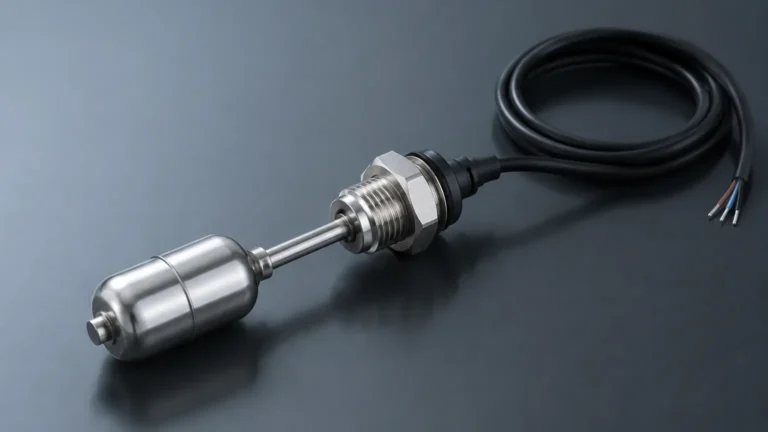
The switch is actuated by a float that contains a permanent magnet. This float is designed to have a lower density than the process liquid, allowing it to rise and fall with the liquid level. As the liquid reaches a predetermined point, the float moves into proximity with the internal reed switch, triggering a signal. This non-contact coupling ensures that the electrical components remain completely isolated from the process media, preventing leaks and corrosion of the switching elements.
Primary Types and Configurations
Magnetic level switches are available in several configurations to suit different tank geometries and mounting requirements. Understanding these variations is the first step in successful instrument selection.
1. Vertical Float Switches
These are typically top-mounted or bottom-mounted. The float travels up and down a vertical stem. These units can be configured with multiple switching points on a single stem, allowing for High-High, High, Low, and Low-Low level detection with one process connection.
2. Side-Mounted (Horizontal) Switches
In applications where top access is restricted, side-mounted magnetic level switches are used. These often feature a hinged float arm. As the liquid level rises, the arm pivots, bringing a magnet at the end of the arm close to a reed switch located inside the mounting flange or housing.
3. Magnetic Bypass Level Switches
Commonly used on large storage tanks, these switches are mounted externally to a bypass chamber (a standpipe connected to the side of the tank). The float moves inside the chamber, and the switches are clamped to the outside of the pipe. This allows for maintenance and adjustment of the switch points without ever breaking the process seal or emptying the tank.
Technical Selection Criteria
Choosing the right magnetic level switches requires a thorough analysis of the process conditions. Engineers must consider the following factors to ensure long-term reliability:
* Specific Gravity (Density): The float must be buoyant enough to rise in the liquid. Standard floats are often rated for liquids with a specific gravity of 0.8 or higher. For light hydrocarbons, specialized low-density floats are required.
* Operating Pressure: The float must be able to withstand the process pressure without collapsing. Welk offers stainless steel floats capable of handling pressures up to 40 bar (approx. 580 psi), whereas plastic floats are generally limited to lower pressure applications.
* Temperature Range: High temperatures can affect the strength of the permanent magnet and the integrity of the reed switch. Standard models often operate up to 120°C (248°F), but high-temperature versions with specialized cooling fins or ceramic insulation can reach 350°C (662°F).
* Material Compatibility: The wetted parts (stem and float) must be resistant to the process media. Common materials include 316L Stainless Steel for general industrial use, and PP (Polypropylene), PVC, or PVDF for highly corrosive acids and bases.
Practical Selection Table
The following table provides a general comparison of common magnetic level switch configurations to assist in the initial selection process.
| Feature | Vertical Multi-Point | Side-Mounted Pivot | Bypass External Switch |
| :— | :— | :— | :— |
| Mounting Position | Top or Bottom | Side Wall | External Chamber |
| Max Switch Points | Up to 6 points | Usually 1 point | Unlimited (Adjustable) |
| Maintenance | Requires tank opening | Requires tank opening | External (No downtime) |
| Pressure Rating | Moderate to High | Moderate | High |
| Viscosity Limit | Low to Medium | Low | Medium |
| Best Use Case | Small tanks/Sumps | Narrow tanks | High-pressure boilers |
Installation and Mounting Guidelines
Proper installation is paramount to the performance of magnetic level switches. Even the most robust sensor will fail if subjected to improper mechanical or electrical stress.
1. Avoid Magnetic Interference: Since the switch relies on magnetic fields, it should be installed away from large motors, transformers, or high-voltage cables. If installed in a carbon steel tank, ensure there is sufficient clearance between the float magnet and the tank wall to prevent "magnetic drag."
2. Turbulence Protection: In tanks with agitators or high-velocity inflow, the float can be damaged by mechanical oscillation. In such cases, a stilling well (a perforated pipe surrounding the stem) should be used to provide a calm environment for the float.
3. Orientation: For vertical switches, ensure the stem is perfectly plumb. A tilt of more than 15 degrees can increase friction between the float and the stem, leading to sticking.
4. Wiring and Protection: Reed switches are sensitive to current spikes. When switching inductive loads (such as solenoid valves or motor starters), always use a protective circuit like a varistor, RC snubber, or an intermediate relay to prevent the reeds from welding shut.

Limitations and Common Risks
While magnetic level switches are highly reliable, they are not universal solutions. Engineers should be aware of the following limitations:
* Build-up and Scaling: If the process liquid is prone to crystallization or heavy scaling, the float may become stuck to the stem. In these environments, non-contact technologies like radar or ultrasonic sensors may be more appropriate.
* Ferrous Particles: If the liquid contains iron filings or magnetic particles, they will adhere to the float magnet. This increases the float's weight and can eventually jam the mechanism. Magnetic traps or filters should be installed upstream if ferrous contamination is expected.
* Mechanical Wear: Although the switching is non-contact, the float still moves mechanically along a stem. Over millions of cycles, or in high-vibration environments, mechanical wear can occur.
Maintenance and Troubleshooting
Magnetic level switches are generally low-maintenance, but periodic inspections are recommended, especially in critical safety loops.
* Visual Inspection: Check for signs of corrosion on the stem and ensure the float moves freely along its entire travel path.
* Contact Resistance Test: Use a multimeter to check the resistance of the switch when closed. A high resistance reading (typically above 1-2 ohms) may indicate that the reed switch is nearing the end of its life or has been damaged by an electrical surge.
* Cleaning: In applications with light coating, remove the assembly and wipe down the stem and float with a compatible solvent to prevent sticking.
Frequently Asked Questions (FAQs)
Q: Can magnetic level switches be used in hazardous areas?
A: Yes. Because the switching element is hermetically sealed, many magnetic switches can be used in intrinsically safe circuits or provided with explosion-proof housings (ATEX/IECEx certified) for use in flammable environments.
Q: What is the difference between SPST and SPDT contacts in these switches?
A: SPST (Single Pole Single Throw) is a simple on/off switch. SPDT (Single Pole Double Throw) provides a common terminal and both a Normally Open (NO) and Normally Closed (NC) contact, allowing for more versatile integration into control systems.
Q: How do I handle high-viscosity liquids?
A: For viscous liquids, a larger float with higher buoyancy force is required. However, if the liquid is thick enough to impede the movement of the float, a different technology, such as a tuning fork level switch, is recommended.
Conclusion
Magnetic level switches provide a dependable and straightforward method for point level detection across a vast array of industrial processes. By understanding the underlying magnetic principles and carefully evaluating process parameters like density, pressure, and chemical compatibility, engineers can implement solutions that offer years of trouble-free service.
Welk continues to innovate in the field of level measurement, providing customized OEM and ODM services to meet the specific needs of our global clientele. For more detailed technical specifications or to explore our full range of Level Switches, please consult our engineering team to find the optimal fit for your application.