Wirelesshart Gateway
Wirelesshart Gateway
In the landscape of industrial automation and process control, the transition from wired to wireless infrastructure has been driven by the need for cost-efficiency, scalability, and the ability to monitor assets in previously inaccessible locations. At the heart of this transition within the process industries is the WirelessHART gateway. As a central component of the IEC 62591 standard, the gateway serves as the critical bridge between the wireless field instrument network and the plant’s wired control system.
For engineers managing tank farms, chemical processing units, or water treatment facilities, understanding the technical nuances of a wirelesshart gateway is essential for ensuring data integrity and system reliability. This guide explores the principles of WirelessHART technology, the specific role of the gateway in level measurement applications, and the practical considerations for selection and installation.
Understanding WirelessHART Technology and Gateway Architecture
WirelessHART is an open-standard wireless networking protocol designed specifically for the requirements of process plants. Unlike consumer-grade Wi-Fi, it is built for high reliability in environments characterized by heavy metal structures and electromagnetic interference. The protocol operates in the 2.4 GHz ISM band using IEEE 802.15.4 compatible radios.
The Mesh Networking Principle
The fundamental strength of WirelessHART lies in its self-organizing, self-healing mesh topology. In this architecture, every field device—such as a radar level meter or a pressure transmitter—can act as a router for its neighbors. If a direct path to the gateway is blocked by a new piece of equipment or a moving vehicle, the network automatically reroutes data through alternative nodes.
The Role of the Network Manager and Security Manager
A wirelesshart gateway is rarely just a radio; it typically houses two vital software components:
1. The Network Manager: This software governs the mesh. It determines the optimal communication paths, manages the timing of data packets, and monitors the health of every node. It ensures that the network remains efficient even as environmental conditions change.
2. The Security Manager: Industrial environments require rigorous protection against unauthorized access. The Security Manager handles key management and authentication. All data in a WirelessHART network is encrypted using AES-128 bit encryption, ensuring that process data remains confidential and tamper-proof.
The Role of the Gateway in Level Measurement Systems
In level measurement applications, the gateway acts as the primary data concentrator. Whether a facility utilizes ultrasonic level sensors for open-channel flow or high-frequency radar for pressurized chemical tanks, the gateway collects these measurements and translates them into protocols that the Distributed Control System (DCS) or Programmable Logic Controller (PLC) can understand, such as Modbus TCP/IP, EtherNet/IP, or OPC.
For facilities looking to modernize their monitoring capabilities, integrating wireless gateways allows for the rapid deployment of instruments without the prohibitive costs of trenching and cabling. This is particularly relevant for level measurement in remote storage tanks or large-scale water treatment basins. To explore the range of instruments compatible with these wireless architectures, engineers can visit the Main Page to review product options and application support.
Technical Principles of WirelessHART Communication
To appreciate why a wirelesshart gateway is reliable, one must look at the communication techniques employed at the physical and data link layers.
Time Division Multiple Access (TDMA)
WirelessHART uses TDMA to coordinate data transmission. The gateway synchronizes all devices in the network to a common time base, divided into 10-millisecond "slots." Each device is assigned specific slots for transmission and reception. This eliminates "collisions"—a common problem in standard Wi-Fi where multiple devices try to speak at once—and ensures predictable latency.
Frequency Hopping (FHSS)
To combat interference from other wireless systems (like Wi-Fi or Bluetooth), WirelessHART employs Frequency Hopping Spread Spectrum (FHSS). The network hops across 15 different channels. If one channel is experiencing interference, the gateway and the field devices simply move to the next available frequency in the sequence. This "channel blacklisting" is managed automatically by the gateway to maintain high data reliability.
Key Selection Criteria for a WirelessHART Gateway
Choosing the right gateway requires balancing current capacity needs with future expansion plans. The following criteria are paramount during the evaluation phase:
1. Device Capacity
Gateways are typically rated by the number of field devices they can support. Entry-level gateways may support up to 25 or 50 devices, while high-capacity industrial gateways can manage 100 or more. It is best practice to select a gateway that provides at least 20% overhead for future additions.
2. Integration Protocols
Ensure the gateway supports the specific wired protocol of your host system. Most modern gateways offer multiple concurrent outputs, such as Modbus RTU/TCP, EtherNet/IP, and HART-IP. HART-IP is particularly useful as it allows for the pass-through of diagnostic information from the level sensors to Asset Management Software (AMS).
3. Hazardous Area Certifications
In the oil and gas or chemical industries, the gateway may need to be installed in a classified area. Look for ATEX, IECEx, or Class I Division 2 certifications. If the gateway is located in a safe area but the sensors are in a hazardous zone, ensure the gateway is compatible with the intrinsically safe (IS) requirements of the field nodes.
4. Power Supply Options
While field devices are often battery-powered, the gateway is a high-duty-cycle device and typically requires a constant power supply (24V DC or Power over Ethernet). In remote locations, some gateways are designed to operate on solar power kits with integrated battery backups.
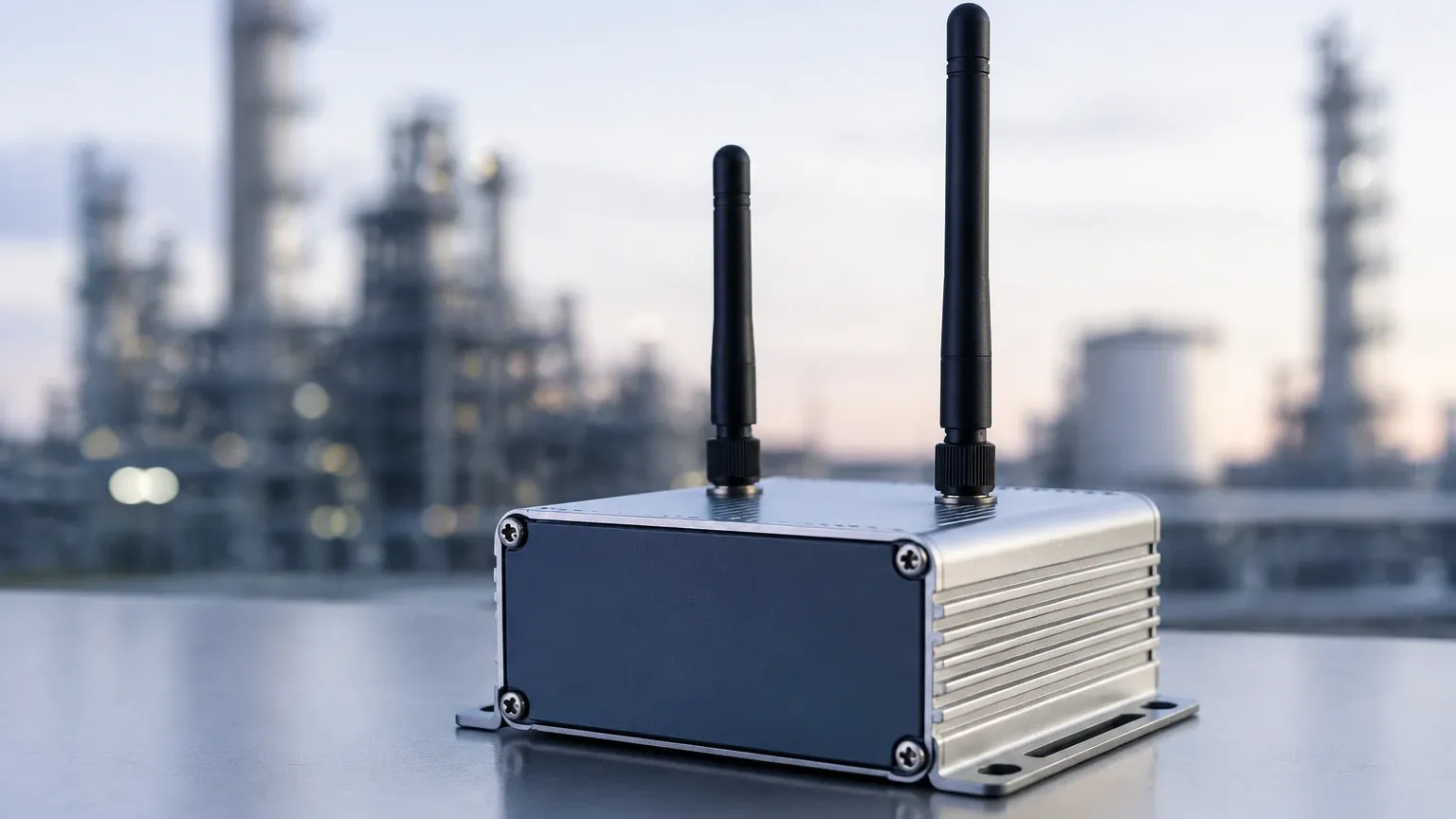
Installation and Commissioning Best Practices
The performance of a WirelessHART network is heavily dependent on the physical placement of the gateway and its antenna.
* Antenna Elevation: The gateway antenna should be mounted as high as possible, ideally 2 to 3 meters above the tallest equipment in the vicinity. This provides a clear "line of sight" to the first tier of field devices.
* The 1-to-5 Rule: For a robust mesh, each device should ideally have at least three neighbors within radio range. However, at the gateway level, it is recommended that at least five field devices have a direct, high-quality connection to the gateway to serve as the "backbone" of the mesh.
* Grounding and Surge Protection: Since gateways are often mounted in elevated, exposed positions, they are susceptible to lightning strikes and electrical surges. Proper grounding of the gateway housing and the use of coaxial surge protectors for external antennas are mandatory for long-term reliability.
Limitations and Common Risks
While highly effective, WirelessHART gateways and their associated networks have specific limitations that must be addressed during the design phase:
1. Update Rates and Latency: Because WirelessHART is optimized for low power consumption, it is not suitable for high-speed control loops (e.g., millisecond-response motor control). Typical update rates for level measurement range from 1 second to several minutes. Faster update rates will significantly decrease the battery life of the field instruments.
2. Bandwidth Constraints: WirelessHART is designed for small packets of process data and diagnostics. It is not intended for transmitting high-resolution video or large file transfers.
3. Obstructions: While the mesh can route around obstacles, a complete "wall" of metal or dense concrete can still block signals. Site surveys or signal strength simulations are recommended for complex indoor environments.
Comparison Table: Gateway Evaluation Features
| Feature | Standard Requirement | Advanced Requirement | Impact on Performance |
| :— | :— | :— | :— |
| Network Capacity | 25 – 50 nodes | 100+ nodes | Determines scalability of the tank farm monitoring. |
| Update Rate | 8 – 16 seconds | 1 second | Affects how quickly the DCS sees level changes. |
| Redundancy | Single Gateway | Redundant Gateway Pair | Prevents total network failure if one gateway loses power. |
| Antenna Type | 2 dBi Omnidirectional | Remote High-Gain Antenna | Extends the reach to distant remote sensors. |
| Data Security | AES-128 Encryption | Role-Based Access Control | Protects against cyber threats and unauthorized configuration. |
Frequently Asked Questions
Q: Can I mix different brands of level sensors with a single WirelessHART gateway?
A: Yes. One of the primary advantages of the WirelessHART standard is interoperability. You can connect a Welk radar level meter and a third-party pressure transmitter to the same gateway, provided they are both certified to the IEC 62591 standard.
Q: How far can the gateway be from the level sensors?
A: In an open field, a standard gateway can communicate with a device up to 200–300 meters away. However, in a dense industrial environment, this range is typically reduced to 30–50 meters. Remember that the mesh allows devices to relay data, so the total network can span much larger distances than a single radio link.
Q: What happens if the gateway fails?
A: If the gateway fails, the wireless devices will continue to attempt to communicate but will eventually enter a "deep sleep" or "search" mode to conserve battery. Process data will not reach the control room until the gateway is restored. For critical applications, redundant gateways are highly recommended.
Q: Is a site survey always necessary before installing a gateway?
A: For small installations with clear line-of-sight, a formal survey may not be necessary. However, for large-scale deployments or environments with significant obstructions, a radio frequency (RF) site survey helps identify potential "dead zones" and ensures the mesh is properly balanced.
By carefully considering the network manager capabilities, integration requirements, and physical installation environment, engineers can deploy a wirelesshart gateway that provides a stable, secure, and cost-effective foundation for modern industrial level measurement and process automation.