Non-contact Ultrasonic Transmitters for Water Tanks
Non-contact Ultrasonic Transmitters for Water Tanks
In the realm of industrial automation and water resource management, the ability to monitor liquid levels accurately and without physical contact is a significant operational advantage. Non-contact ultrasonic transmitters for water tanks have become a staple technology for engineers seeking reliable, low-maintenance solutions for everything from municipal water storage to industrial process cooling towers. By utilizing high-frequency sound waves to determine the distance to a liquid surface, these instruments provide a digital or analog representation of the tank's contents without the mechanical wear associated with floats or the corrosion risks inherent in submerged sensors.
This article examines the underlying physics of ultrasonic measurement, provides practical selection criteria for engineering teams, and outlines the critical installation parameters required to ensure long-term accuracy in diverse water-handling environments.
Measurement Principles: How Ultrasonic Technology Works
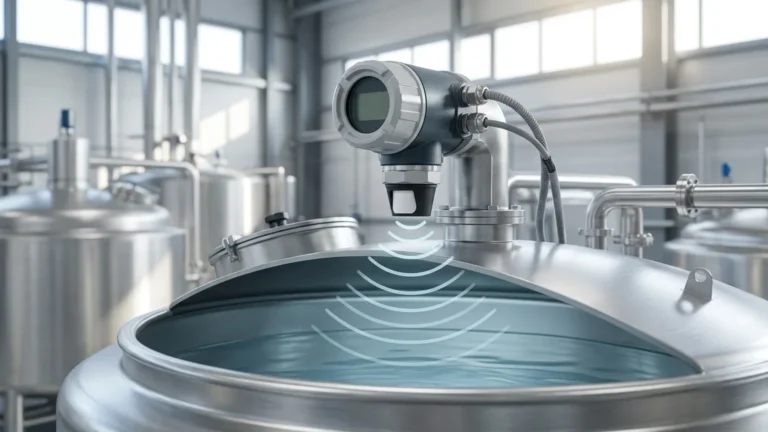
At its core, an ultrasonic level transmitter operates on the "Time-of-Flight" (ToF) principle. The device contains a piezoelectric crystal that, when energized, vibrates at a specific frequency (typically between 20 kHz and 200 kHz). This vibration generates a pulse of sound—an ultrasonic wave—that travels through the air space in the tank.
When the sound wave hits the surface of the water, a portion of the energy is reflected back toward the sensor. The transmitter then switches to a receiving mode to detect this echo. The internal microprocessor measures the exact time interval between the emission of the pulse and the reception of the echo.
The Calculation
The distance from the sensor to the water surface is calculated using the formula:
Distance = (Speed of Sound × Time) / 2
Since the transmitter is mounted at a known height (the reference point), the liquid level is determined by subtracting the measured distance from the total tank height.
Temperature Compensation
A critical factor in the accuracy of Ultrasonic Level Meters is the speed of sound. Sound travels through air at approximately 343 meters per second (m/s) at 20°C, but this speed changes by about 0.17% for every degree Celsius change in temperature. To maintain accuracy, modern non-contact ultrasonic transmitters for water tanks include an integrated temperature sensor. This sensor allows the device to automatically adjust the distance calculation based on the ambient air temperature within the tank's headspace.
Advantages of Non-contact Measurement
Choosing non-contact transmitters over contact-based technologies like hydrostatic probes or magnetic level gauges offers several distinct benefits:
1. Zero Maintenance on Wetted Parts: Because the sensor never touches the water, there is no risk of scaling, biofouling, or chemical corrosion of the transducer face. This is particularly valuable in wastewater or reclaimed water applications.
2. Hygiene and Safety: In potable water storage, maintaining a sealed environment is paramount. Non-contact sensors are mounted at the top of the tank, reducing the risk of contamination and eliminating the need for tank-bottom penetrations that could leak.
3. Ease of Retrofitting: These units can often be installed on existing tank process connections (flanges or NPT/BSP threads) without draining the vessel.
4. Versatility: The same sensor can be used for various liquids, provided the headspace remains relatively clear of heavy vapors or dust.
Selection Criteria for Water Tank Applications
When specifying non-contact ultrasonic transmitters for water tanks, engineers must consider several technical variables to ensure the chosen model matches the application requirements.
1. Measurement Range
Transmitters are rated for specific ranges, typically from 0.2 meters (0.66 ft) up to 30 meters (98 ft). It is essential to select a unit where the maximum tank height falls within 80% of the sensor’s rated range to ensure a strong signal return even in less-than-ideal conditions.
2. The "Dead Zone" (Blocking Distance)
Every ultrasonic sensor has a "dead zone" immediately in front of the transducer face where it cannot accurately process an echo. This occurs because the crystal needs time to stop vibrating from the transmission before it can begin listening for the return pulse. Common dead zones range from 0.2m to 0.5m. The transmitter must be mounted high enough so that the maximum water level never enters this zone.
3. Beam Angle
The ultrasonic pulse spreads out as it travels, forming a cone. The beam angle (usually between 5° and 12°) determines the diameter of the area the sound wave covers. If the beam is too wide, it may hit internal tank structures like ladders, pipes, or stay-braces, causing false echoes.
4. Output and Communication
Standard industrial units typically offer a 4-20mA analog output. However, for integration into modern SCADA systems or IoT platforms, engineers may require digital protocols such as Modbus RTU, HART, or Profibus.
| Feature | Standard Water Tank | Deep Reservoir/Sump | Chemical Dosing Tank |
| :— | :— | :— | :— |
| Typical Range | 2m – 10m | 10m – 30m | 1m – 5m |
| Transducer Material | ABS / PVC | Reinforced PVDF | PTFE / PVDF |
| Beam Angle | Standard (10°-12°) | Narrow (5°-8°) | Standard |
| Protection Rating | IP66 / IP67 | IP68 (Submersible head) | IP67 (Corrosion resistant) |
Installation Guidelines and Considerations
Correct physical installation is the most influential factor in the performance of ultrasonic level meters. Even the most advanced sensor will fail if it is poorly positioned.
Positioning and Alignment
* Verticality: The transducer face must be perfectly parallel to the liquid surface. A tilt of even a few degrees can cause the reflected signal to bounce away from the sensor rather than returning to it.
* Wall Distance: To avoid "edge echoes," the sensor should be placed at least 20cm to 50cm away from the tank wall, depending on the beam angle and tank depth.
* Inlet Interference: Never install the sensor directly above the water inlet. The turbulence and splashing from incoming water will scatter the ultrasonic signal and create significant noise in the data.
Overcoming Obstacles
In tanks with internal obstructions (e.g., heating coils or support beams), engineers can utilize a "standpipe" or "stillwell." This is a vertical pipe that extends from the top to the bottom of the tank. The ultrasonic sensor is mounted at the top of the pipe. The pipe acts as a waveguide, focusing the sound and protecting the signal from internal obstructions and surface turbulence.

Limitations and Application Risks
While non-contact ultrasonic transmitters for water tanks are robust, they are not universal solutions. Certain environmental factors can degrade their performance:
* Surface Foam: Light, airy foam is an excellent sound absorber. If a thick layer of foam covers the water surface, the ultrasonic pulse may be absorbed rather than reflected, leading to a "Loss of Echo" (LOE) error.
* Heavy Vapor and Steam: While water vapor is generally manageable, extreme steam can change the density of the air in the headspace, significantly affecting the speed of sound and causing measurement errors.
* Vacuum or High Pressure: Ultrasonic waves require a medium (air or gas) to travel. They cannot function in a vacuum. Furthermore, high pressure can change the attenuation characteristics of the air, potentially reducing the effective range.
* Turbulence: Rapidly boiling or heavily agitated water can scatter the sound waves. In these cases, software filtering (damping) or the use of a stillwell is required.
Maintenance and Troubleshooting
Non-contact sensors require very little maintenance, but periodic inspections are recommended.
1. Transducer Cleaning: In high-humidity environments, condensation can form on the transducer face. While most modern Ultrasonic Level Meters are designed to shed droplets, a buildup of mineral deposits or spider webs can interfere with the signal and should be wiped away with a soft cloth.
2. Signal Diagnostics: Most digital transmitters provide a "Signal Strength" or "Echo Confidence" metric. If this value drops over time, it may indicate a shifting sensor or an increase in surface foam.
3. False Echo Mapping: If a new obstruction is placed in the tank, the transmitter’s software can often be programmed to "ignore" echoes at a specific distance. This is known as false echo suppression or envelope masking.
Frequently Asked Questions (FAQ)
Q: Can ultrasonic transmitters measure through a closed plastic tank lid?
A: Generally, no. The sound wave is reflected by the first solid surface it hits. To measure the liquid inside, the sensor must be mounted through a hole in the lid or installed inside the tank. Some very thin-walled plastic containers can be measured using specialized high-power sensors, but this is not standard practice for industrial water tanks.
Q: How does wind affect the measurement in open-air sumps?
A: Strong wind can "blow" the ultrasonic pulse away, especially over long distances (e.g., >10 meters). For outdoor applications, using a sensor with a higher power output or installing a protective shroud can help maintain signal integrity.
Q: What is the difference between a two-wire and a four-wire transmitter?
A: A two-wire transmitter uses the same pair of wires for both power and the 4-20mA signal, which is more cost-effective for wiring. A four-wire transmitter has separate wires for power (often 110/220V AC or 24V DC) and signal, which allows for higher power consumption, often resulting in a stronger ultrasonic pulse and better performance in difficult conditions.
Conclusion
Non-contact ultrasonic transmitters for water tanks represent a mature and highly effective technology for modern industrial requirements. By understanding the relationship between beam angles, dead zones, and environmental factors like foam and temperature, engineers can specify systems that provide years of maintenance-free service. When accuracy and hygiene are the primary drivers of a project, the ultrasonic method remains one of the most cost-effective and reliable choices available in the level measurement market.
Download Non-contact Ultrasonic Transmitters for Water Tanks as a PDF