Wastewater Level Sensor
Wastewater Level Sensor
In the field of industrial and municipal water management, selecting the appropriate wastewater level sensor is a critical engineering decision. Wastewater environments are notoriously harsh, characterized by corrosive gases, floating debris, varying viscosity, and the presence of foam or turbulence. Accurate level monitoring is essential not only for process efficiency but also for preventing environmental overflows and ensuring the longevity of pumping equipment.
As a professional manufacturer, Welk provides a range of instrumentation designed to meet these challenges. Understanding the underlying measurement principles is the first step toward selecting a solution that minimizes maintenance and maximizes uptime. This guide explores the primary technologies used in wastewater level measurement, their practical applications, and the technical considerations necessary for successful deployment.
Measurement Principles for Wastewater Applications
Before selecting a specific sensor, engineers must evaluate how different physical principles interact with the unique properties of wastewater. The most common technologies include ultrasonic, radar, and hydrostatic pressure measurement.
Ultrasonic Level Measurement (Non-Contact)
Ultrasonic sensors operate on the Time-of-Flight (ToF) principle. The sensor emits high-frequency sound pulses that travel through the air, reflect off the liquid surface, and return to the transducer. By measuring the time interval between emission and reception, the device calculates the distance to the liquid surface.
In wastewater applications, ultrasonic sensors are favored for their non-contact nature, which prevents fouling from raw sewage or sludge. However, they are sensitive to air temperature fluctuations (requiring compensation) and can be obstructed by heavy foam or steam, which absorbs or scatters the sound waves.
Radar Level Measurement (Non-Contact)
Radar sensors also use the ToF principle but utilize electromagnetic microwave pulses instead of sound. These pulses travel at the speed of light and reflect off the dielectric boundary of the wastewater.
Radar technology, particularly 80GHz high-frequency radar, offers significant advantages in wastewater. Unlike ultrasonic waves, radar signals are unaffected by air temperature, pressure, or the presence of vapors and gases like Hydrogen Sulfide (H2S). This makes radar the preferred choice for sealed lift stations or primary treatment tanks where atmospheric conditions are unstable.
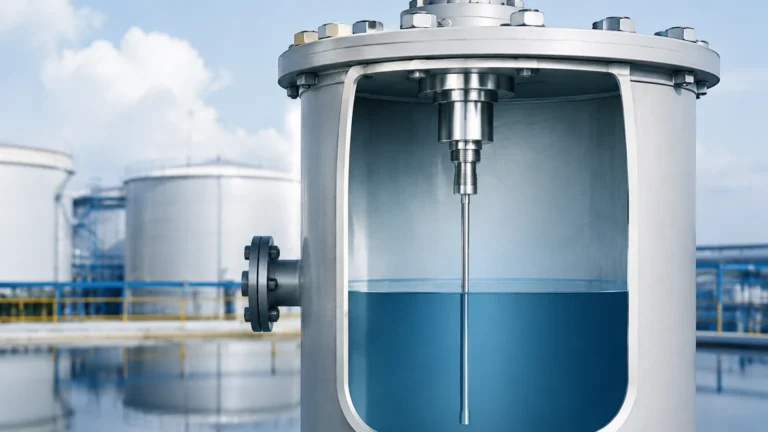
Hydrostatic Level Measurement (Contact)
Hydrostatic sensors are submersible pressure transmitters. They measure the head pressure exerted by the liquid column above the sensor diaphragm. This pressure is directly proportional to the liquid level according to the formula: $P = \rho \cdot g \cdot h$, where $\rho$ is the density, $g$ is gravity, and $h$ is the height of the liquid.
For wastewater, these sensors must be equipped with large, flush-mounted diaphragms to prevent clogging by suspended solids or fibrous materials. They are highly effective in deep wells or wet wells where surface turbulence or foam would interfere with non-contact sensors.
Practical Selection Criteria
Choosing the right wastewater level sensor requires a detailed analysis of the installation site. The following table summarizes the primary selection factors for the most common technologies.
Selection Comparison Table
| Feature | Ultrasonic | Radar (FMCW) | Hydrostatic |
| :— | :— | :— | :— |
| Measurement Type | Non-contact | Non-contact | Contact (Submerged) |
| Media Suitability | Clear water, some solids | All liquids, sludge, foam | Heavy sludge, turbulent water |
| Accuracy | ±0.25% of range | ±2 mm to ±5 mm | ±0.1% to ±0.5% of span |
| Max Range | Up to 15 meters | Up to 30+ meters | Up to 200 meters |
| Effect of Foam | High (Signal loss) | Minimal to Moderate | None |
| Effect of Vapors | High (Speed of sound) | None | None |
| Maintenance | Low | Very Low | Moderate (Cleaning required) |
| Typical Application | Open channels, flumes | Process tanks, lift stations | Deep wells, reservoirs |
Environmental Factors
When evaluating a wastewater level sensor, consider the presence of H2S gas. This gas is highly corrosive to copper and standard electronics. Sensors used in these environments should feature PVDF or Tefzel housings and high-grade stainless steel (316L) or Hastelloy components for submerged parts. For non-contact sensors, ensuring the electronics are hermetically sealed is vital for long-term reliability.
Installation Considerations and Best Practices
Even the most advanced sensor will fail if installed incorrectly. Wastewater infrastructure often presents physical constraints that must be managed during the engineering phase.
Positioning and Dead Zones
All non-contact sensors have a "dead zone" or "blocking distance" directly beneath the sensor face where measurement is impossible. For ultrasonic sensors, this is typically 0.25m to 0.5m (approx. 10 to 20 inches), while modern radar sensors have much smaller dead zones. The sensor must be mounted high enough that the maximum expected liquid level never enters this zone.
Turbulence and Stilling Wells
In wet wells where high-volume pumps create significant surface turbulence, a stilling well (a vertical pipe with vent holes) can be used to provide a calm surface for the sensor to measure. For hydrostatic sensors, a stilling well also protects the cable and sensor body from the mechanical force of moving water and debris.
Beam Angle and Obstructions
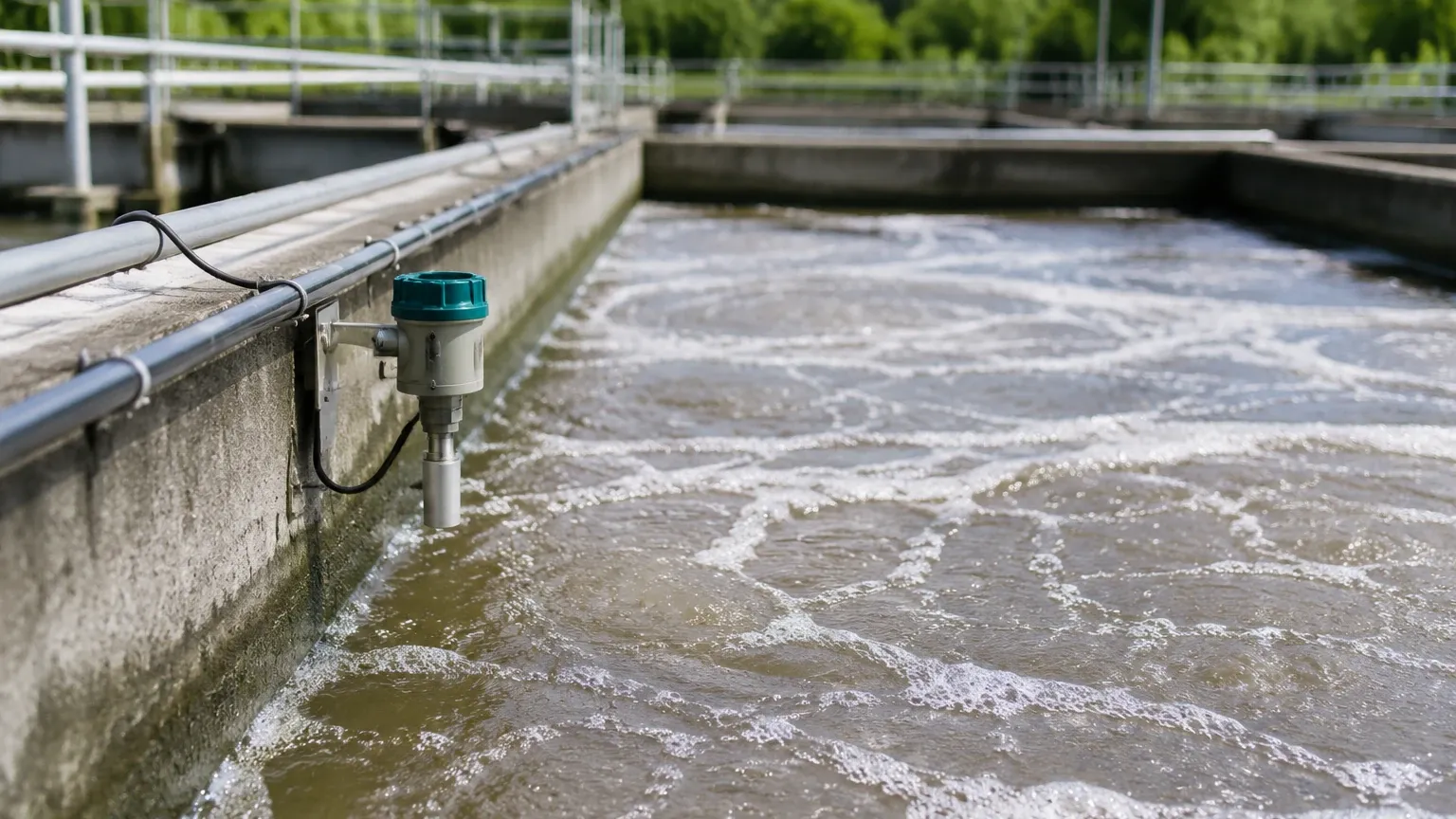
Non-contact sensors emit signals in a cone shape. Any internal structures within this cone—such as ladders, pipes, or pump supports—will create false echoes. High-frequency radar (80GHz) offers a much narrower beam angle (often as low as 3 degrees) compared to ultrasonic sensors (typically 10-12 degrees), allowing for easier installation in narrow shafts or crowded tanks.
Limitations and Common Risks
Understanding where a wastewater level sensor might fail is as important as knowing its strengths.
1. Grease and Ragging: In raw sewage, "fatbergs" and fibrous materials (rags) can coat submerged sensors. Hydrostatic sensors are particularly vulnerable to this. Regular cleaning intervals or the use of non-stick diaphragm coatings are necessary.
2. Foam Interference: Heavy, thick foam can act as an insulator for ultrasonic waves, leading to "lost echo" errors. In these scenarios, radar is a better non-contact alternative, though extremely dense foam may still require a stilling well or a contact-based pressure sensor.
3. Lightning and Surges: Since many wastewater sensors are located outdoors or in remote lift stations, they are susceptible to lightning strikes. Integrated surge protection and proper grounding are essential to prevent premature board failure.
4. Condensation: In humid wastewater environments, water droplets can form on the sensor face. While radar can typically "see through" some condensation, ultrasonic sensors may experience signal attenuation. Many Welk sensors utilize a convex lens design to encourage droplets to run off the face rather than pooling.
Frequently Asked Questions (FAQs)
Q: How often should a wastewater level sensor be calibrated?
A: For non-contact sensors like radar, factory calibration is often sufficient for the life of the device, though an annual "check-look" against a manual tape measure is recommended. Hydrostatic sensors may require zero-point adjustment annually to account for sensor drift or changes in the specific gravity of the wastewater.
Q: Can I use an ultrasonic sensor in a pressurized tank?
A: It is generally not recommended. Ultrasonic waves depend on the density of the air to travel. Changes in pressure alter air density, which changes the speed of sound and introduces significant errors. Radar is the standard for pressurized applications.
Q: What is the best sensor for a sludge thickening tank?
A: Sludge has higher viscosity and density than standard wastewater. Radar is often the best choice because it is unaffected by the density changes of the sludge. If using hydrostatic sensors, ensure the diaphragm is large and flush-mounted to prevent the thick media from clogging the pressure port.
Q: How do I handle signal loss caused by heavy steam?
A: Steam significantly affects ultrasonic sensors because it changes the medium through which the sound travels. Radar (microwave) signals are unaffected by steam, making them the superior choice for high-temperature wastewater processes.
Conclusion and Technical Support
Selecting the right wastewater level sensor involves balancing cost, accuracy, and maintenance requirements. While ultrasonic sensors remain a cost-effective solution for simple open-channel applications, the increasing affordability of radar technology has made it the go-to choice for complex lift stations and treatment processes. Hydrostatic sensors continue to provide unmatched reliability in deep-well and high-turbulence environments where a stable mounting point for non-contact sensors is unavailable.
As you plan your next water or wastewater project, it is essential to consult with experts who understand the nuances of industrial automation. For detailed specifications, technical drawings, and personalized application support, we invite you to Review product options and application support on our Main Page.
Welk provides a comprehensive portfolio of level measurement instruments, from advanced radar transmitters to rugged hydrostatic sensors, ensuring that your wastewater management system operates with precision and reliability. Whether you are upgrading an existing facility or designing a new treatment plant, our engineering team is available to help you navigate the complexities of sensor selection and installation.