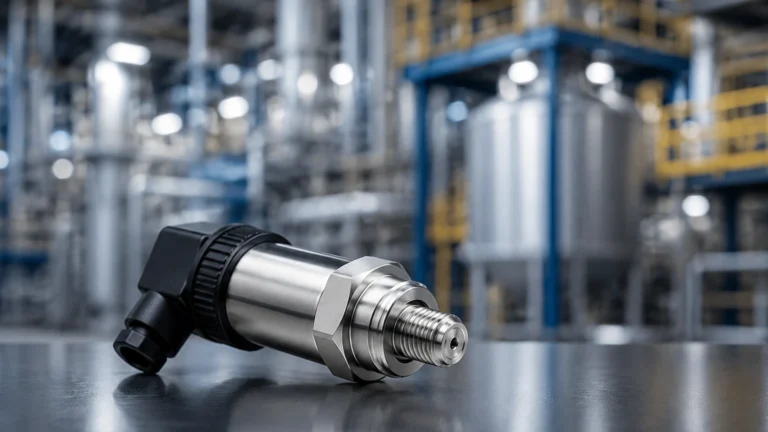
80.5mm to Inches
80.5mm to Inches
In the field of industrial process control and level measurement, precision is the cornerstone of system reliability. Engineers often encounter the need to reconcile metric and imperial units when integrating international equipment into existing facilities. Converting 80.5mm to inches is a common requirement when dealing with sensor housing diameters, flange specifications, or nozzle clearances for level measurement instruments.
For a professional manufacturer like Welk, understanding these dimensional nuances ensures that radar level meters, ultrasonic sensors, and hydrostatic transmitters fit perfectly within the mechanical constraints of a tank or vessel. This guide provides a technical breakdown of the conversion, its application in level measurement, and the engineering principles that dictate how physical dimensions influence sensor performance.
The Mathematical Conversion: 80.5mm to Inches
To convert millimeters to inches, the standard conversion factor is 25.4 millimeters per inch. This is an exact international standard used across all engineering disciplines.
The Calculation:
80.5 mm ÷ 25.4 = 3.16929133858 inches
For most industrial applications, rounding to three or four decimal places is sufficient:
* 80.5mm ≈ 3.169 inches
* 80.5mm ≈ 3 11/64 inches (fractional equivalent)
In the context of industrial piping and vessel nozzles, 80.5mm is closely related to the internal diameter of a 3-inch (DN80) pipe. Specifically, Schedule 40 steel pipe in the 3-inch size has an internal diameter of approximately 3.068 inches (77.9mm), while Schedule 10 may be closer to 3.26 inches (82.8mm). Therefore, an instrument or housing with an 80.5mm outer diameter is designed to interact with standard 3-inch process connections, often requiring careful verification of tolerances.
Measurement Principles and Dimensional Influence
Before selecting a level meter based on its physical size, it is essential to understand how the measurement technology interacts with the installation space. The physical diameter of a sensor—whether it is 80.5mm or another size—dictates its compatibility with the vessel's mounting nozzle.
Radar Level Measurement
Radar level meters, particularly high-frequency 80GHz models, utilize electromagnetic waves to measure the distance to a liquid or solid surface. The size of the antenna (often housed in a structure near 80.5mm in diameter for DN80 fittings) directly impacts the beam angle. A larger antenna typically produces a narrower beam, which is advantageous in tall, narrow tanks with internal obstructions like agitators or heating coils.
Ultrasonic Level Sensors
Ultrasonic sensors use sound waves. The transducer diameter is a critical factor in determining the "dead zone" or blocking distance. If an 80.5mm sensor is mounted in a nozzle that is too narrow or too long, the sound waves may reflect off the nozzle walls (ringing effect), leading to false readings. Precise conversion from 80.5mm to inches helps engineers ensure the nozzle diameter is wide enough to prevent these interference echoes.
Hydrostatic Level Transmitters
For hydrostatic pressure sensors, the 80.5mm dimension might refer to the diameter of a flush diaphragm. In viscous or corrosive applications, a larger diaphragm area provides better sensitivity and prevents clogging. Ensuring the mounting flange matches this diameter is vital for a leak-proof seal.
Industrial Selection Table: Metric and Imperial Equivalents
When reviewing product options and application support on the Main Page, engineers should refer to the following table to understand how common metric dimensions used in level instrumentation relate to imperial standards.
| Metric (mm) | Decimal Inches | Fractional Inch (Approx) | Common Application |
| :— | :— | :— | :— |
| 50 mm | 1.968 in | 2 in | DN50 / 2" Pipe Nozzle |
| 75 mm | 2.952 in | 3 in | Standard Sensor Housing |
| 80.5 mm | 3.169 in | 3 11/64 in | DN80 Mounting / Large Radar Antennas |
| 100 mm | 3.937 in | 4 in | DN100 / 4" Flange Face |
| 150 mm | 5.905 in | 6 in | High-Pressure Process Connections |
Installation Considerations for 80.5mm Components
When installing a level meter with an 80.5mm diameter component, several practical engineering factors must be addressed to ensure long-term accuracy and safety.
1. Nozzle Clearance and Beam Angle
If you are installing a radar or ultrasonic meter through a nozzle, the 80.5mm dimension must be compared against the nozzle's internal diameter. For a radar meter, the beam must clear the bottom edge of the nozzle. If the nozzle is 3 inches (approx. 76.2mm ID), an 80.5mm sensor will not fit. You would require at least a DN100 (4-inch) nozzle. Always verify the internal diameter (ID) of the pipe, not just the nominal size.
2. Flange Matching
In many global projects, instruments are manufactured to metric standards (DIN/EN), while the site uses imperial standards (ANSI/ASME). An 80.5mm sensor housing might be intended for a DN80 flange. While DN80 and 3-inch ANSI flanges have similar bolt patterns, they are not identical. Using an adapter or a multi-standard flange is often necessary to bridge the gap between 80.5mm to inches specifications.
3. Gasket and Seal Selection
Precision in the 80.5mm measurement is critical for selecting the correct gasket. A gasket that is too small will protrude into the process flow, potentially causing turbulence or buildup that interferes with ultrasonic signals. A gasket that is too large may fail to provide an adequate high-pressure seal.
4. Thermal Expansion
In high-temperature chemical processing, materials expand. An 80.5mm stainless steel housing will expand at a different rate than a plastic tank port. Engineers must account for these tolerances to prevent the sensor from becoming seized in the mounting port or cracking the vessel connection.
Limitations and Potential Risks
While converting 80.5mm to inches is mathematically simple, the practical application carries risks if not handled with engineering oversight.
* Tolerance Stacking: Manufacturing tolerances might mean a part labeled 80.5mm is actually 80.6mm. In a tight-tolerance imperial fit (3.17 inches), this fraction of a millimeter can prevent assembly.
* Nominal vs. Actual: Never assume a "3-inch" pipe has a 3-inch ID. Depending on the "Schedule" (wall thickness), the ID can vary significantly. Always measure the actual ID before specifying an 80.5mm instrument.
* Material Compatibility: If the 80.5mm component is a PTFE-lined radar antenna, the lining adds thickness. Ensure the total diameter, including the protective layer, is accounted for in the conversion.
Frequently Asked Questions (FAQ)
Is 80.5mm the same as a 3-inch pipe?
No. A standard 3-inch pipe (NPS 3) has an outside diameter of 3.5 inches (88.9mm). The internal diameter varies by schedule but is typically around 3.068 inches (77.9mm). An 80.5mm component is slightly larger than the internal diameter of a standard Schedule 40 3-inch pipe and would likely require a 4-inch nozzle for clearance.
How do I convert 80.5mm to inches for a CAD drawing?
Most modern CAD software (like AutoCAD or SolidWorks) allows you to toggle units. However, for manual entry, use 3.16929. If you are working in a precision machining environment, verify if the design requires a "press fit" or a "clearance fit," as this will determine how many decimal places are necessary.
Why does Welk use metric measurements for some level meters?
As a global manufacturer, Welk adheres to international ISO and DIN standards, which are metric-based. This ensures consistency across water treatment, chemical, and oil and gas applications worldwide. We provide detailed conversion charts and customized OEM/ODM services to ensure these metric instruments integrate seamlessly with imperial systems.
What is the significance of 80.5mm in radar level meters?
This dimension often corresponds to the diameter of the lens antenna or the outer protective sleeve of a solids-level radar. It is designed to provide a specific gain and beamwidth, optimized for medium-to-large sized silos and tanks.
Conclusion
Accurately converting 80.5mm to inches is a fundamental step in process engineering and instrument selection. Whether you are retrofitting an old tank with new ultrasonic sensors or designing a new chemical reactor with radar level measurement, understanding the physical dimensions ensures a successful installation.
By following strict quality control and providing reliable, cost-effective solutions, Welk helps customers bridge the gap between different measurement standards. For more information on specific sensor dimensions, flange options, or to find the right technology for your application, visit the Main Page to explore our comprehensive range of industrial level measurement instruments.