Mine Expo Elko
Mine Expo Elko
Mine Expo Elko, often referred to as the Elko Mining Expo, stands as one of the most critical regional events for the mining industry in North America. Held in the heart of the Carlin Trend in Nevada, this exhibition serves as a vital junction where mining operators, engineers, and equipment manufacturers converge to discuss the evolution of extraction and processing technologies. For professionals managing complex mining infrastructures, the expo is a primary venue for evaluating the instrumentation that ensures operational safety and efficiency.
In the harsh environments characteristic of Nevada’s gold and silver mines, level measurement is a fundamental requirement. From monitoring the inventory of corrosive leaching chemicals to managing the levels in massive ore silos and tailings ponds, the reliability of sensors is non-negotiable. This article explores the technical landscape of level measurement technologies relevant to the mining sector, providing an engineering reference for those attending events like Mine Expo Elko or seeking to upgrade their facility's instrumentation.
The Role of Level Measurement in Mining Operations
Level measurement in mining is not a one-size-fits-all application. The industry deals with a diverse range of materials, including abrasive slurries, fine dust-prone powders, and aggressive chemical reagents. Inaccurate level readings can lead to catastrophic tank overflows, equipment damage due to pump dry-running, or significant production delays.
At a major gathering like Mine Expo Elko, the focus often shifts toward how instrumentation can withstand the "triple threat" of mining: vibration, dust, and chemical corrosion. To select the right tool, engineers must first understand the physics behind the primary measurement principles used in modern industrial level meters.
Core Measurement Principles
Radar Level Measurement (Non-Contact)
Radar technology, specifically Frequency Modulated Continuous Wave (FMCW) radar, has become the gold standard for mining applications. These meters emit high-frequency microwave signals (typically in the 26 GHz or 80 GHz range) that reflect off the surface of the material back to the sensor.
* Principle: The device measures the frequency shift or the time of flight of the microwave signal. Since microwaves do not require a medium to travel, they are unaffected by vacuum, pressure, or high temperatures.
* Mining Advantage: Radar is exceptionally resistant to dust. In ore silos where fine particles create a dense cloud, radar signals penetrate the dust to provide an accurate distance to the material surface. High-frequency 80 GHz radar allows for a narrow beam angle, which is essential for avoiding interference from internal tank structures or silo walls.
Ultrasonic Level Measurement
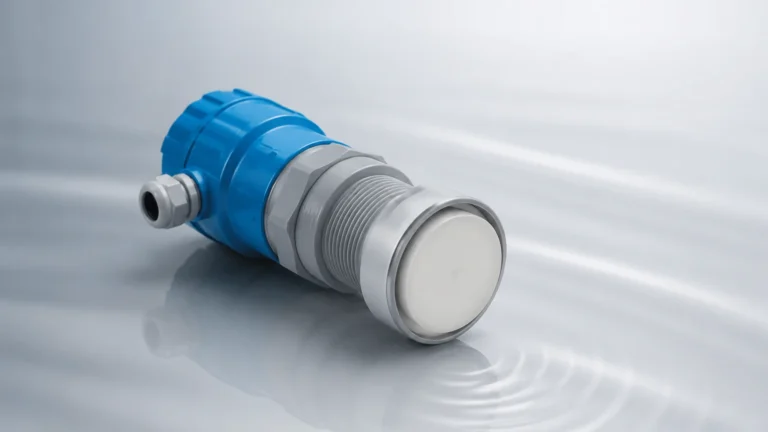
Ultrasonic sensors use sound waves to determine the distance to a liquid or solid surface. The sensor emits a pulse and measures the time it takes for the echo to return.
* Principle: Based on the speed of sound ($v \approx 343$ m/s in air at $20^\circ$C), the distance is calculated as $D = (v \times t) / 2$.
* Mining Advantage: These are cost-effective solutions for open-channel flow measurement in water treatment plants or monitoring water levels in sumps. However, they are sensitive to air temperature fluctuations and heavy dust, which can attenuate the sound signal.
Hydrostatic Level Measurement
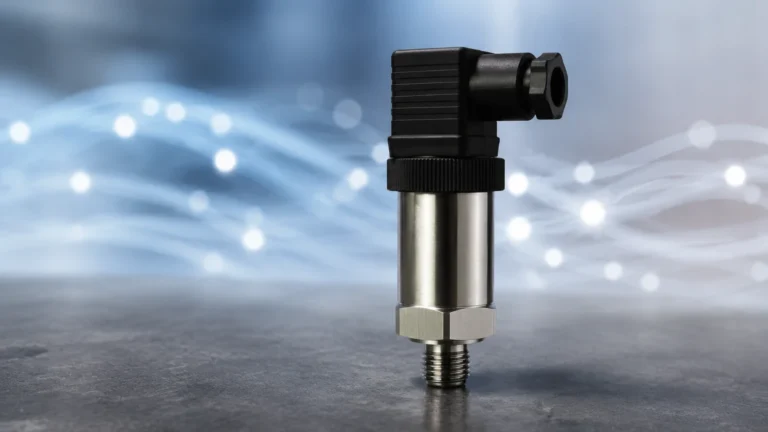
Hydrostatic transmitters measure the pressure exerted by a liquid column. In mining, these are frequently used in deep wells or large liquid storage tanks.
* Principle: The pressure ($P$) at the bottom of a vessel is proportional to the height ($h$) of the liquid: $P = \rho \times g \times h$, where $\rho$ is the density and $g$ is gravity.
* Mining Advantage: This is a robust, contact-based method. When equipped with ceramic diaphragms, these sensors can resist the abrasive nature of slurries and the corrosive effects of acids used in heap leaching.
Magnetic Level Gauges
Magnetic level gauges provide a high-visibility local indication and can be paired with transmitters for remote monitoring.
* Principle: A float containing a magnet moves with the liquid level inside a bypass chamber. This magnet flips colored flags on an external scale.
* Mining Advantage: They provide a mechanical backup that does not require power for local viewing, which is critical for safety during power outages in remote mine sites.
Selection Criteria for Mining Environments
When evaluating technologies at Mine Expo Elko, engineers should use a structured set of criteria to ensure the selected instrument survives the application.
1. Material State: Is the material a liquid, a slurry, or a solid? Solids (like crushed ore) require sensors that can handle uneven surfaces and low dielectric constants.
2. Environmental Conditions: In Elko, temperatures can swing from $-20^\circ$C ($-4^\circ$F) in winter to over $40^\circ$C ($104^\circ$F) in summer. Instruments must have high-quality ingress protection (IP67 or IP68) and UV resistance.
3. Chemical Compatibility: For gold extraction, sensors often come into contact with sodium cyanide or sulfuric acid. Wetted parts should be made of PVDF, PTFE, or high-grade stainless steel (316L).
4. Measurement Range: Large-scale mining silos can exceed 30 meters (approx. 98 feet) in height. Radar sensors are typically better suited for these long-range requirements compared to ultrasonic variants.
Practical Selection Table
| Technology | Best Application | Max Range (Typical) | Resistance to Dust | Cost Profile |
| :— | :— | :— | :— | :— |
| 80 GHz Radar | Ore Silos, Slurry Tanks | 120m | Excellent | High |
| Ultrasonic | Water Sumps, Open Channels | 15m | Poor | Low |
| Hydrostatic | Deep Wells, Acid Tanks | 200m+ | N/A (Contact) | Moderate |
| Magnetic Gauge | Chemical Storage Tanks | 6m | N/A (Contact) | Moderate |
| Level Switch | Overfill Protection | N/A | Good | Low |
Installation Considerations in Mining Applications
Proper installation is as critical as selecting the right technology. Even the most advanced radar meter will fail if mounted incorrectly.
* Beam Obstruction: Ensure the signal beam path is clear of ladders, agitators, or support beams. For radar, a "mapping" or "false echo suppression" run should be performed during commissioning to ignore static internal structures.
* Nozzle Geometry: The sensor nozzle should be short enough that the sensor diaphragm or antenna extends slightly into the vessel to prevent signal ringing within the nozzle.
* Mounting Angle: For solid materials, the surface is rarely flat. Mounting the sensor on a swiveling flange allows the beam to be aimed at the angle of repose of the material, maximizing the return signal strength.
* Stilling Wells: In tanks with heavy agitation or foam, installing a hydrostatic transmitter or a guided wave radar inside a stilling well (a vertical pipe) can provide a stable surface for measurement.

Common Risks and Limitations
In the context of Mine Expo Elko, it is important to discuss the limitations of these technologies to avoid common pitfalls.
* Foam Interference: Heavy foam on the surface of a flotation cell can absorb ultrasonic and radar signals. In these cases, a displacement-based or hydrostatic approach may be more reliable.
* Build-up: In sticky clay or wet ore applications, material can build up on the sensor face. Non-contact radar with a flat-face antenna is less susceptible to this than traditional horn antennas.
* Dielectric Constant ($dk$): Radar relies on the reflection of microwaves. Materials with a very low $dk$ (like certain dry powders) reflect very little energy. High-sensitivity radar units are required for these specific mining products.
Frequently Asked Questions (FAQ)
Q: Can radar level meters work in the presence of heavy steam?
A: Yes. Unlike ultrasonic waves, which are slowed or deflected by steam and vapor, radar microwaves pass through these atmospheric conditions with negligible attenuation, making them ideal for hot leaching processes.
Q: How often do hydrostatic level transmitters need calibration in mining?
A: Because mining slurries can be abrasive, the diaphragm may wear over time, shifting the calibration. It is recommended to check the zero-point every 6 to 12 months, depending on the abrasiveness of the fluid.
Q: What is the best way to monitor tailings dam levels?
A: Tailings dams often require a combination of hydrostatic pressure sensors for water pressure within the dam wall and non-contact radar for surface level monitoring to ensure environmental compliance and safety.
Q: Are wireless level meters suitable for remote mine sites?
A: Yes, many modern level meters support WirelessHART or LoRaWAN protocols, which are excellent for monitoring remote tanks or ponds where running cable is cost-prohibitive.
Conclusion
Attending events like Mine Expo Elko provides a unique opportunity for mining professionals to witness the latest advancements in instrumentation firsthand. As mining operations become increasingly automated, the demand for precise, real-time data grows. Whether you are managing a gold mine in Nevada or a copper operation in South America, selecting the correct level measurement technology is the first step toward a safer and more profitable operation.
For engineers looking to compare specific models or request a customized solution for a challenging application, visiting the Main Page of a dedicated manufacturer like Welk can provide deep technical insights and product specifications. By understanding the measurement principles and environmental constraints of the mine site, operators can ensure their instrumentation provides reliable service for years to come.