Deltatop Dp62d
Deltatop Dp62d
In the landscape of industrial process control, the accuracy of flow and level measurement is paramount for operational efficiency, safety, and cost management. Among the various technologies available, differential pressure (DP) measurement remains a fundamental method. The deltatop dp62d represents a specialized solution within this category, often utilized in complex piping environments where traditional measurement devices might struggle. Understanding the engineering principles behind the deltatop dp62d, its integration requirements, and how it compares to alternative technologies like radar or ultrasonic sensors is essential for instrumentation engineers and plant managers.
As a professional manufacturer of industrial level measurement instruments, Welk provides a broad spectrum of solutions, including radar level meters and hydrostatic transmitters. While the deltatop dp62d focuses on flow measurement through differential pressure, the underlying physics of pressure-based sensing shares significant commonality with the level measurement systems found on our Main Page.
Understanding Differential Pressure Measurement Principles
Differential pressure measurement is based on Bernoulli's principle, which states that as the speed of a moving fluid increases, the pressure within the fluid decreases. In a closed pipe, by introducing a primary element—such as an orifice plate, a Venturi tube, or a Pitot tube—a pressure drop is intentionally created.
For the deltatop dp62d, the system typically utilizes a Pitot tube (specifically a multi-port averaging Pitot tube) as the primary element. The device measures the difference between the total pressure (impact pressure) and the static pressure.
The Physics of Averaging Pitot Tubes
Unlike a standard Pitot tube that measures pressure at a single point in the flow stream, an averaging Pitot tube like the one used in the deltatop dp62d features multiple sensing ports across the pipe diameter. This design allows the instrument to account for the flow profile, providing a more accurate average velocity measurement even in conditions where the flow may not be fully developed or is slightly turbulent.
The relationship between flow velocity ($v$) and differential pressure ($ΔP$) is expressed as:
$$v = K \sqrt{\frac{2\u0394P}{\rho}}$$
Where:
* K is the flow coefficient (specific to the probe geometry).
* ΔP is the differential pressure ($P_{total} – P_{static}$).
* ρ (rho) is the density of the fluid.
By calculating the velocity and knowing the cross-sectional area of the pipe, the mass or volumetric flow rate can be determined. This principle is highly reliable for steam, gases, and low-viscosity liquids.
Technical Overview of the Deltatop DP62D System
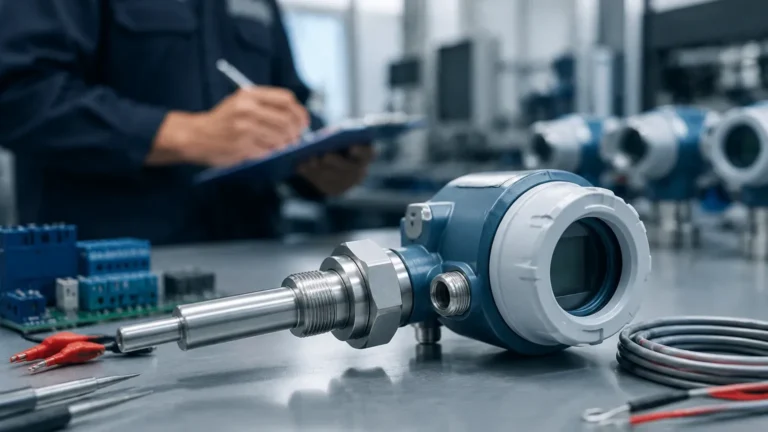
The deltatop dp62d is not merely a sensor but a complete measuring system. It typically consists of the primary element (the probe), the manifold, and the differential pressure transmitter.
Key Components
1. Primary Element: The probe is inserted into the process piping. It is designed to withstand high temperatures and pressures, often constructed from stainless steel or exotic alloys for corrosive environments.
2. Manifold: A valve assembly (3-way or 5-way) that allows for the isolation of the transmitter from the process for calibration or maintenance without shutting down the main line.
3. DP Transmitter: The electronic component that converts the physical pressure difference into a 4-20mA HART, PROFIBUS, or FOUNDATION Fieldbus signal.
Application Range
The deltatop dp62d is particularly effective in large diameter pipes where installing an orifice plate would result in significant permanent pressure loss. Because the Pitot tube creates minimal obstruction, it is an energy-efficient choice for high-volume flow applications.
Comparing DP Measurement with Modern Radar and Ultrasonic Sensors
While the deltatop dp62d is a robust choice for flow, industrial facilities often require level measurement in tanks and vessels. It is important to distinguish when to use differential pressure systems versus the non-contact technologies offered by Welk.
| Feature | Differential Pressure (DP) | Radar (GWR/Non-Contact) | Ultrasonic |
| :— | :— | :— | :— |
| Measurement Type | Contact (via impulse lines/probes) | Non-contact or Guided | Non-contact |
| Primary Application | Flow & Hydrostatic Level | Liquid & Solid Level | Liquid Level & Open Channel Flow |
| Accuracy | High (if density is constant) | Extremely High (±1mm to ±3mm) | Moderate (±0.25% of range) |
| Maintenance | High (impulse line clogging) | Very Low | Low (keep sensor face clean) |
| Pressure/Temp | Excellent for extremes | Excellent for extremes | Limited by speed of sound |
| Media Influence | Affected by density changes | Affected by Dielectric Constant | Affected by vapor/foam |
For many level applications, a radar level meter is preferred over a DP system because it is independent of the fluid's density, temperature, and pressure. However, in high-pressure steam drums or closed-loop boiler systems, the deltatop dp62d or similar DP-based hydrostatic level measurements remain the industry standard due to their ability to handle extreme saturation conditions.
Selection Criteria for Industrial Level and Flow Applications
Selecting between a deltatop dp62d and a Welk radar or ultrasonic sensor requires a detailed analysis of the process parameters. Engineers should confirm the following before finalizing a specification:
1. Fluid State: Is the media a liquid, gas, or steam? DP systems like the DP62D are versatile across all three, whereas ultrasonic sensors are generally restricted to liquids in level applications.
2. Process Pressure and Temperature: DP systems can operate at pressures exceeding 400 bar and temperatures above 1000°C depending on the probe material. Radar sensors from Welk also offer high-temperature variants, but ultrasonic sensors are typically limited to below 150°C.
3. Installation Footprint: The deltatop dp62d requires a specific length of straight pipe run (upstream and downstream) to ensure a stable flow profile. If space is limited, a radar level meter or a specialized flow meter may be necessary.
4. Density Stability: Since DP measurement is dependent on the square root of density, any fluctuation in process temperature that changes the fluid density will result in measurement errors unless compensation is applied.

Installation Best Practices for DP62D and Hydrostatic Systems
Proper installation is the most critical factor in the performance of a deltatop dp62d system. Errors in mounting or impulse line routing can lead to significant offsets.
Orientation and Leveling
* Gas Applications: The transmitter should ideally be mounted above the tapping point so that any condensate drains back into the process pipe.
* Liquid and Steam Applications: The transmitter should be mounted below the tapping point to ensure that the impulse lines remain full of liquid, preventing air bubbles from causing erratic readings.
Impulse Lines
Impulse lines connect the primary element to the transmitter. They should be as short as possible to minimize lag and potential leakage points. For the deltatop dp62d, ensuring that both the high-pressure and low-pressure lines are at the same temperature is vital to prevent density-induced errors within the lines themselves.
Welk Hydrostatic Alternatives
In applications where the deltatop dp62d might be considered for level measurement (hydrostatic), Welk offers submersible and flange-mounted hydrostatic transmitters. These are often easier to install than DP systems with impulse lines because they utilize a direct-sensing diaphragm, eliminating the risk of clogging in small-diameter tubing.
Maintenance and Troubleshooting in Process Environments
Even a well-installed deltatop dp62d requires periodic maintenance to ensure long-term reliability. Common issues include:
* Clogging of Sensing Ports: In fluids with high particulate matter, the ports on the averaging Pitot tube can become blocked. Regular "blow-down" or purging cycles may be required.
* Zero-Shift: Over time, the DP transmitter may experience a slight shift in its zero point. This should be checked using the manifold to equalize the pressure across the transmitter while the process is under pressure.
* Manifold Leaks: Small leaks in the manifold valves can lead to large errors in differential pressure, especially at low flow rates where the $ΔP$ signal is already weak.
Limitations and Considerations
While the deltatop dp62d is highly effective, it is not a "one-size-fits-all" solution. Its main limitation is the "Turndown Ratio." Because the signal is a square root function of the flow, the usable range is typically limited to 4:1 or 10:1. If your process requires measuring very low and very high flows with the same device, a different technology—such as a Welk ultrasonic flow meter or a multi-variable transmitter—might be required.
Furthermore, for level measurement in tanks containing corrosive chemicals, the contact nature of the DP62D's probe may lead to material degradation. In these instances, we recommend reviewing our non-contact radar solutions on our Main Page, which keep the sensing elements entirely isolated from the process media.
Frequently Asked Questions (FAQ)
Q: Can the deltatop dp62d be used for bidirectional flow?
A: Standard averaging Pitot tubes are designed for unidirectional flow. While some specialized probes exist for bidirectional measurement, they require a symmetrical probe design and a transmitter capable of processing negative differential pressure.
Q: What is the permanent pressure loss associated with the DP62D?
A: One of the primary advantages of this system is its low permanent pressure loss, typically less than 10% of the generated differential pressure. This is significantly lower than orifice plates, which can lose up to 60-70% of the $ΔP$.
Q: How does the system handle saturated steam?
A: For steam applications, condensate pots are often used in the impulse lines to ensure the transmitter is protected from high temperatures and that the lines remain filled with water at a constant head pressure.
Q: Is the deltatop dp62d suitable for hygienic applications?
A: Generally, no. The small sensing ports and the internal structure of the Pitot tube are difficult to clean in place (CIP). For food and beverage or pharmaceutical applications, Welk recommends hygienic radar or hydrostatic level sensors with flush diaphragms.
By carefully evaluating the process requirements and understanding the strengths of differential pressure systems like the deltatop dp62d, engineers can ensure accurate and reliable measurements. For further technical assistance or to explore alternative level measurement technologies, please visit our comprehensive product resource center.