Online Ammonia Analyzer
Online Ammonia Analyzer
In industrial process control and environmental monitoring, the ability to measure ammonia concentration in real-time is critical for operational efficiency and regulatory compliance. An online ammonia analyzer provides continuous data, allowing for immediate adjustments in wastewater treatment, chemical production, and power generation. Unlike laboratory testing, which introduces significant lag time, online systems enable automated feedback loops that optimize chemical dosing and protect downstream ecosystems.
Ammonia in aqueous solutions typically exists in two forms: free ammonia ($NH_3$) and the ammonium ion ($NH_4^+$). The sum of these two is referred to as Total Ammonia Nitrogen (TAN). The balance between these forms is heavily dependent on the pH and temperature of the medium. As pH increases, the equilibrium shifts toward free ammonia gas, which is the form measured by many gas-sensing technologies, whereas lower pH levels favor the ammonium ion, typically targeted by ion-selective electrodes.
Fundamental Principles of Ammonia Measurement
Before selecting an online ammonia analyzer, it is essential to understand the underlying measurement principles. Most industrial analyzers utilize one of three primary methodologies: colorimetric analysis, ion-selective electrodes (ISE), or gas-sensing membranes.
Colorimetric Principle (Indophenol Blue/Salicylate)
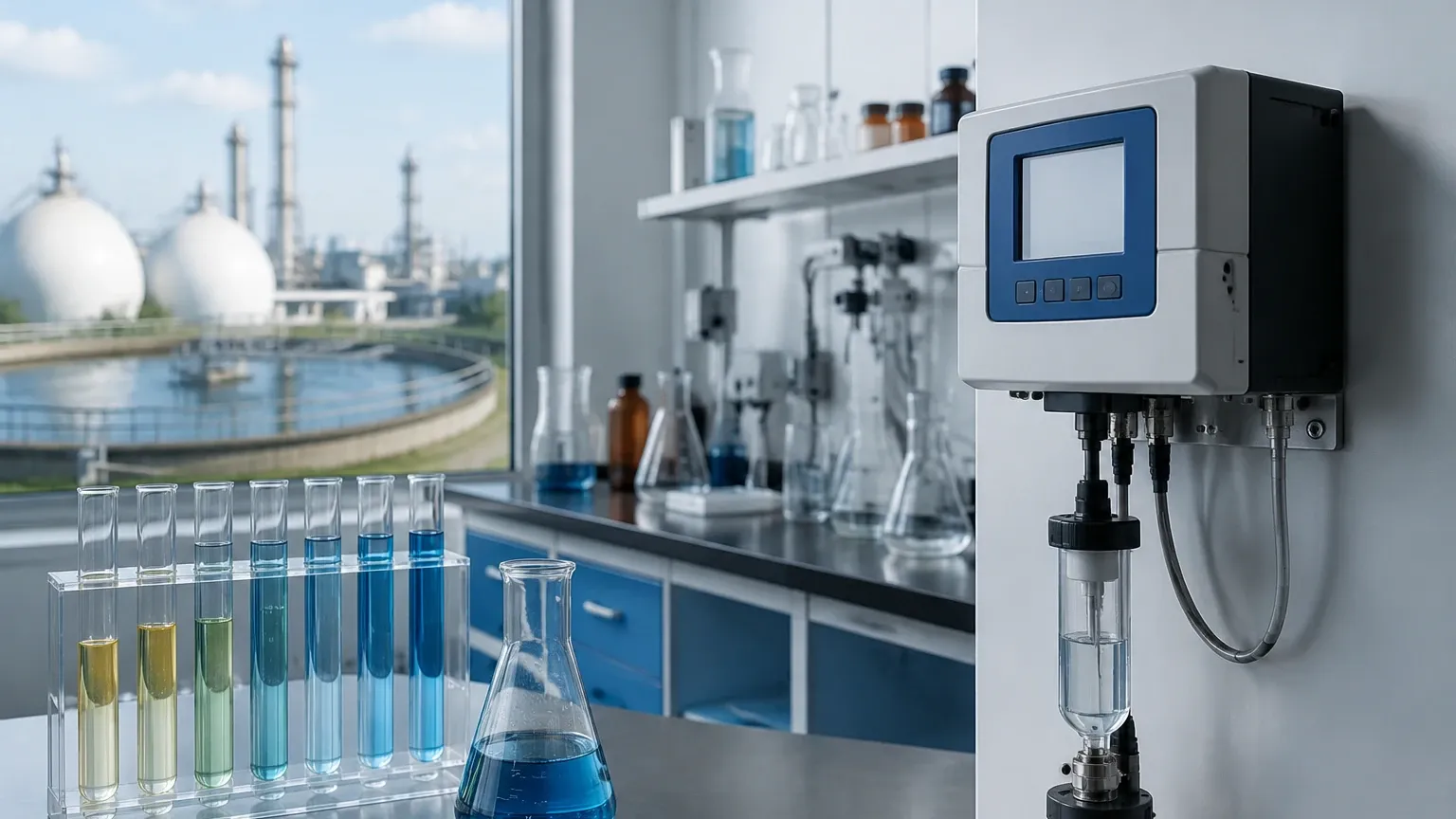
Colorimetric analyzers automate the chemical reactions used in laboratory settings. The most common method is the salicylate method. In this process, ammonia reacts with salicylate and hypochlorite in the presence of a catalyst (such as sodium nitroprusside) to form a blue-green compound. The intensity of the color is proportional to the ammonia concentration, which is measured by a photometer at a specific wavelength (typically around 650 nm to 690 nm).
This method is highly accurate and provides a true measurement of total ammonia nitrogen. However, it requires a steady supply of chemical reagents and involves a discrete sampling cycle, meaning the measurement is "continuous" only in the sense that it repeats every few minutes.
Ion-Selective Electrode (ISE) Principle
The ISE method uses a specialized membrane that is selectively permeable to ammonium ions. When the electrode is immersed in the sample, a potential difference develops across the membrane relative to a reference electrode. This potential is logarithmic to the concentration of $NH_4^+$ ions, following the Nernst equation.
Because ISEs respond only to the ionic form, the sample must often be pH-adjusted to ensure all ammonia is in the $NH_4^+$ state, or the analyzer must perform a simultaneous pH and temperature measurement to calculate the total ammonia nitrogen mathematically. ISE systems offer a faster response time than colorimetric units but are susceptible to interference from other cations, particularly potassium ($K^+$).
Gas-Sensing Electrode Principle
In this configuration, the sample is typically treated with a strong base (like sodium hydroxide) to raise the pH above 11. This converts all ammonium ions into dissolved ammonia gas. The gas diffuses through a hydrophobic membrane into an internal electrolyte solution, changing its pH. This pH shift is measured by an internal glass electrode. This method is robust against ionic interferences because only gas can pass through the membrane, making it suitable for complex industrial effluents.
Key Technologies in Online Ammonia Analysis
Modern industrial facilities require analyzers that can withstand harsh environments while maintaining high precision. The choice of technology often depends on the specific application requirements, such as the presence of suspended solids or the need for extremely low detection limits.
UV Absorption Spectroscopy
Recent advancements have led to the development of reagent-free ammonia analyzers using Ultraviolet (UV) absorption. Ammonia gas has a distinct absorption spectrum in the deep UV range. By using a flash lamp and a high-resolution spectrometer, the analyzer can determine ammonia concentration without chemical consumables. These systems are increasingly popular in municipal wastewater applications due to their low maintenance requirements, though they may require advanced filtration to handle high turbidity.
Comparison of Measurement Technologies
| Feature | Colorimetric (Salicylate) | Ion-Selective Electrode (ISE) | Gas-Sensing Electrode | UV Absorption |
| :— | :— | :— | :— | :— |
| Detection Limit | Very Low (<0.05 mg/L) | Moderate (~0.1 mg/L) | Moderate (~0.05 mg/L) | Low (~0.1 mg/L) |
| Response Time | 5–15 minutes | <2 minutes | 2–5 minutes | <1 minute |
| Reagents Required | Yes | No (or pH buffer) | Yes (Caustic) | No |
| Maintenance | High (Reagent refill) | Moderate (Calibration) | Moderate (Membrane) | Low (Cleaning) |
| Interferences | Color, Turbidity | Potassium, Sodium | Volatile Amines | Turbidity, Organics |
Selection Criteria for Industrial Applications
Choosing the right online ammonia analyzer involves balancing technical performance with the total cost of ownership. Engineering teams should evaluate the following criteria:
1. Measurement Range: Wastewater effluent usually requires a low range (0–10 mg/L), while raw sewage or chemical process streams may require ranges up to 1000 mg/L or higher.
2. Sample Matrix: If the sample contains high levels of suspended solids, a non-contact UV system or a gas-sensing system with robust filtration is preferred over a direct-immersion ISE.
3. Environmental Conditions: Analyzers located outdoors must be rated for the local temperature range. In cold climates, reagent-based analyzers require heated enclosures to prevent chemical crystallization.
4. Data Integration: Most modern analyzers provide 4-20mA analog outputs, RS485 (Modbus RTU), or Ethernet/IP for integration into a PLC or SCADA system.
Installation and Sampling Considerations
The accuracy of an online ammonia analyzer is only as good as the sample it receives. Proper installation is critical to prevent clogging and ensure the sample is representative of the process.
* Sampling Point: The intake should be located in a well-mixed area, such as the discharge side of a pump or a turbulent section of a pipe. Avoid areas where air bubbles or heavy sediment can accumulate.
* Filtration and Conditioning: For colorimetric and ISE systems, a self-cleaning bypass filter is often necessary to remove large particles that could damage the internal fluidics. If the sample temperature exceeds 40°C, a sample cooler may be required to protect the sensors.
* Distance: Keep the distance between the sampling point and the analyzer as short as possible to minimize lag time. If long distances are unavoidable, use a high-flow bypass loop to ensure fresh sample reaches the analyzer quickly.
Integration with Level Measurement and Process Control
In a complete industrial automation setup, ammonia analyzers do not operate in isolation. They are part of a broader instrumentation network that includes flow meters and level sensors. For instance, in a denitrification tank, the ammonia level dictates the rate of carbon source dosing, while level transmitters ensure that the tank does not overflow and that the reagent storage tanks are adequately supplied.
Welk provides a range of level measurement solutions that complement online analytical systems. Reliable level data is essential for managing the chemical reagents required by colorimetric ammonia analyzers. For more information on coordinating these measurement technologies, engineers can refer to the Main Page for technical specifications on ultrasonic and radar level meters that are commonly used in reagent storage and process tank management.
Furthermore, hydrostatic level transmitters are often employed in the same wastewater pits where ammonia sensors are installed. Ensuring these instruments are compatible in terms of material construction and signal output is a key step in successful system integration.
Maintenance and Troubleshooting
To ensure long-term reliability, a scheduled maintenance program is mandatory for any online ammonia analyzer.
* Calibration: Most systems require weekly or monthly calibration using a standard solution of known concentration. Automated calibration features can reduce manual labor but require additional reagent storage.
* Cleaning: Sensors immersed in wastewater are prone to biofouling. Many ISE and UV sensors include integrated wipers or air-blast cleaning systems to keep the sensing surface clear.
* Reagent Management: For colorimetric units, reagents typically have a shelf life of 3 to 6 months. It is vital to monitor the levels of these reagents; using a high-accuracy level switch or sensor in the reagent cabinet can prevent data gaps caused by empty containers.
Common Troubleshooting Steps
* Drifting Readings: Often caused by electrode exhaustion (in ISE) or light source aging (in UV/Colorimetric). Check the slope of the last calibration.
* Slow Response: Usually indicates a fouled membrane or a partially clogged sample line.
* Erratic Data: Check for air bubbles in the flow cell or electromagnetic interference (EMI) on the signal cable.
Frequently Asked Questions (FAQ)
Q: What is the difference between $NH_3-N$ and $NH_4^+$?
A: $NH_3-N$ refers to the nitrogen content derived from ammonia, which is a standard way of reporting concentration in environmental regulations. $NH_4^+$ is the ammonium ion. Most analyzers can be programmed to display results in either format, but it is important to verify which one is required for your reporting.
Q: Can an online ammonia analyzer measure urea?
A: Standard ammonia analyzers do not measure urea directly. However, if the urea is hydrolyzed into ammonia (either naturally or through an enzymatic reactor), the resulting ammonia can be measured.
Q: How does temperature affect the measurement?
A: Temperature affects both the chemical equilibrium between $NH_3$ and $NH_4^+$ and the sensitivity of the electrodes. High-quality analyzers include an integrated temperature sensor (typically a Pt100 or Pt1000) to provide automatic temperature compensation.
Q: Are these analyzers suitable for hazardous areas?
A: Yes, many manufacturers offer versions with ATEX or Class I Div 2 certifications. These typically involve purged enclosures or intrinsically safe electronics to prevent the ignition of flammable gases in chemical plants or refineries.
By understanding the chemical principles and mechanical requirements of an online ammonia analyzer, engineers can implement a monitoring solution that provides reliable data for years. Whether managing a municipal treatment plant or a complex chemical process, the integration of accurate analytical data with robust level and flow measurement remains the cornerstone of modern process control.