Float Type Level Switches
Float Type Level Switches
In the landscape of industrial automation and process control, point level detection remains a critical requirement for safety, inventory management, and operational efficiency. Among the various technologies available, float type level switches are perhaps the most established and widely utilized. These devices provide a reliable, mechanical response to liquid level changes, serving as the primary line of defense against tank overfills or dry-run conditions in pumps. As a leading manufacturer, Welk offers a range of industrial-grade Level Switches designed to withstand the rigors of chemical processing, water treatment, and oil and gas applications.
This article provides a comprehensive engineering reference for float type level switches, detailing their operating principles, design variations, selection criteria, and practical installation considerations.
Measurement Principles and Operating Mechanisms
The fundamental operation of float type level switches is based on two primary physical concepts: Archimedes' Principle of Buoyancy and magnetic (or mechanical) actuation.
The Buoyancy Principle
Archimedes' principle states that any object, wholly or partially immersed in a fluid, is buoyed up by a force equal to the weight of the fluid displaced by the object. In the context of a level switch, the "float" is designed with a lower mean density than the liquid it is intended to measure. As the liquid level rises, the buoyant force eventually exceeds the weight of the float, causing it to move upward. Conversely, as the level drops, gravity pulls the float down.
Actuation Methods
While the movement is driven by buoyancy, the signal generation occurs through one of two common methods:
1. Magnetic Reed Switch Actuation: This is the most common design for modern industrial float switches. The float contains a permanent magnet. The stationary stem (the rod the float slides along) contains a hermetically sealed reed switch. When the float’s magnetic field aligns with the reed switch, the contacts close (or open), completing an electrical circuit. This design is advantageous because the switching elements are completely isolated from the process media.
2. Mechanical Microswitch Actuation: In some larger or older designs, particularly horizontal side-mounted switches, the float is attached to a lever arm. As the float moves, the mechanical pivot actuates a microswitch located outside the process vessel. These are often used in heavy-duty applications where higher electrical current switching is required without an intermediate relay.
Common Configurations of Float Type Level Switches
Industrial applications vary significantly in terms of tank geometry and access points. Consequently, float type level switches are available in several distinct configurations.
Vertical Mount Level Switches
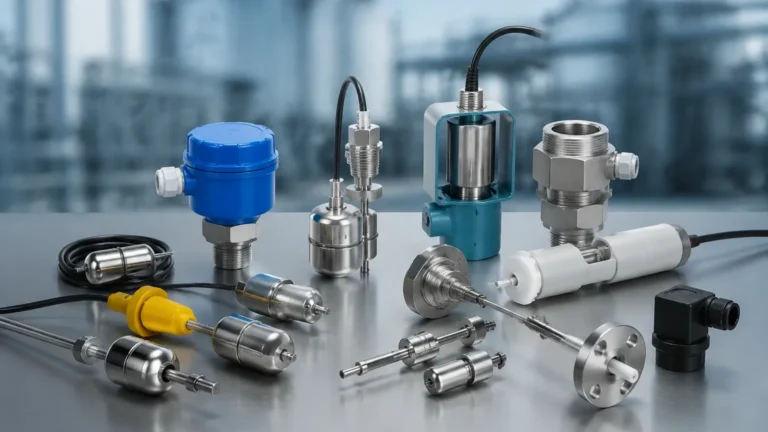
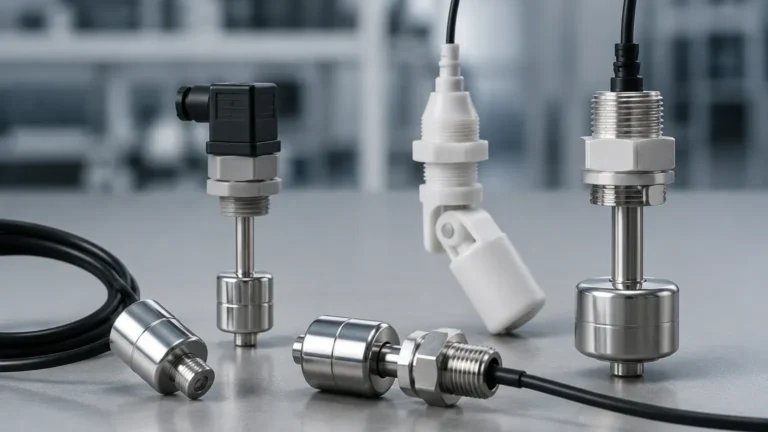
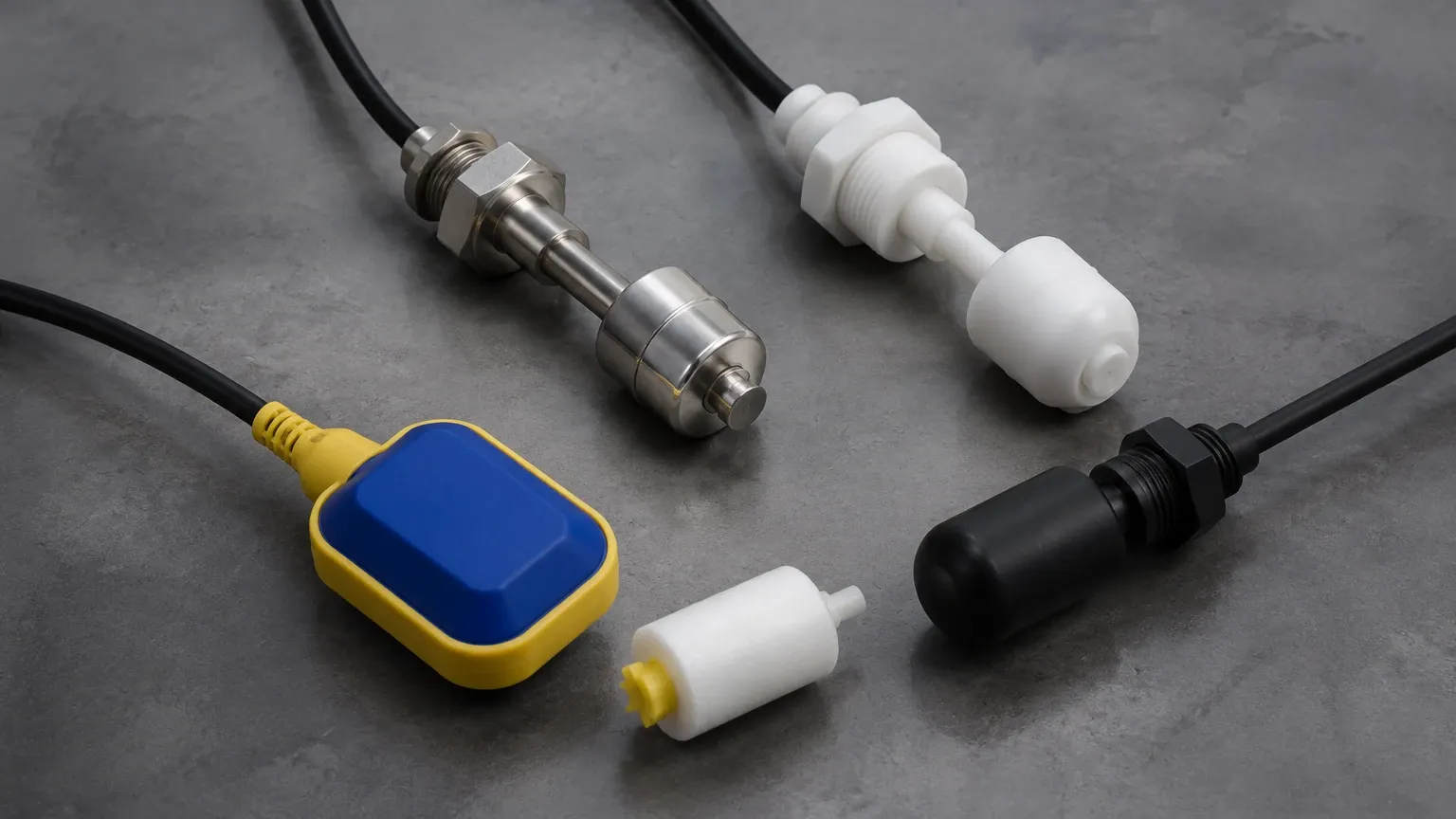
Vertical switches are typically mounted through the top or bottom of a tank. They consist of a vertical stem and one or more floats. These are ideal for deep tanks where multiple level points (e.g., high-high, high, low, and low-low) need to be monitored using a single process entry point. Multi-point vertical switches can be customized with specific spacing between the switching points to match the vessel's dimensions.
Horizontal (Side-Mount) Level Switches
Horizontal switches are installed through the side wall of a vessel. They are often used when top access is restricted or when only a single point (such as a high-level alarm) is required. The float is usually attached to a hinged arm or a flexible bellows. When the liquid reaches the float, it pivots upward, triggering the switch. These are common in small tanks, hydraulic power units, and boilers.
Cable-Suspended Float Switches
For large-scale applications like wastewater sumps or open reservoirs, cable-suspended float switches (often called "float balls") are used. The switch mechanism is encased within a waterproof, buoyant housing attached to a flexible cable. As the level rises, the housing tilts, and an internal ball or pendulum triggers a microswitch. These are valued for their simplicity and resistance to fouling in liquids containing solids.
Technical Selection Criteria
Selecting the correct float type level switches requires a detailed understanding of the process environment. Engineers must confirm several parameters before specifying a device.
Specific Gravity (SG)
For a float to function, its density must be significantly lower than the density of the liquid. Most industrial floats are designed for liquids with a specific gravity of 0.8 or higher. However, for light hydrocarbons or liquefied gases, specialized floats with high buoyancy and low mass are required. If the liquid’s SG is too low, the float will remain submerged and fail to actuate the switch.
Material Compatibility
The choice of material is dictated by the chemical nature of the fluid and the required durability:
* Stainless Steel (316L): The standard for high-pressure, high-temperature, and sanitary applications. It offers excellent resistance to many chemicals and organic solvents.
* Polypropylene (PP): A cost-effective choice for water treatment and acidic/alkaline solutions at moderate temperatures.
* PVDF/PTFE: Reserved for highly aggressive chemical environments where even stainless steel might corrode.
Pressure and Temperature Ratings
Float switches must be rated for the maximum design pressure and temperature of the vessel. Standard plastic switches may be limited to 3 bar (43 psi) and 80°C (176°F), while heavy-duty stainless steel versions can handle upwards of 40 bar (580 psi) and 200°C (392°F). High-pressure applications require thicker float walls, which in turn increases the float's weight and may affect the minimum required specific gravity.
Practical Selection Table
| Feature | Vertical Multi-Point | Horizontal Side-Mount | Cable-Suspended |
| :— | :— | :— | :— |
| Best Use Case | Multiple setpoints in one tank | Single point high/low alarm | Sumps, wastewater, large pits |
| Mounting | Top or Bottom (NPT/Flange) | Side Wall (NPT/Flange) | Suspended by cable |
| Pressure Range | Up to 40 bar (580 psi) | Up to 25 bar (362 psi) | Atmospheric/Low pressure |
| Max Temperature | Up to 200°C (392°F) | Up to 150°C (302°F) | Up to 60°C – 80°C (140°F – 176°F) |
| Media Type | Clean to slightly dirty liquids | Clean liquids | Liquids with suspended solids |
Installation and Maintenance Guidelines
Proper installation is paramount to ensuring the longevity and accuracy of float type level switches.
Avoiding Turbulence
One of the most common causes of premature failure or false alarms is liquid turbulence. If a switch is installed near a fill pipe or an agitator, the float may bounce, causing the switch to "chatter." This can lead to electrical noise and mechanical wear. In such cases, a stilling well (a perforated pipe surrounding the switch) should be used to provide a calm environment for the float.
Orientation and Clearance
For vertical switches, ensure the stem is perfectly plumb. Even a slight tilt can cause the float to bind against the stem, preventing movement. For horizontal switches, ensure there is sufficient internal clearance for the float's arc of travel. It is also critical to position the switch away from internal tank structures like baffles or heating coils.
Wiring and Electrical Protection
Float switches often use reed switches, which have limited current-carrying capacity. Switching high-inductive loads (like large pump motors) directly through a reed switch will cause the contacts to weld together. Always use an intermediate relay or a motor starter. Additionally, for hazardous areas, intrinsically safe barriers must be used to limit the energy available at the switch contacts.
Limitations and Application Risks
While float type level switches are highly reliable, they are not suitable for every application. Engineers should be aware of the following limitations:
1. Coating and Buildup: If the process liquid is highly viscous or prone to crystallization (e.g., molasses or heavy crude oil), the material can build up on the stem or the float. This increases the weight of the float or causes it to stick, leading to failure.
2. Mechanical Wear: Because these are moving parts, they are subject to mechanical fatigue over millions of cycles. Regular inspection is required in high-cycle applications.
3. Ferrous Particles: In systems where the liquid may contain iron filings or magnetic scale, these particles can be attracted to the float's internal magnet, eventually jamming the mechanism.
4. Foam: Float switches respond to the liquid level, not the foam level. If an application requires foam detection, technologies like ultrasonic or capacitance sensors are more appropriate.
Frequently Asked Questions (FAQs)
Q: Can float switches be used in hazardous (Ex) areas?
A: Yes, provided they are designed with explosion-proof housings or are connected to intrinsically safe circuits. Stainless steel models are typically preferred for these environments due to their durability and grounding capabilities.
Q: How do I change a switch from Normally Open (NO) to Normally Closed (NC)?
A: For many vertical float switches, this can be achieved by simply removing the retaining clip and flipping the float 180 degrees on the stem. This reverses the position of the internal magnet relative to the reed switch.
Q: What is the minimum specific gravity for a stainless steel float?
A: Typically, a standard 316SS float requires a specific gravity of at least 0.7 to 0.8. Specialized high-buoyancy floats can operate in liquids with an SG as low as 0.45.
Q: Are float switches affected by changes in dielectric constant or conductivity?
A: No. Unlike radar or conductive probes, float switches are purely mechanical/magnetic and are unaffected by the electrical properties of the liquid, making them very versatile for changing process media.
For engineers seeking a robust and cost-effective solution for point level control, float type level switches remain a top-tier choice. By understanding the physical requirements of the media and the mechanical constraints of the vessel, users can implement a level control system that provides years of maintenance-free service. For more technical specifications and product options, explore the full range of Level Switches offered by Welk.