Level Control Switches
Level Control Switches
In industrial process automation, maintaining the correct volume of liquids or solids within a vessel is critical for both operational efficiency and safety. Level control switches serve as the primary line of defense in point-level detection, providing discrete signals to control pumps, open or close valves, or trigger emergency alarms. Unlike continuous level transmitters that provide a constant data stream of the vessel's contents, level control switches are designed to detect when a substance reaches a specific, predetermined height.
Selecting the appropriate technology for level control switches requires a deep understanding of the physical properties of the medium, the environmental conditions of the process, and the specific requirements of the control loop. This guide examines the fundamental measurement principles, selection criteria, and installation best practices for industrial level switches.
Measurement Principles of Level Control Switches
To choose the right instrument, engineers must first understand how different technologies interact with the process media. Each principle offers distinct advantages depending on whether the medium is a liquid, a granular solid, or a slurry.
1. Buoyancy (Float Switches)
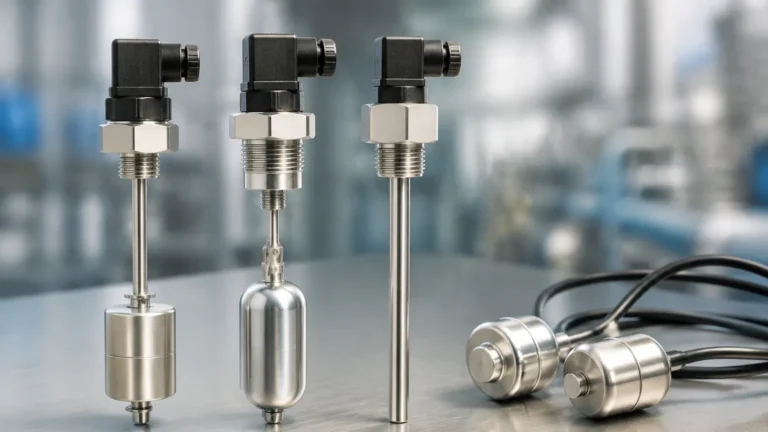
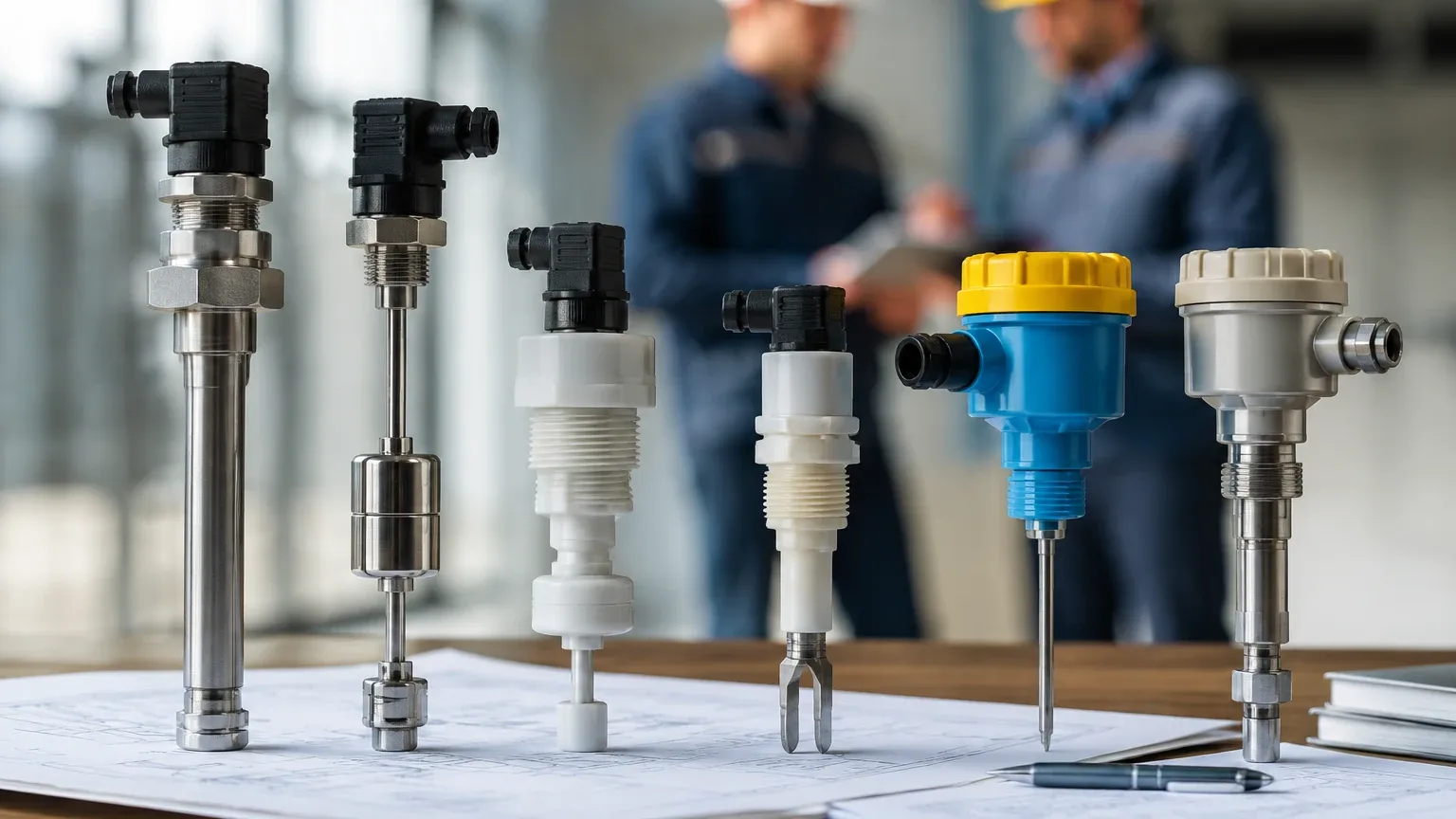
Float switches are among the most established technologies for liquid level detection. They operate on the principle of buoyancy, where a float—containing a permanent magnet—rises or falls with the liquid level. When the float reaches a specific point, the magnetic field actuates a hermetically sealed reed switch or a microswitch located within the stem or housing.
These switches are highly reliable for clean, non-coating liquids. They are often used in water treatment and fuel storage. However, they are susceptible to mechanical failure if the medium contains debris or is highly viscous, which can cause the float to stick.
2. Vibrating Point Level (Tuning Fork)
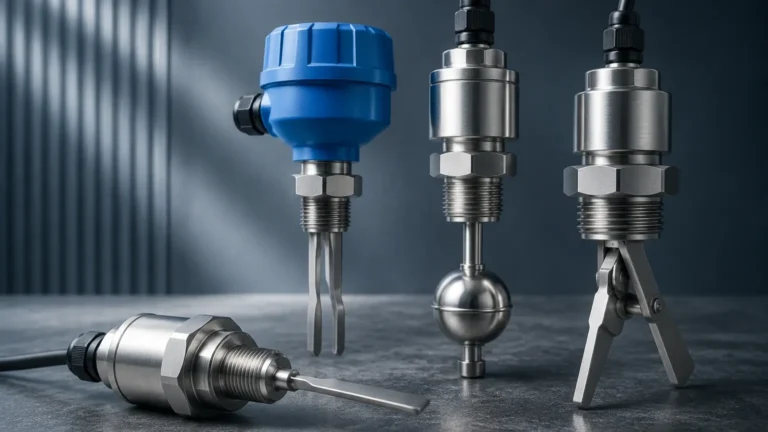
Vibrating level switches, often referred to as tuning forks, utilize a piezoelectric crystal to vibrate two tines at their natural resonant frequency in air. When the tines are covered by a liquid or solid, the frequency of vibration changes or stops entirely. This shift is detected by the internal electronics and converted into a switching signal.
This technology is exceptionally versatile because it is largely unaffected by the dielectric constant, density, or conductivity of the medium. It is a preferred choice for "fail-safe" high-level alarms because the electronics can detect if the vibration has stopped due to a component failure or the presence of the medium.
3. Capacitance Level Switches
Capacitance switches measure the electrical capacitance between a sensing electrode (the probe) and the vessel wall (the ground). The medium acts as a dielectric. As the level rises and covers the probe, the capacitance increases because the dielectric constant of the medium is higher than that of air.
Modern capacitance switches often include "active shield" technology to ignore material buildup on the probe, making them suitable for sticky liquids or powders. They are effective in high-pressure and high-temperature environments but require calibration based on the specific dielectric constant of the material.
4. Conductive Level Switches
Conductive switches are used exclusively with conductive liquids, such as water, acids, or alkalis. The system uses a low-voltage, low-current circuit between two electrodes or an electrode and the tank wall. When the liquid touches the electrode, it completes the circuit. Because they have no moving parts, they are highly durable, though they cannot be used with oils or non-conductive hydrocarbons.
5. Ultrasonic Level Switches
Ultrasonic switches use a pair of crystals (a transmitter and a receiver) separated by a small gap. When the gap is filled with air, the ultrasonic signal cannot pass efficiently. When liquid fills the gap, the signal is transmitted across, triggering the switch. These are ideal for highly corrosive or ultrapure liquids where contact with moving parts must be avoided.
Selection Criteria for Industrial Applications
Choosing the correct Level Switches involves evaluating the physical and chemical properties of the process. The following table provides a comparison of common technologies based on typical application requirements.
Level Switch Technology Comparison Table
| Technology | Suitable Media | Max Temperature (Typical) | Max Pressure (Typical) | Key Advantage |
| :— | :— | :— | :— | :— |
| Float | Clean Liquids | 150°C (302°F) | 40 bar (580 psi) | Simple, no power required |
| Vibrating Fork | Liquids, Powders | 250°C (482°F) | 64 bar (928 psi) | Maintenance-free, fail-safe |
| Capacitance | Liquids, Solids, Slurries | 400°C (752°F) | 100 bar (1450 psi) | Handles high temp/pressure |
| Conductive | Conductive Liquids | 100°C (212°F) | 10 bar (145 psi) | Low cost, multi-point |
| Optical | Clean Liquids | 125°C (257°F) | 50 bar (725 psi) | Compact, fast response |
Critical Evaluation Factors
1. Media Viscosity and Coating: If the material is prone to leaving a film (like honey or heavy oil), vibrating forks or capacitance switches with buildup compensation are necessary. Float switches will likely fail in these conditions.
2. Chemical Compatibility: The wetted parts (316L stainless steel, PTFE, PP, or Hastelloy) must be compatible with the process fluid to prevent corrosion and premature failure.
3. Hazardous Areas: For oil and gas or chemical processing, switches must be rated for explosive atmospheres (ATEX, IECEx, or UL/CSA Class I, Div 1).
4. Process Connections: Standard threaded connections (NPT/G) are common for small vessels, while flanged connections (ANSI/DIN) are preferred for high-pressure industrial tanks.
Installation Considerations and Best Practices
Proper installation is as important as selecting the right technology. Even the most advanced level control switches will provide false readings if installed incorrectly.
Orientation
Most level switches can be mounted either horizontally (side-mounted) or vertically (top-mounted).
* Horizontal Mounting: Ideal for point-level detection at a specific height. Ensure the tines of a vibrating fork are oriented vertically so that material can drain off them easily.
* Vertical Mounting: Often used for high-level alarms or in tanks where side access is restricted. Long probes may require support if the tank experiences high agitation.
Avoiding Interference
Avoid installing switches directly in the path of the tank's inlet stream. The falling material can cause false triggering or mechanical damage to the probe. If the tank contains an agitator, the switch should be positioned to avoid the vortex or high-velocity zones. Stilling wells can be used to protect the switch from turbulence and foam.
Wiring and Enclosures
In outdoor or wash-down environments, ensure the cable entry points face downward to prevent moisture from entering the housing via the conduit. Using a "drip loop" in the wiring is a standard engineering practice to redirect condensation away from the instrument head.
Limitations and Common Risks
While level control switches are robust, they are not universal solutions. Engineers should be aware of the following risks:
* Foam Interference: Some technologies, like ultrasonic and certain capacitance switches, may struggle to distinguish between liquid and dense foam. In these cases, vibrating forks tuned for liquid density are usually more reliable.
* Turbulence: High-velocity splashing can lead to "chatter," where the switch rapidly toggles on and off. This can be mitigated using electronics with adjustable delay timers (typically 0.5 to 10 seconds).
* Material Buildup: In solids applications, "bridging" or "rat-holing" can occur, where material clings to the walls or the sensor even when the level has dropped. Selecting a switch with a high sensitivity adjustment or a specialized probe geometry is essential for these scenarios.
Frequently Asked Questions (FAQs)
Q: Can a level switch be used for continuous level measurement?
No. A level switch only provides a binary (on/off) signal. For continuous data (e.g., 0–100% full), you must use a level transmitter, such as a radar or hydrostatic sensor.
Q: What is the difference between NPN/PNP and Relay outputs?
NPN and PNP are transistor outputs used for high-speed switching and direct connection to PLCs. Relay outputs (SPDT/DPDT) are used for switching higher current loads, such as small motors or heavy-duty solenoids, but have a slower response time and a finite mechanical life.
Q: How often should level control switches be calibrated?
Mechanical switches like floats rarely require calibration but need regular inspection for mechanical wear. Electronic switches like capacitance probes should be checked annually, especially if the dielectric constant of the process media changes.
Q: Is it possible to detect the interface between two liquids (e.g., oil and water)?
Yes, certain capacitance and float switches (with weighted floats) are specifically designed for interface detection. The sensor is tuned to ignore the top layer (oil) and only trigger when it contacts the bottom layer (water).
Conclusion
Level control switches are fundamental components in modern industrial systems, providing critical safety and process control functions. By understanding the specific measurement principles—from the simplicity of buoyancy to the precision of vibrating forks—and adhering to rigorous installation standards, facilities can ensure long-term reliability and minimize downtime. When selecting a device, always confirm the process temperature, pressure, and chemical compatibility to ensure the chosen instrument is fit for purpose.