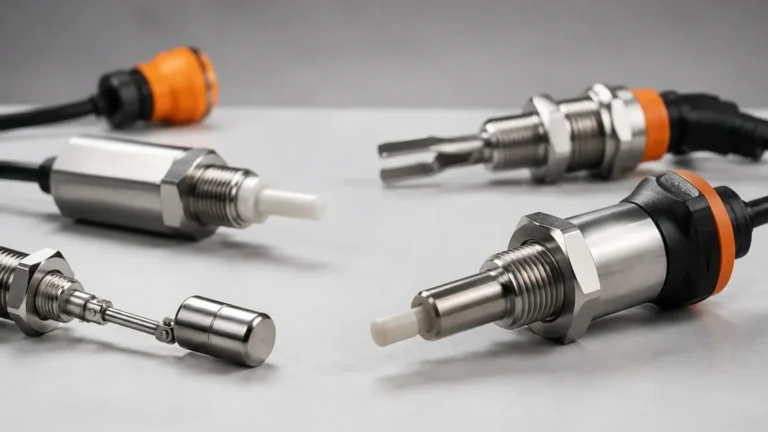
Vibrating Tuning Fork Level Switches
Vibrating Tuning Fork Level Switches
In the field of industrial process control, point level detection is a critical function for preventing tank overfills, protecting pumps from dry running, and managing inventory in silos. Among the various technologies available, vibrating tuning fork level switches have emerged as one of the most versatile and reliable solutions. These instruments are designed to detect the presence or absence of liquids or solids at a specific height, providing a digital output to control systems.
As a professional manufacturer, Welk provides advanced level measurement instruments tailored for demanding environments. Understanding the engineering principles behind vibrating tuning fork level switches is essential for selecting the correct instrument for water treatment, chemical processing, or oil and gas applications.
Measurement Principle of Vibrating Tuning Fork Level Switches
The operation of a vibrating tuning fork level switch is based on the principle of frequency shift caused by the change in damping when the sensor element is immersed in a medium.
Piezoelectric Excitation
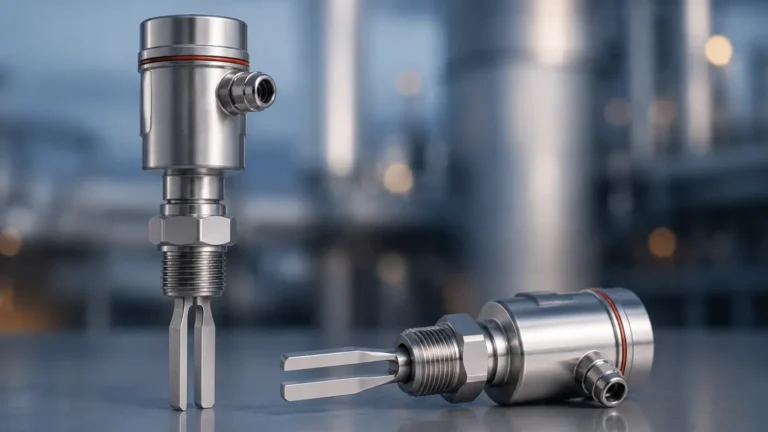
The sensor consists of a tuning fork—a pair of metal tines—that is vibrated at its natural resonant frequency by a set of piezoelectric crystals located within the housing. One crystal acts as the transmitter, converting electrical energy into mechanical vibration, while the other acts as a receiver to monitor the frequency and amplitude of the vibration.
Frequency Shift and Detection
When the tuning fork is in the air (the "dry" state), it vibrates at its natural resonant frequency, which is typically around 1,200 Hz to 1,400 Hz for liquid applications and lower for solids. As the material level rises and covers the tines (the "wet" state), the density of the medium increases the mass of the vibrating system, causing the resonant frequency to drop significantly.
Internal electronics continuously monitor this frequency. Once the shift crosses a predefined threshold, the instrument triggers a relay or a transistor output (such as PNP/NPN) to signal the change in level. This method is highly immune to changes in pressure, temperature, foam, bubbles, or the dielectric constant of the material, making it superior to many capacitive or ultrasonic switches in complex environments.
Key Features and Advantages
Vibrating tuning fork level switches are preferred in modern industrial automation due to several inherent design benefits:
1. No Moving Parts: Unlike float switches or paddle wheels, there are no mechanical linkages to wear out or jam, resulting in a significantly longer service life and reduced maintenance requirements.
2. Independent of Media Properties: The switch is largely unaffected by the electrical properties of the liquid (conductivity or dielectric constant), turbulence, or the presence of bubbles and foam.
3. Compact Design: Small fork dimensions allow for installation in tight spaces and small-diameter pipes for pump protection.
4. Self-Monitoring: Many advanced units can detect damage to the tines or internal electronic failure, providing a fail-safe signal to the control room.
5. High Temperature and Pressure Resilience: Standard models often handle process temperatures from -40°C to 150°C (-40°F to 302°F) and pressures up to 40 bar (580 psi), with specialized versions exceeding these limits.
Selection Criteria for Industrial Applications
Choosing the right instrument requires a detailed analysis of the process media and the environmental conditions. When evaluating Level Switches, engineers must consider the following factors:
Media Density
The sensitivity of the tuning fork is calibrated based on the density of the material. For liquid switches, a minimum density of 0.5 g/cm³ (500 kg/m³) is standard. For solids, such as powders or granules, the fork design is usually larger to accommodate lower densities, sometimes detecting materials as light as 0.01 g/cm³.
Viscosity and Coating
While tuning forks are resistant to minor buildup, highly viscous liquids (above 10,000 mPa·s) can damp the vibration even when the level has dropped, leading to a false "full" signal. In such cases, specialized fork coatings or polished surfaces may be required to facilitate material shedding.
Material Compatibility
The wetted parts are typically constructed from 316L stainless steel, but for corrosive chemical applications, materials like Hastelloy, Monel, or plastic coatings (PFA/ETFE) are necessary to prevent chemical attack.
Practical Selection Table
The following table provides a general guideline for selecting between liquid and solid variants of vibrating tuning fork level switches.
| Feature | Liquid Tuning Fork | Solid Tuning Fork (Granules/Powder) |
| :— | :— | :— |
| Typical Frequency | 1,000 – 1,400 Hz | 85 – 150 Hz |
| Minimum Density | 0.5 g/cm³ (Standard) | 0.01 – 0.1 g/cm³ |
| Max Viscosity | 10,000 mPa·s | N/A (Flowability is key) |
| Common Applications | Overfill protection, pump dry-run | Silo high/low alarm, blockage detection |
| Fork Size | Compact (approx. 40mm – 100mm) | Large (approx. 100mm – 200mm) |
| Sensitivity Adjustment | Usually fixed | Often adjustable for light powders |

Installation Considerations
Proper installation is critical to ensure the reliability of the level switch and to prevent premature failure. Engineers should adhere to the following guidelines:
Orientation and Positioning
* Side Mounting: When installed horizontally, the tines should be oriented so that the flat surfaces are vertical (perpendicular to the ground). This prevents material from resting on the tines and causing a false trigger.
* Top Mounting: For high-level alarms, the switch is mounted vertically. Ensure the fork length is sufficient to reach the desired trigger point, accounting for any nozzles or standpipes.
Avoiding Flow Streams
The tuning fork should not be placed directly in the path of a heavy inflow of material. The mechanical force of falling solids or high-velocity liquid can damage the tines or cause excessive wear. If the location is unavoidable, a protective baffle or shield should be installed above the fork.
Cable Gland Orientation
To prevent moisture ingress into the electronics housing, the cable gland should always point downward. If the switch is mounted horizontally, create a "drip loop" in the cable to ensure water runs off the cable before reaching the entry point.
Nozzle Clearance
If the switch is installed in a mounting nozzle, the fork tines must extend fully into the vessel. If the tines remain inside the nozzle, material can become trapped (bridging), leading to inaccurate readings.
Limitations and Prohibitions
While vibrating tuning fork level switches are highly robust, they are not suitable for every application. Understanding these limitations prevents operational failures:
* Extreme Buildup and Bridging: In applications with very sticky media (e.g., wet clay or thick resins) that can bridge the gap between the two tines, the vibration will be permanently damped. In these scenarios, a single-rod vibrating probe or a microwave switch may be more appropriate.
| Large Particle Size: For solids, if the grain size is larger than the gap between the tines, mechanical jamming can occur.
* Strong Vibration: If the vessel itself is subject to heavy mechanical vibration at a frequency close to the fork's resonant frequency, it may cause interference. High-quality switches use frequency-shifting logic to mitigate this, but it remains a consideration for heavy machinery installations.
Frequently Asked Questions (FAQs)
Q: Do vibrating tuning fork level switches require calibration?
A: Generally, no. Most liquid tuning forks are factory-calibrated to work with any liquid above a certain density. For solids, some units feature a sensitivity adjustment (potentiometer or switch) to fine-tune the response for extremely light powders.
Q: Can these switches be used in vacuum tanks?
A: Yes. Since the measurement principle relies on mechanical vibration and not air pressure or sound waves, tuning forks function perfectly in vacuum conditions, provided the process connection and housing seals are rated for vacuum service.
Q: What is the difference between "Fail-Safe High" and "Fail-Safe Low"?
A: This refers to the state the relay takes during a power failure or sensor fault. Fail-Safe High (FSH) is used for overfill protection; the relay de-energizes when the level is high or power is lost. Fail-Safe Low (FSL) is used for dry-run protection, de-energizing when the level is low or power is lost.
Q: Are they suitable for hygienic applications?
A: Yes, many vibrating tuning fork switches are available with polished stainless steel forks and hygienic connections (like Tri-Clamp) specifically for the food, beverage, and pharmaceutical industries.
Conclusion
Vibrating tuning fork level switches represent a pinnacle of reliability for point level detection in modern industry. By understanding the interaction between the fork's resonant frequency and the process media, engineers can implement a maintenance-free solution that enhances plant safety and efficiency. Whether managing water treatment facilities or complex chemical reactors, selecting the appropriate fork material and configuration is the first step toward robust automation.