Ammonia Sensor Water
Ammonia Sensor Water
In industrial water treatment and process engineering, monitoring ammonia levels is a critical requirement for regulatory compliance, environmental protection, and process efficiency. Ammonia ($NH_3$) and its ionized form, ammonium ($NH_4^+$), collectively known as Total Ammonia Nitrogen (TAN), are prevalent in municipal wastewater, chemical manufacturing, and aquaculture. Selecting the correct ammonia sensor for water applications requires a deep understanding of the chemical equilibrium of ammonia, the specific measurement technologies available, and the environmental conditions of the installation site.
This guide provides a comprehensive technical overview of ammonia sensing technologies, selection criteria, and practical installation strategies for industrial professionals.
Measurement Principles of Ammonia Sensors
Before selecting an ammonia sensor for water, it is essential to understand how these instruments detect the target analyte. Ammonia in water exists in a pH-dependent equilibrium:
$$NH_3 + H_2O \rightleftharpoons NH_4^+ + OH^-$$
At a low pH (acidic), ammonia exists almost entirely as the ammonium ion ($NH_4^+$). As the pH increases (alkaline), it shifts toward the unionized ammonia gas ($NH_3$) form. Because different sensors detect different forms, the measurement principle dictates the sensor's suitability for a specific process.
1. Ion-Selective Electrodes (ISE)
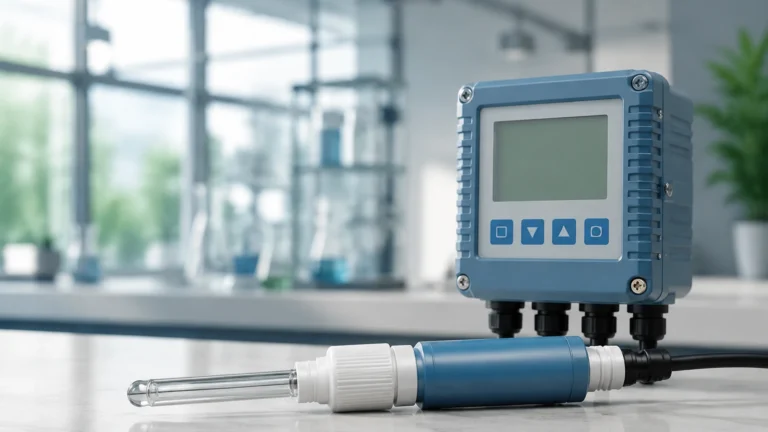
Ion-selective electrodes are the most common tool for continuous online monitoring. They function similarly to a pH probe but are designed with a membrane selective to the ammonium ion ($NH_4^+$).
* Mechanism: The sensor measures the potential difference across a specialized membrane. As ammonium ions interact with the membrane, a voltage is generated relative to a reference electrode.
* Compensation: Since ISE sensors only detect $NH_4^+$, they must be paired with a pH sensor and a temperature sensor. The transmitter uses these inputs to calculate the Total Ammonia Nitrogen (TAN) based on the known equilibrium constants.
* Advantages: Real-time data, relatively low cost, and no reagent requirements.
2. Gas-Sensing Electrodes
Gas-sensing ammonia sensors involve a hydrophobic gas-permeable membrane that separates the sample water from an internal electrolyte solution.
* Mechanism: The sample's pH is typically raised (via reagent injection) to convert all ammonium to dissolved ammonia gas. The gas passes through the membrane and changes the pH of the internal electrolyte, which is then measured by an internal pH electrode.
* Advantages: This method is less sensitive to ionic interference (like potassium) compared to standard ISE sensors.
3. Colorimetric (Spectrophotometric) Analyzers
Automated colorimetric analyzers use chemical reagents to produce a color change proportional to the ammonia concentration.
* Mechanism: Common methods include the Nessler method (producing a yellow/brown color) or the Phenate method (producing a blue color, known as the Indophenol Blue method). An optical cell measures the light absorbance at a specific wavelength.
* Advantages: Extremely high accuracy and sensitivity, often used as the "gold standard" for regulatory reporting.
* Limitations: High maintenance due to reagent consumption and mechanical complexity.
Selection Criteria for Ammonia Sensors in Industrial Water
Choosing the right ammonia sensor for water depends on the specific demands of the application. Engineers must evaluate the following factors:
Sensitivity and Range
In wastewater effluent monitoring, sensors must detect low concentrations (0.1 to 10 mg/L). In contrast, raw sewage or industrial process water may require ranges up to 500 or 1,000 mg/L. ISE sensors generally offer a wide dynamic range but may lose accuracy at the extreme low end.
Interference Ions
ISE sensors are susceptible to interference from ions with similar charge and size. For ammonium sensors, potassium ($K^+$) is the primary interferent. If the potassium concentration is high or fluctuating, an ISE sensor may provide false-high readings unless a potassium compensation electrode is used.
Maintenance Requirements
In B2B environments, the Total Cost of Ownership (TCO) is heavily influenced by maintenance. Colorimetric analyzers require monthly reagent refills and tubing replacements. ISE sensors require periodic calibration and membrane replacement (typically every 6 to 12 months).
Practical Selection Table
| Technology | Typical Range | Accuracy | Maintenance | Best Application |
| :— | :— | :— | :— | :— |
| Ammonium ISE | 0.1–1,000 mg/L | ±5% | Moderate (Calibration) | Aeration tanks, wastewater |
| Gas-Sensing | 0.05–500 mg/L | ±3% | High (Reagents/Membrane) | Laboratory, clean water |
| Colorimetric | 0.01–100 mg/L | ±2% | Very High (Reagents) | Effluent monitoring, drinking water |
| UV Absorption | 0.5–100 mg/L | ±5% | Low (No reagents) | High-load industrial water |
Installation Considerations
Proper installation is as important as the sensor technology itself. Poor placement can lead to sluggish response times or premature sensor failure.
1. Flow Velocity: For ISE sensors, a minimum flow velocity of 0.3 m/s (approx. 1 ft/s) is recommended to prevent the buildup of solids on the membrane while ensuring a fresh sample reaches the sensing surface.
2. Submersion Depth: Sensors should be submerged deep enough to avoid surface turbulence and air bubbles, which can interfere with the membrane interface. However, they should not be placed so deep that they sit in the sludge layer at the bottom of a tank.
3. Orientation: Most ammonia sensors should be installed at an angle (typically 45 degrees) with the sensing end pointing downstream. This orientation allows the flow to naturally "sweep" the membrane, reducing fouling.
4. Temperature Stability: Ammonia equilibrium is highly temperature-dependent. Ensure the sensor has integrated temperature compensation and, if possible, install it in a location with relatively stable process temperatures.
Limitations and Common Risks
While modern ammonia sensors for water are robust, they are not "set and forget" devices. Users should be aware of the following risks:
* Biofouling: In wastewater applications, biological growth (biofilm) can coat the sensor membrane. This creates a micro-environment where ammonia levels differ from the bulk liquid, leading to significant errors. Integrated cleaning systems (such as compressed air or mechanical wipers) are highly recommended.
* Chemical Compatibility: Industrial processes involving strong oxidizers or specific solvents can degrade the ion-selective membranes or the sensor body materials (e.g., PVC or PEEK).
* Calibration Drift: All electrochemical sensors experience drift. A rigorous calibration schedule using standard solutions of known concentrations is necessary to maintain B2B quality standards.

Integration with Industrial Automation
In a modern industrial facility, an ammonia sensor does not operate in isolation. It is part of a broader instrumentation ecosystem that includes flow meters and level measurement devices. For instance, in a sequencing batch reactor (SBR), ammonia sensors work alongside level transmitters to determine the timing of aeration and decanting cycles.
As a professional manufacturer of industrial measurement instruments, Welk provides the foundational level and pressure sensing technology required to manage these complex water treatment systems. For more information on how to integrate high-precision instrumentation into your process, visit our Main Page to review product options and application support.
Frequently Asked Questions (FAQs)
Q: How often should I calibrate my ammonia sensor?
A: For most industrial ISE sensors, a weekly calibration check is recommended, with a full calibration performed once a month or if the check shows a deviation of more than 10%.
Q: Can ammonia sensors be used in saltwater?
A: Yes, but with caution. High salinity increases the ionic strength of the water, which can affect ISE readings. Specific saltwater-calibrated probes or gas-sensing electrodes are preferred for aquaculture and marine applications.
Q: What is the difference between $NH_3$ and $NH_4-N$?
A: $NH_3$ refers specifically to the unionized gas molecule. $NH_4-N$ (Ammonia-Nitrogen) refers to the weight of the nitrogen atom within the ammonia or ammonium molecule. Most regulatory standards and industrial sensors report in $NH_4-N$ or TAN (Total Ammonia Nitrogen) to maintain consistency.
Q: Do I need a separate pH sensor?
A: If you are using an ISE sensor to measure Total Ammonia, yes. The ratio of $NH_3$ to $NH_4^+$ changes drastically with pH. Without a live pH input, the transmitter cannot accurately calculate the total concentration.
Conclusion
Deploying an ammonia sensor for water is a strategic decision that impacts both operational costs and environmental compliance. By understanding the measurement principles—whether ISE, gas-sensing, or colorimetric—and accounting for factors like potassium interference and biofouling, engineers can select a solution that provides reliable, long-term data. When combined with robust level and flow instrumentation, these sensors enable precise control over the most demanding industrial water processes.