API 2350 5th Edition Overfill Prevention Process Opp
API 2350 5th Edition Overfill Prevention Process Opp
In the industrial landscape of petroleum and chemical storage, the risk of a tank overfill represents one of the most significant threats to safety, environmental integrity, and operational continuity. The American Petroleum Institute (API) Standard 2350, specifically the 5th edition, provides the definitive framework for preventing these incidents. Central to this standard is the api 2350 5th edition overfill prevention process opp, a comprehensive methodology that integrates hardware, software, and human management systems to ensure that tank levels never exceed safe limits.
For engineers and facility managers, understanding the nuances of the Overfill Prevention Process (OPP) is not merely a matter of compliance but a critical step in risk mitigation. This article explores the technical requirements of the 5th edition, the categorization of storage tanks, and the selection of level measurement technologies required to build a robust safety system.
Introduction to API 2350 5th Edition and the Overfill Prevention Process (OPP)
API 2350 applies to atmospheric storage tanks that store Class I and Class II liquids (flammable and combustible liquids). The 5th edition, released to modernize safety protocols, shifted the focus from simple hardware requirements to a more holistic "Management System" approach.
The Overfill Prevention Process (OPP) is defined as the set of procedures and equipment used to prevent a tank from being filled beyond its safe capacity. Unlike previous iterations that focused heavily on the "High-High" level alarm, the 5th edition emphasizes the Overfill Management System (OMS). This system requires documented procedures for tank operations, including the calculation of response times, the definition of tank levels, and the formal training of personnel.
The OPP is essentially the operational arm of the OMS. It dictates how level data is gathered, how alarms are communicated, and how emergency shutdowns are executed. To understand how to implement this, one must first look at the categorization of tanks defined by the standard.
The Three Categories of Tank Overfill Prevention
API 2350 5th Edition classifies tanks into three distinct categories based on the level of automation and the presence of independent safety systems. Each category has different requirements for the OPP.
Category 1: Manual Overfill Prevention
These are tanks where the overfill prevention relies entirely on manual intervention. The operator monitors the level (often via a mechanical gauge) and manually stops the receipt of product. Under the 5th edition, Category 1 tanks require a high level of administrative control and are generally discouraged for high-turnover or high-risk facilities.
Category 2: Integrated Systems
Category 2 tanks utilize an automatic tank gauging (ATG) system that provides level data to the operator. This system must include an independent high-level alarm (HLA) that is separate from the primary level transmitter. While the alarm is automated, the shutdown process may still be manual, requiring an operator to close valves or stop pumps upon receiving the alert.
Category 3: Automated Overfill Prevention Systems (AOPS)
Category 3 represents the highest level of safety. These tanks are equipped with an Automated Overfill Prevention System (AOPS) that is completely independent of the ATG used for inventory management. If the level reaches the critical "High-High" point, the AOPS automatically triggers a safety instrumented function (SIF) to terminate the flow of liquid without human intervention. This is often aligned with SIL (Safety Integrity Level) ratings under IEC 61511.
Core Components of an Effective Overfill Prevention Process (OPP)
Implementing an api 2350 5th edition overfill prevention process opp requires a detailed analysis of four specific tank levels:
1. Maximum Working Level (MWL): The highest level to which a tank is normally filled during routine operations.
2. High Level (HL): The point at which the first alarm is triggered, notifying the operator that the tank is reaching capacity.
3. High-High Level (HHL): The critical trigger point for the overfill prevention system. This level must be calculated to allow sufficient "Response Time."
4. Critical High Level (CHL): The point at which an overfill occurs, potentially leading to a spill or tank damage.
The "Response Time" is the most critical calculation in the OPP. It must account for the time required for valves to close, pumps to spin down, and the momentum of the fluid in the pipeline to dissipate. API 2350 5th edition mandates that this time be physically verified and documented.
Level Measurement Technologies for API 2350 Compliance
To meet the requirements of the OPP, instrumentation must be reliable, accurate, and capable of operating in hazardous environments. Before selecting a device, it is essential to understand the measurement principles used in modern industrial Main Page solutions.
1. Radar Level Meters (FMCW and Pulsed)
Radar technology is the gold standard for API 2350 compliance, particularly for Category 2 and 3 tanks.
* Principle: Radar meters emit electromagnetic waves (typically in the 24GHz or 80GHz range). The waves reflect off the liquid surface and return to the sensor. By measuring the Time of Flight (ToF) or the frequency shift (FMCW), the device calculates the distance to the product.
* Suitability: Because radar is non-contact, it is unaffected by changes in density, pressure, or temperature. High-frequency 80GHz radar is particularly effective in tanks with internal obstructions or heavy vapor blankets.
2. Guided Wave Radar (GWR)
* Principle: GWR uses a probe (rod or cable) to guide the microwave signal to the liquid surface.
* Suitability: It is highly effective for liquids with low dielectric constants and in applications where foam might dissipate a non-contact radar signal. It is frequently used for independent high-high level switching.
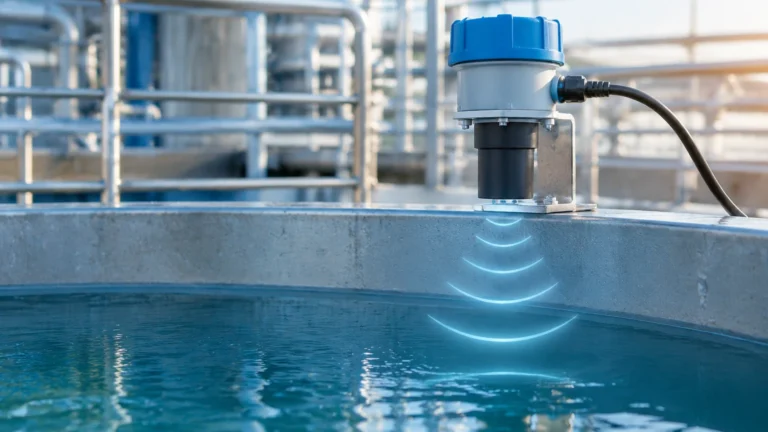
3. Ultrasonic Level Sensors
* Principle: These sensors emit sound pulses that reflect off the surface.
* Suitability: While cost-effective, they are generally limited to water-based liquids and atmospheric tanks without heavy vapors or foam. They are often used in Category 1 or 2 auxiliary tanks.
4. Tuning Fork Level Switches
* Principle: A fork-shaped sensor vibrates at its resonant frequency. When the liquid covers the fork, the frequency changes, triggering a relay.
* Suitability: These are ideal for the independent "High-High" alarm required in Category 2 and 3 systems because they provide a simple, fail-safe point measurement.
Selection Criteria for Overfill Prevention Instrumentation
When designing an OPP, the selection of the level meter depends on the specific process conditions. The following table provides a general guideline for technology selection:
| Feature | Radar (80GHz) | Guided Wave Radar | Ultrasonic | Tuning Fork Switch |
| :— | :— | :— | :— | :— |
| Measurement Type | Continuous | Continuous | Continuous | Point Level |
| Accuracy | ±1 mm to ±2 mm | ±2 mm | ±5 mm to ±10 mm | N/A (Point) |
| Vapor/Steam Resistance | Excellent | Good | Poor | Excellent |
| Foam Resistance | Moderate | Good | Poor | Excellent |
| Independent Alarm Use | Primary/Secondary | Primary/Secondary | Primary | Secondary (HHL) |
| Max Range | Up to 100m (328ft) | Up to 75m (246ft) | Up to 15m (49ft) | N/A |

Installation and Calibration Best Practices
Even the most advanced radar level meter will fail to meet API 2350 standards if installed incorrectly. For a successful api 2350 5th edition overfill prevention process opp, consider the following:
* Nozzle Placement: For non-contact radar, ensure the nozzle is not too close to the tank wall to avoid false reflections (multipath interference). The nozzle should be perpendicular to the liquid surface.
* Stilling Wells: In tanks with significant turbulence or internal structures (like heating coils), installing the level meter inside a stilling well or bypass pipe is recommended to ensure a stable surface reading.
* Independence: For Category 3 systems, the AOPS sensor must be physically independent of the ATG. This means using a separate tank penetration (nozzle) and separate power/signal wiring to ensure that a single point of failure cannot disable both systems.
* Environmental Protection: Level meters should be rated for the hazardous zone (ATEX/IECEx) and equipped with sunshades if installed in extreme climates to prevent electronics overheating.
Proof Testing and Maintenance Requirements
API 2350 5th edition places a heavy emphasis on the lifecycle of the overfill prevention system. It is not enough to install the equipment; it must be regularly tested to ensure it will function during an actual overfill event.
1. Proof Testing: This involves a functional test of the entire loop—from the sensor to the alarm/logic solver to the final control element (valve). The standard requires that these tests be performed at scheduled intervals, typically annually, or as defined by the risk assessment.
2. Calibration Verification: Continuous level transmitters should be checked against manual hand-gauging (using a steel tape) to ensure accuracy. API 2350 allows for a specific tolerance between the ATG and the manual gauge.
3. Documentation: The 5th edition requires meticulous record-keeping. Every alarm, every test, and every maintenance action must be logged as part of the Overfill Management System.
Limitations and Considerations
While the api 2350 5th edition overfill prevention process opp significantly reduces risk, it is not infallible.
* Human Factors: The 5th edition acknowledges that human error is a leading cause of overfills. If an operator ignores an HLA or overrides an AOPS, the hardware cannot prevent the spill.
* Media Properties: Changes in the dielectric constant of the liquid can affect the signal strength of radar meters. Similarly, high-viscosity liquids can cause "bridging" on tuning fork switches.
* Mechanical Failure: Automated valves can seize if not exercised regularly. The OPP must include a maintenance schedule for these mechanical components.
Frequently Asked Questions (FAQs)
Q: Does API 2350 apply to pressurized tanks?
A: No, API 2350 specifically covers atmospheric tanks. For pressurized vessels (like LPG bullets), other standards such as API 2510 or local pressure vessel codes apply.
Q: Can I use the same sensor for inventory management and overfill prevention?
A: For Category 1 and 2, the primary ATG provides the data, but Category 2 requires an independent alarm. For Category 3, the standard mandates a completely independent sensor for the AOPS to ensure redundancy.
Q: What is the minimum response time required by the standard?
A: API 2350 does not set a universal time (e.g., "10 minutes"). Instead, it requires the owner/operator to calculate the time based on the maximum fill rate and the time needed for the system or operator to terminate the flow.
Q: Is 80GHz radar better than 24GHz for overfill prevention?
A: In most cases, yes. 80GHz radar has a narrower beam angle, which makes it easier to avoid internal obstructions and provides better accuracy, which is vital for calculating the HHL and CHL margins.
By adhering to the api 2350 5th edition overfill prevention process opp, facilities can transition from reactive safety measures to a proactive, managed safety culture. Selecting high-quality instrumentation and maintaining a rigorous testing schedule are the cornerstones of this transition, ensuring that storage operations remain safe, compliant, and efficient.
Download API 2350 5th Edition Overfill Prevention Process Opp as a PDF