Composite Samplers
Composite Samplers
In industrial wastewater management and process control, obtaining a representative sample of a liquid stream is a fundamental requirement for regulatory compliance and process optimization. Composite samplers are specialized automated instruments designed to collect multiple discrete samples over a defined period and combine them into a single container. This process provides a "composite" view of the liquid's characteristics, offering an integrated average of the chemical and physical properties of the stream rather than a single, potentially misleading snapshot.
For engineers and plant managers, understanding the synergy between composite samplers and primary measurement instruments, such as those found on the Welk Main Page, is essential for building a reliable monitoring station. This guide explores the principles, selection criteria, and installation requirements for composite sampling systems in B2B industrial environments.
Understanding the Role of Composite Samplers
Composite samplers are primarily used when the concentration of pollutants or process chemicals fluctuates over time. A single "grab sample" taken at 10:00 AM might show low levels of a specific compound, while a surge at 2:00 PM goes unnoticed. Composite sampling mitigates this risk by averaging the variations.
These systems are ubiquitous in:
* Municipal Wastewater Treatment: Monitoring influent and effluent for BOD (Biochemical Oxygen Demand), COD (Chemical Oxygen Demand), and Total Suspended Solids (TSS).
* Industrial Discharge Monitoring: Ensuring compliance with environmental permits in chemical, pharmaceutical, and food processing plants.
* Stormwater Management: Capturing runoff data during rain events where flow rates and pollutant loads change rapidly.
Operational Principles: How Composite Samplers Function
Composite samplers operate based on two primary logic structures: time-weighted and flow-weighted (proportional) sampling. Choosing the correct principle depends on the stability of the flow rate in the channel or pipe being monitored.
Time-Weighted Sampling
In a time-weighted configuration, the sampler is programmed to collect a specific volume of liquid at fixed time intervals (e.g., 100 ml every 15 minutes). This method is suitable for processes where the flow rate is relatively constant. However, if the flow rate varies significantly, time-weighted sampling can lead to inaccuracies, as it gives equal weight to low-flow and high-flow periods.
Flow-Weighted (Proportional) Sampling
Flow-weighted sampling is the industry standard for dynamic environments. In this mode, the sampler collects a volume of liquid that is proportional to the total flow volume. This requires integration with an external flow meter or a level transmitter.
For example, a radar level meter or ultrasonic sensor measures the liquid level in a flume or weir. The level data is converted into a flow rate, and for every 1,000 liters (1 m³) of liquid that passes, the sampler is triggered to take one aliquot. This ensures that the final composite sample accurately reflects the total mass loading of pollutants over the monitoring period.
The Critical Link: Level Measurement and Sampling Accuracy
The accuracy of a composite sampler is only as good as the trigger signal it receives. In open-channel applications, level measurement is the primary method for calculating flow. If the level sensor is inaccurate or fails, the composite sampler will either over-sample or under-sample, leading to invalid laboratory results.
Welk provides a range of industrial level measurement instruments, including high-precision radar level meters and ultrasonic sensors, which are frequently used as the "brain" for flow-proportional composite samplers. By providing a stable 4-20mA or pulse output, these sensors allow the sampler to track the flow curve precisely. Engineers can review various sensor technologies and application support on the Main Page to ensure their sampling station is built on a foundation of accurate primary data.
Technical Selection Criteria for Composite Samplers
When selecting a composite sampler, several technical factors must be evaluated to ensure the device can withstand the application environment and provide representative samples.
1. Pumping Mechanism
Most modern composite samplers use one of two pumping methods:
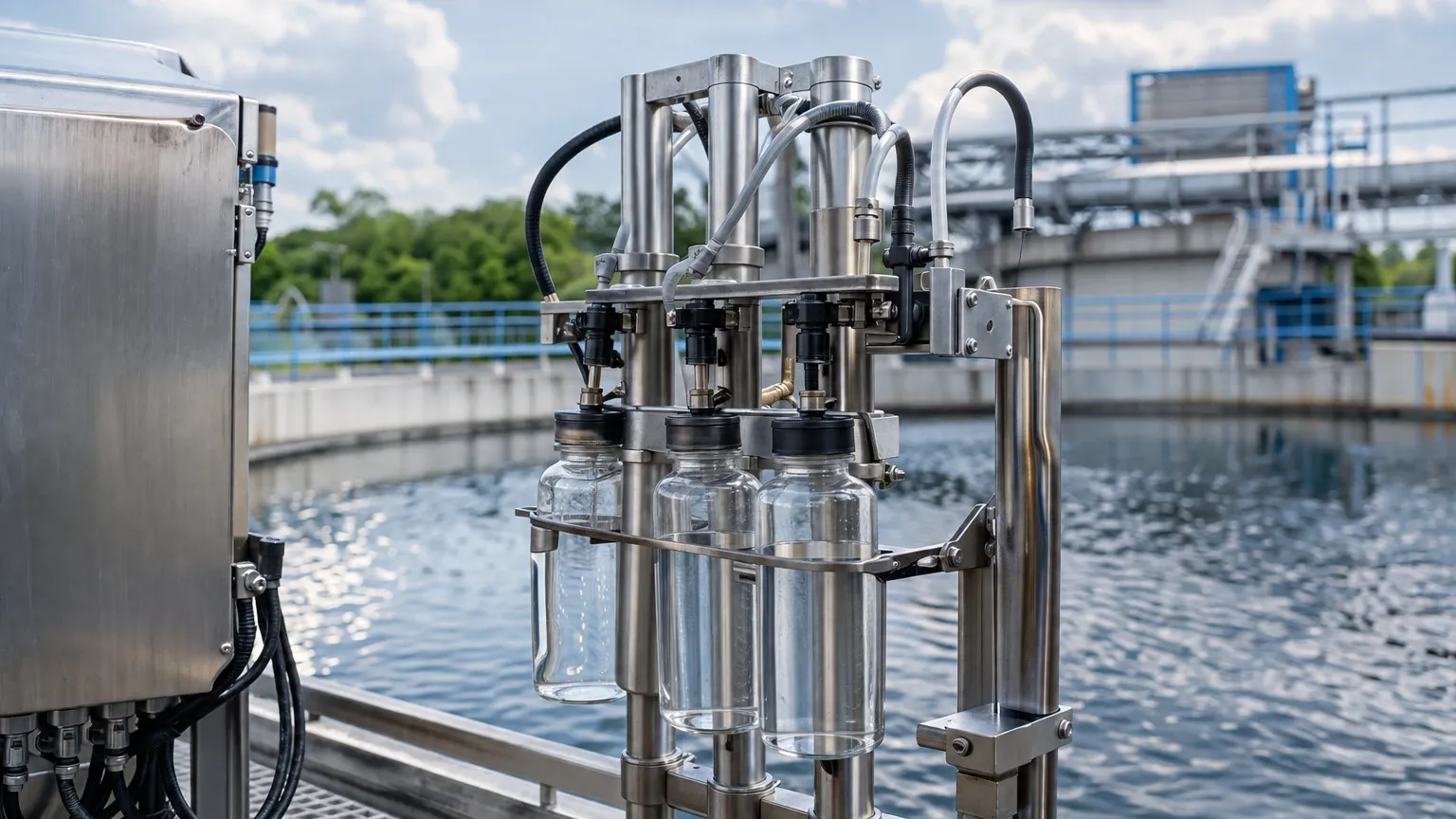
* Peristaltic Pumps: These use a rotating roller to squeeze a flexible tube, creating a vacuum that draws the sample. They are excellent for general wastewater because the liquid never touches the pump's internal mechanical parts, reducing contamination risks.
* Vacuum/Pressure Pumps: These use a vacuum to pull the sample into a chamber and then use pressure to discharge it into the container. They often achieve higher transport velocities, which is beneficial for keeping heavy solids in suspension during the sampling process.
2. Sample Cooling and Preservation
Biological and chemical changes can occur rapidly once a sample is collected.
* Stationary Samplers: Usually equipped with integrated refrigeration units to maintain the sample at 4°C (39.2°F), which is the standard requirement for many regulatory tests.
* Portable Samplers: Often rely on ice or passive insulation. These are used for short-term studies (24 hours or less) where a power source for refrigeration is unavailable.
3. Material Compatibility
The intake tubing and sample containers must be compatible with the liquid being sampled. While polyethylene is standard for most wastewater, glass containers and Teflon-lined tubing are required when sampling for volatile organic compounds (VOCs) or specific priority pollutants to prevent leaching or adsorption.
Selection Comparison Table
| Feature | Portable Samplers | Stationary Samplers | Heavy-Duty Industrial Samplers |
| :— | :— | :— | :— |
| Power Source | Battery / Solar | AC Mains (110/220V) | AC Mains / Hardwired |
| Cooling | Ice / Insulated | Active Refrigeration | High-Capacity Refrigeration |
| Environment | Manholes, Remote Sites | Treatment Plants | Chemical / Harsh Environments |
| Sample Capacity | Single 10L or 24x1L | Single 10L to 20L | Custom / Large Volume |
| Typical Weight | 10–15 kg (empty) | 50–100 kg | >100 kg |
Installation Guidelines and Best Practices
Proper installation is vital to prevent sample bias and mechanical failure. Engineers should adhere to the following guidelines:
* Intake Line Placement: The intake strainer should be placed in the center of the flow stream, ideally in a zone of high turbulence to ensure the liquid is well-mixed. Avoid placing the strainer at the very bottom of a channel where it might suck up silt, or at the very top where it might capture floating oils and greases.
* Vertical Lift and Line Length: Most samplers have a maximum vertical lift (the height the pump must pull the liquid) of approximately 6 to 8 meters (20 to 26 feet). Keep the intake line as short and straight as possible to minimize "dead volume" and reduce the risk of clogging.
* Transport Velocity: To ensure that suspended solids do not settle out in the tubing, the sampler must maintain a minimum transport velocity. International standards often recommend at least 0.6 meters per second (2 feet per second).
* Cross-Contamination Prevention: Ensure the sampler is programmed for a "pre-purge" and "post-purge" cycle. This uses air to blow out any remaining liquid from the previous sample before and after each collection cycle.
Limitations and Maintenance Requirements
While composite samplers are powerful tools, they have inherent limitations. They are not suitable for measuring parameters that change almost instantly upon contact with air or temperature shifts, such as dissolved oxygen (DO), pH, or residual chlorine. These parameters should be measured in-situ using continuous sensors.
Maintenance Checklist:
1. Tubing Replacement: Peristaltic pump tubing undergoes significant mechanical stress and should be replaced every 500 to 1,000 samples to prevent rupture.
2. Cleaning: The intake strainer and internal sample distributor must be cleaned regularly to prevent algae growth and debris buildup.
3. Desiccant Check: For electronic controllers, ensure the desiccant is active (usually indicated by a color change) to prevent moisture damage to the internal circuitry.
4. Calibration: Periodically verify that the volume collected matches the programmed volume (e.g., if programmed for 100 ml, verify the actual delivery into a graduated cylinder).
Frequently Asked Questions
Q: Can composite samplers be used in hazardous (Ex) zones?
A: Yes, but you must specify an explosion-proof model. These are designed with purged housings or intrinsically safe electronics to prevent ignition in environments with flammable gases, common in oil and gas or chemical processing.
Q: How do I choose between a single-bottle and a multi-bottle configuration?
A: Single-bottle (composite) is best for a 24-hour average. Multi-bottle (e.g., 24 x 1L bottles) allows for "discrete sampling," where you can see how the water chemistry changed hour-by-hour while still having the option to manually composite them later.
Q: What is the maximum particle size a composite sampler can handle?
A: This depends on the intake strainer and tubing diameter. Most industrial samplers can handle solids up to 9mm (0.35 inches), but for high-solids applications, a vacuum-style sampler is often more robust than a peristaltic one.
Conclusion
Composite samplers are an indispensable component of modern industrial water management. By automating the collection of representative samples, they allow facilities to remain compliant with environmental regulations and gain deep insights into their process efficiency. However, the success of a sampling program relies heavily on the integration of accurate flow and level data.
Before deploying a sampling system, it is critical to evaluate the hydraulic conditions of the site and select the appropriate primary measurement technology. For a comprehensive range of level measurement solutions that support accurate flow-proportional sampling, visit the Welk Main Page to explore technical specifications and application-specific recommendations.