Best Sanitary Flow Meter
Best Sanitary Flow Meter
In the food, beverage, pharmaceutical, and biotechnology industries, the term "sanitary" is not merely a descriptor of cleanliness; it is a rigorous engineering standard. Selecting the best sanitary flow meter requires an understanding of fluid dynamics, material science, and stringent regulatory compliance. Unlike standard industrial flow meters, sanitary versions must facilitate Clean-in-Place (CIP) and Steam-in-Place (SIP) processes without compromising the integrity of the product or the accuracy of the measurement.
This guide examines the leading technologies used in hygienic flow measurement, providing technical insights into their principles, selection criteria, and installation requirements to help engineers optimize their process lines.
Core Measurement Principles for Hygienic Applications
To determine the best sanitary flow meter for a specific application, one must first understand the physics behind the measurement. In sanitary environments, the goal is to measure flow with minimal pressure drop and zero risk of bacterial growth.
Electromagnetic Flow Meters (Magmeters)
Electromagnetic flow meters operate on Faraday’s Law of Induction. When a conductive liquid flows through a magnetic field generated by the meter, it induces a voltage proportional to the velocity of the liquid.
In a sanitary context, magmeters are highly valued because they offer a "full-bore" design. There are no moving parts or obstructions in the flow path, which minimizes pressure drop and eliminates areas where bacteria could collect. They are ideal for conductive fluids such as milk, juices, and various pharmaceutical buffers.
Coriolis Mass Flow Meters
Coriolis meters measure mass flow directly by monitoring the inertia of the fluid as it moves through vibrating tubes. The phase shift in the vibration frequency is directly proportional to the mass flow rate.
These are often considered the best sanitary flow meter for high-precision applications because they are independent of fluid properties like viscosity and density. Furthermore, they can measure density and temperature simultaneously, providing a comprehensive data set for process control in yogurt production or high-value chemical dosing.
Ultrasonic Flow Meters (Transit-Time)
Ultrasonic meters use sound waves to calculate flow velocity. In the transit-time method, signals are sent upstream and downstream; the difference in travel time determines the flow rate. For sanitary applications, clamp-on ultrasonic meters are gaining popularity because they never touch the process fluid, ensuring 100% sterility. However, inline sanitary ultrasonic meters with polished internal surfaces are also common for permanent installations.
Turbine Flow Meters
Sanitary turbine meters use a multi-bladed rotor suspended in the flow stream. The rotational speed of the rotor is proportional to the flow velocity. While they offer excellent repeatability, they do contain moving parts and bearings, which require careful maintenance to ensure they remain hygienic. They are typically used for low-viscosity fluids like purified water or clear beverages.
Selection Criteria for the Best Sanitary Flow Meter
Identifying the "best" meter is subjective to the process requirements. Engineers must evaluate several critical factors to ensure the instrument meets both performance and regulatory standards.
Material Compliance and Surface Finish
The primary requirement for any sanitary instrument is material safety. The wetted parts must be made of non-reactive materials, typically 316L stainless steel. For liners in electromagnetic meters, PFA or PTFE is standard due to their chemical resistance and ability to withstand high temperatures.
Surface roughness, denoted as Ra, is a critical metric. For most food and beverage applications, an Ra ≤ 0.8 µm (32 µin) is required. In high-purity pharmaceutical applications, this may drop to Ra ≤ 0.4 µm, often achieved through electropolishing.
Regulatory Certifications
A flow meter cannot be classified as sanitary without third-party validation. Look for the following certifications:
* 3-A Sanitary Standards: Common in the US dairy and food industry.
* EHEDG (European Hygienic Engineering & Design Group): Prevalent in Europe, focusing on the cleanability of the equipment.
* FDA (Food and Drug Administration): Ensures all wetted materials (elastomers and plastics) are food-grade.
Performance Metrics
* Accuracy: Coriolis meters typically offer the highest accuracy (±0.1% of rate), while electromagnetic meters provide approximately ±0.5%.
* Turndown Ratio: This defines the range over which the meter can measure accurately. A high turndown ratio (e.g., 100:1) is beneficial for processes with varying flow rates.
* Repeatability: Essential for batching processes where consistency is more important than absolute accuracy.
Technical Comparison and Selection Table
The following table provides a comparative overview of common sanitary flow technologies to assist in the initial selection process.
| Technology | Typical Accuracy | Fluid Conductivity | Moving Parts | CIP/SIP Compatible | Best Use Case |
| :— | :— | :— | :— | :— | :— |
| Electromagnetic | ±0.5% | Required (>5 μS/cm) | No | Yes | Milk, Juice, Beer, Wastewater |
| Coriolis | ±0.1% | Not Required | No | Yes | Dosing, Density Measurement, Oils |
| Ultrasonic | ±1.0% | Not Required | No | Yes | Purified Water, Non-conductive liquids |
| Turbine | ±0.25% | Not Required | Yes | Limited | Water, Alcohol, Low-viscosity fluids |
Installation and Maintenance Guidelines
Even the best sanitary flow meter will fail to perform if installed incorrectly. Proper installation ensures measurement accuracy and maintains the hygienic integrity of the system.
Piping and Orientation
To ensure a stable flow profile, most meters require a specific length of straight pipe upstream and downstream. A common rule of thumb is 5 diameters (5D) of straight pipe before the meter and 3 diameters (3D) after.
Orientation is also vital for hygiene. Meters should be installed in a way that allows them to be self-draining. For example, in vertical lines, the flow should move upward to ensure the pipe remains full and air bubbles are carried away. In horizontal lines, the electrodes of a magmeter should be on the sides (3 and 9 o'clock positions) to prevent sediment or air from interfering with the signal.
Process Connections
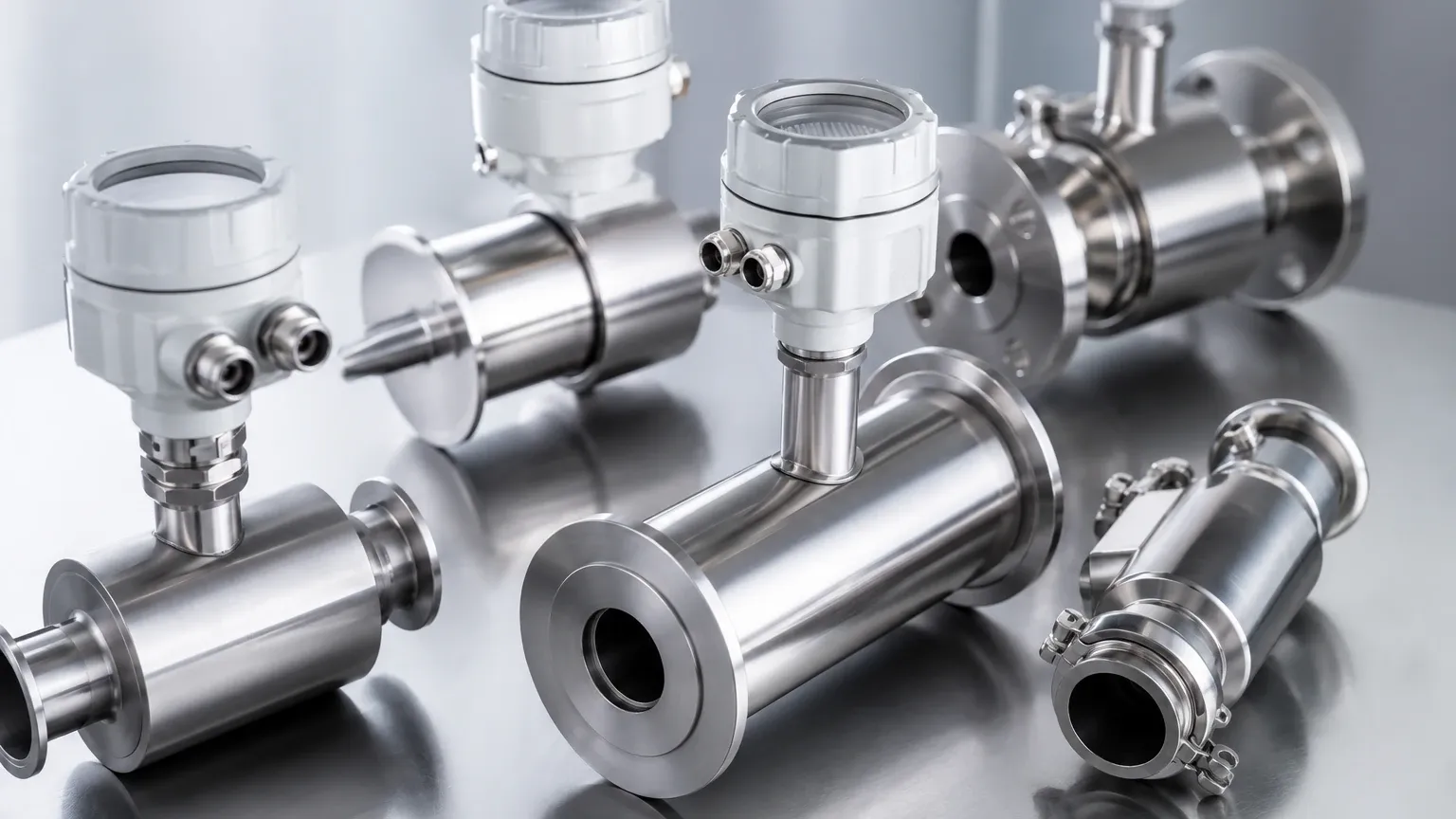
Sanitary flow meters utilize specialized connections rather than standard flanges or NPT threads. The most common is the Tri-Clamp (ISO 2852) fitting, which uses a gasket and a clamp to create a smooth, crevice-free internal joint. Other standards include DIN 11851 (milk couplings) and SMS 1145.
Cleaning Procedures (CIP/SIP)
Sanitary meters must withstand the thermal and chemical shocks of cleaning cycles. CIP involves circulating caustic and acidic solutions at temperatures up to 90°C (194°F). SIP uses saturated steam at temperatures up to 140°C (284°F) for sterilization. It is essential to verify that the meter’s liner and gaskets are rated for these extremes.
Limitations and Process Challenges
While modern flow meters are highly advanced, they are not without limitations. Engineers should be aware of the following challenges:
1. Entrained Air: Air bubbles in the liquid can cause significant errors in electromagnetic and ultrasonic meters. In Coriolis meters, excessive air can cause the tubes to stop vibrating (stalling).
2. Conductivity Limits: Electromagnetic meters cannot measure non-conductive fluids like deionized water or oils. For these applications, Coriolis or ultrasonic meters are necessary.
3. Viscosity Effects: While Coriolis meters are largely immune to viscosity changes, turbine and ultrasonic meters may require Reynolds number corrections when measuring thick syrups or glues.
4. Vibration: Coriolis meters are sensitive to external plant vibrations. Proper mounting and the use of flexible connectors can mitigate this risk.
Integrating Flow and Level Measurement
In a complete process control strategy, flow measurement is often paired with level measurement. While flow meters track the movement of product through pipes, level sensors—such as those found on the Main Page—monitor the inventory within tanks and silos.
For instance, in a dairy processing plant, a Coriolis flow meter might measure the milk being pumped into a pasteurizer, while a radar level transmitter monitors the raw milk storage tank. Integrating these two data points allows for mass balance calculations, leak detection, and automated inventory management. High-precision level measurement, including ultrasonic and radar technologies, provides the necessary redundancy to ensure that flow measurements align with actual storage volumes.
Frequently Asked Questions
Q: Can I use a standard industrial flow meter for food applications?
A: No. Standard meters often have threaded connections or internal crevices that harbor bacteria. They also use materials that may leach chemicals into the product. Only meters with sanitary certifications (3-A, EHEDG) should be used.
Q: How often should a sanitary flow meter be calibrated?
A: Calibration frequency depends on the criticality of the process and regulatory requirements. Most pharmaceutical processes require annual calibration, while food and beverage applications may follow a bi-annual schedule. Many modern meters offer internal diagnostics to verify health between formal calibrations.
Q: What is the best sanitary flow meter for high-viscosity liquids like honey?
A: Coriolis flow meters are generally the best choice for high-viscosity fluids because their accuracy is not affected by changes in viscosity or flow profile.
Q: Are clamp-on ultrasonic meters as accurate as inline meters?
A: Generally, inline meters are more accurate because the path length and pipe geometry are factory-calibrated. However, clamp-on meters offer the advantage of zero process downtime and zero risk of contamination, making them excellent for spot-checking or temporary installations.
Conclusion
Selecting the best sanitary flow meter involves balancing the technical requirements of the fluid with the rigorous hygiene standards of the industry. Electromagnetic meters remain the workhorse for conductive liquids due to their reliability and cost-effectiveness. However, for applications requiring the highest precision or the ability to measure non-conductive fluids, Coriolis and ultrasonic technologies offer superior performance.
By adhering to proper installation practices and ensuring all equipment meets 3-A or EHEDG standards, facilities can ensure both product safety and process efficiency. For comprehensive liquid management, combining these flow solutions with robust level measurement instruments ensures total control over the production environment.