Endress + Hauser
Endress + Hauser
In the landscape of industrial process automation, level measurement serves as a critical pillar for operational safety, inventory management, and process efficiency. High-end instrumentation providers, such as Endress + Hauser, have established a global reputation for precision and reliability. For process engineers and procurement specialists, understanding the underlying physics of these instruments is essential for making informed decisions. Whether integrating premium solutions or seeking cost-effective alternatives from specialized manufacturers like Welk, a deep dive into measurement principles and application constraints is necessary to ensure long-term performance.
Measurement Principles and Technology
Before selecting a level transmitter, it is vital to understand the physical principles that govern different sensing technologies. Modern industrial level measurement generally falls into two categories: continuous measurement and point level detection.
Radar Level Measurement (Time-of-Flight)
Radar level meters, including both guided wave radar (GWR) and non-contact radar, utilize the Time-of-Flight (ToF) principle. The instrument emits high-frequency electromagnetic pulses (typically in the 6GHz, 26GHz, or 80GHz range). These pulses travel at the speed of light, reflect off the surface of the medium, and return to the sensor. The distance is calculated based on the time interval between emission and reception.
* Non-Contact Radar: Ideal for corrosive or hygienic applications where the sensor should not touch the media. Higher frequencies (80GHz) offer narrower beam angles, which are better for avoiding internal tank obstructions.
* Guided Wave Radar: Uses a probe (cable or rod) to guide the signal. This is highly effective for low dielectric media or applications with heavy foam and turbulence.
Ultrasonic Level Sensors
Ultrasonic sensors function similarly to radar but use sound waves instead of electromagnetic pulses. A transducer emits an ultrasonic pulse that bounces off the product surface. The time taken for the echo to return is proportional to the distance. Because sound speed is affected by air temperature, these sensors include integrated temperature compensation.
Hydrostatic Level Transmitters
Hydrostatic measurement relies on the relationship between the height of a liquid and the pressure it exerts at the bottom of a vessel. The formula $P = \rho \cdot g \cdot h$ (where $P$ is pressure, $\rho$ is density, $g$ is gravity, and $h$ is height) allows the transmitter to calculate the level based on the weight of the liquid column. This method is widely used in open tanks and reservoirs.
Magnetic Level Gauges
Magnetic gauges utilize a float containing a permanent magnet. As the liquid level rises and falls, the float moves within a bypass chamber. This movement is coupled with an external visual indicator or a reed-chain transmitter, providing a clear, mechanical representation of the level that does not require power for local indication.
Evaluating Radar Level Measurement
When considering high-performance radar solutions similar to those offered by Endress + Hauser, engineers must evaluate the dielectric constant ($ε_r$) of the medium. The dielectric constant determines how much of the radar signal is reflected. Water has a high $ε_r$ (~80), making it an excellent reflector, while hydrocarbons like oil have low $ε_r$ (~2), requiring more sensitive electronics or guided wave technology.
Frequency Considerations
* 6GHz – 10GHz: Best for applications with heavy steam or dust, as longer wavelengths can penetrate these obstacles more effectively.
* 26GHz: A versatile middle ground for most chemical and water treatment applications.
* 80GHz: The current industry standard for precision. The narrow beam allows for installation in narrow nozzles and prevents "false echoes" from agitators or tank walls.
Ultrasonic and Hydrostatic Alternatives
While radar is often seen as the "gold standard," ultrasonic and hydrostatic methods remain vital for specific B2B applications due to their cost-to-performance ratio.
Ultrasonic Limitations:
Ultrasonic sensors are sensitive to vacuum conditions (sound cannot travel in a vacuum) and high-pressure environments where the air density changes significantly. They are also prone to interference from heavy foam, which absorbs the sound energy rather than reflecting it.
Hydrostatic Advantages:
Hydrostatic transmitters are exceptionally reliable in deep wells or large storage tanks where mounting a sensor at the top is impractical. However, they require a constant media density. If the liquid density changes due to temperature fluctuations or chemical composition shifts, the level reading will drift unless compensated by a secondary pressure sensor (differential pressure measurement).
Key Selection Criteria for Industrial Applications
Selecting the right instrument requires a systematic approach. The following table provides a comparison of the most common technologies used by brands like Endress + Hauser and Welk.
| Technology | Accuracy | Max Temperature | Max Pressure | Media Type | Best Use Case |
| :— | :— | :— | :— | :— | :— |
| Non-Contact Radar | ±1mm to ±5mm | Up to 450°C | Up to 160 bar | Liquids/Solids | Corrosive chemicals, high-temp reactors |
| Guided Wave Radar | ±2mm | Up to 400°C | Up to 400 bar | Liquids/Solids | Low dielectric oils, turbulent surfaces |
| Ultrasonic | ±0.25% of range | Up to 80°C | Up to 3 bar | Liquids | Water treatment, open channels |
| Hydrostatic | ±0.1% to ±0.5% | Up to 100°C | N/A (Submersible) | Liquids | Deep wells, water towers, fuel tanks |
| Magnetic Gauge | ±5mm to ±10mm | Up to 400°C | Up to 250 bar | Liquids | High-pressure boilers, visual monitoring |
Application-Specific Factors
1. Chemical Compatibility: Ensure that wetted parts (PTFE, 316L Stainless Steel, Hastelloy) are resistant to the process media.
2. Vessel Geometry: Internal structures like heating coils or baffles can interfere with non-contact signals.
3. Hygienic Requirements: For food and beverage or pharmaceutical applications, sensors must meet EHEDG or 3-A standards, featuring tri-clamp connections and polished surfaces.
Installation Best Practices and Common Pitfalls
Even the most advanced instrument from a premium provider like Endress + Hauser will fail if installed incorrectly. Engineers should follow these guidelines:
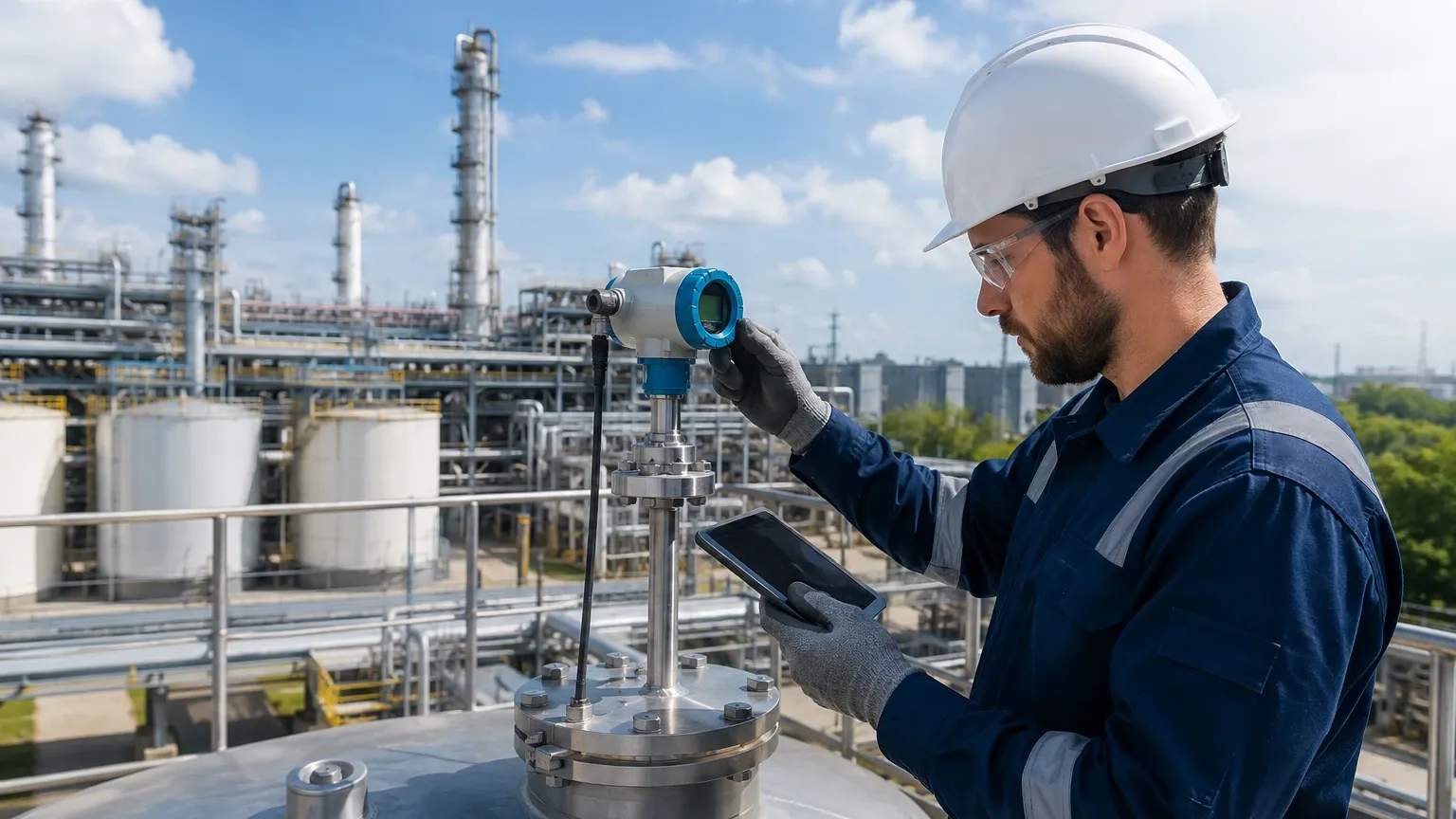
* Nozzle Geometry: For radar and ultrasonic sensors, the nozzle should be as short as possible. If the nozzle is too long or narrow, the signal may reflect off the nozzle wall, creating a "near-field" interference zone.
* Avoid the Inlet: Never install a level sensor directly above the tank's filling stream. The turbulence and falling liquid will cause erratic readings.
* Blocking Distance (Dead Zone): Every ToF sensor has a minimum distance it cannot measure (the dead zone). Ensure the maximum liquid level does not enter this zone.
* Stilling Wells: In tanks with heavy agitation or foam, installing a radar or ultrasonic sensor inside a stilling well (a vertical pipe) can provide a calm surface for accurate measurement.
Market Comparison: Global Brands and Specialized Manufacturers
The decision between a global conglomerate like Endress + Hauser and a specialized manufacturer like Welk often comes down to the specific needs of the project.
Global Brands (Endress + Hauser, etc.):
* Pros: Extensive global support networks, wide range of certifications (ATEX, SIL, FM), and high-end R&D.
* Cons: Higher price points, longer lead times for customized units, and complex configuration software.
Specialized Manufacturers (Welk):
* Pros: Cost-effective solutions, highly flexible OEM/ODM services, and faster response times for custom engineering requirements.
* Cons: Smaller global footprint, though often offset by robust technical support for specific industrial automation projects.
For many industrial applications in water treatment and chemical processing, specialized manufacturers provide the same technical accuracy as premium brands but with a focus on practical engineering and cost-efficiency. To explore a comprehensive range of these solutions, engineers can Review product options and application support on our Main Page.
Frequently Asked Questions (FAQ)
1. How does the dielectric constant affect radar measurement?
The dielectric constant ($ε_r$) is a measure of a material's ability to store electrical energy. In radar level measurement, it determines the strength of the reflected signal. Materials with a low $ε_r$ (like liquefied gases or plastic pellets) reflect very little energy, making them harder to detect without guided wave radar or high-sensitivity 80GHz sensors.
2. Can ultrasonic sensors be used in pressurized tanks?
Generally, no. As pressure increases, the density of the air or gas above the liquid changes, which alters the speed of sound. This leads to significant measurement errors. Furthermore, at high pressures (typically above 3 bar), the transducer may fail to vibrate correctly. Radar is the preferred choice for pressurized vessels.
3. What is the difference between a level transmitter and a level switch?
A level transmitter provides continuous measurement (e.g., 4-20mA or HART signal representing 0-100% of the tank volume). A level switch is a point-level device that simply triggers an alert or action when the liquid reaches a specific height (e.g., high-level alarm or pump control).
4. Why is temperature compensation necessary for ultrasonic sensors?
The speed of sound in air changes by approximately 0.17% per degree Celsius. Without compensation, a 10-degree shift in ambient temperature could result in a measurement error of several centimeters. Most modern sensors include a thermistor near the transducer to automate this correction.
5. When should I use a Magnetic Level Gauge instead of a Radar sensor?
Magnetic level gauges are ideal when visual local indication is a priority and when the process involves extreme pressures or temperatures that might damage electronic sensor heads. They are also preferred in applications where power is not always available for local monitoring.