Bioprocess Control and Monitoring Systems
Bioprocess Control and Monitoring Systems
In the industrial production of pharmaceuticals, vaccines, biofuels, and specialized food ingredients, the efficiency of a facility depends on the precision of its bioprocess control and monitoring systems. These systems are designed to manage the complex biological reactions occurring within bioreactors and fermenters, ensuring that living cells or enzymes operate under optimal conditions.
For process engineers and plant managers, monitoring parameters such as temperature, pH, dissolved oxygen, and liquid level is not merely about data collection; it is about maintaining the delicate equilibrium required for high-yield production. This guide focuses on the technical aspects of level measurement within these systems, providing a practical reference for selecting and installing the instrumentation necessary for robust bioprocess automation.
The Role of Level Measurement in Bioprocess Control
Bioprocess control and monitoring systems rely on a continuous stream of real-time data to execute automated logic. Level measurement is a critical variable in this matrix. Whether managing the addition of nutrient media, controlling the harvest of a finished batch, or monitoring the progress of a Clean-in-Place (CIP) cycle, accurate level data prevents vessel overflow, pump cavitation, and batch loss.
In bioprocessing, level sensors must operate in environments that are frequently subjected to high-pressure steam sterilization and aggressive chemical cleaning. Consequently, the choice of measurement technology must balance precision with the physical demands of sanitary processing. To understand which instrument fits a specific application, it is essential to first review the underlying measurement principles.
Core Measurement Principles for Bioprocess Applications
Radar Level Measurement (Non-Contact)
Radar level meters utilize high-frequency electromagnetic waves, typically in the 80 GHz range, to measure the distance to the liquid surface. The instrument emits a signal that reflects off the product and returns to the sensor. The system calculates the level based on the Time of Flight (ToF) of the signal.
In the context of bioprocess control and monitoring systems, radar is often the preferred choice because it is non-contact. The sensor does not touch the biological media, reducing the risk of contamination. Modern 80 GHz radar units offer a narrow beam angle, which allows them to avoid interference from internal vessel components like agitators, baffles, and spargers.
Ultrasonic Level Sensing
Ultrasonic sensors function similarly to radar but use sound waves instead of electromagnetic waves. The sensor emits an ultrasonic pulse that bounces off the liquid surface. While cost-effective for water treatment and general utility tanks, ultrasonic sensors have limitations in bioprocessing. They are sensitive to changes in gas composition (such as high CO2 levels in fermenters) and can be obscured by heavy foam or steam, which absorbs the sound energy.
Hydrostatic Pressure Measurement
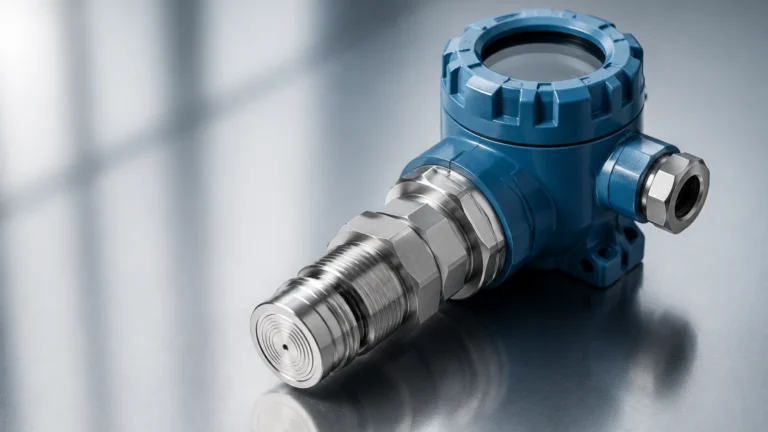
Hydrostatic level transmitters measure the pressure exerted by the liquid column at the bottom of a tank. Since pressure is directly proportional to the height of the liquid and its density ($P = \rho gh$), the system can calculate the level accurately if the density remains constant. In bioprocessing, hydrostatic sensors must use flush-mounted diaphragms to ensure there are no "dead legs" where bacteria can grow.
Magnetic Level Gauges
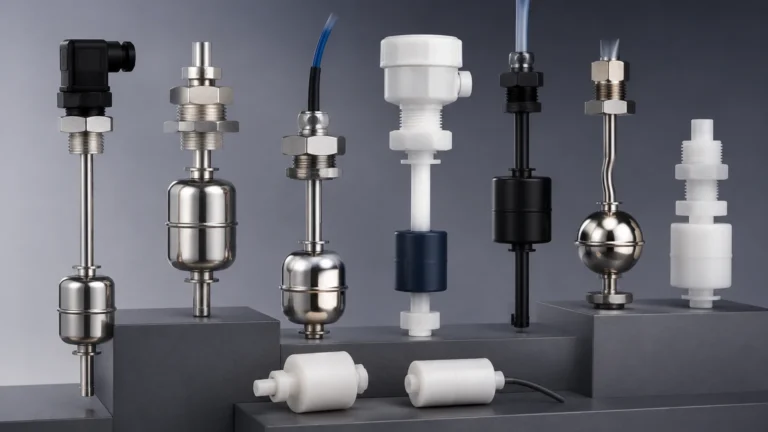
Magnetic level gauges are used for external visual indication and electronic monitoring. A float containing a magnet moves with the liquid level inside a bypass chamber, flipping magnetic flags on the outside of the chamber. These are commonly used in utility applications or large storage tanks where a secondary visual reference is required alongside the electronic control system.
Selection Criteria for Bioprocess Instrumentation
When integrating level sensors into bioprocess control and monitoring systems, several technical factors must be evaluated to ensure long-term reliability and regulatory compliance.
1. Sanitary Design and Material Compatibility
Instruments must feature sanitary connections, typically Tri-clamp or specialized aseptic flanges. The wetted materials must be non-reactive and corrosion-resistant, usually 316L stainless steel or high-grade polymers like PTFE. Surface finishes must meet strict roughness standards (typically Ra ≤ 0.8 µm) to prevent microbial attachment.
2. Resistance to CIP and SIP Processes
Bioprocess vessels undergo Clean-in-Place (CIP) with caustic chemicals and Steam-in-Place (SIP) at temperatures reaching 121°C to 135°C (approx. 1.1 to 2.1 bar). Level sensors must be rated to withstand these thermal and chemical shocks without losing calibration or suffering seal failure.
3. Handling Agitation and Foam
Fermentation processes often involve high-speed agitation and the formation of surface foam. Radar sensors with advanced signal processing can often "see through" light foam, while hydrostatic sensors remain unaffected by surface turbulence. Engineers should review product options and application support on the Main Page of equipment providers to identify models specifically tuned for agitated environments.
Technical Comparison Table
| Technology | Principle | Ideal Application | Accuracy | Hygiene Rating |
| :— | :— | :— | :— | :— |
| 80GHz Radar | Electromagnetic ToF | Fermenters, Agitated Tanks | ±1 mm | Excellent (Non-contact) |
| Ultrasonic | Sound Wave Reflection | Buffer Prep, Water Tanks | ±2 mm | Good |
| Hydrostatic | Pressure Differential | Storage Tanks, Constant Density | ±0.1% FS | High (Flush Diaphragm) |
| Magnetic Gauge | Buoyancy/Magnetism | Utility Vessels, Bypass | ±5 mm | Moderate |
| Level Switch | Vibration/Capacitance | Overfill Protection | N/A | High |

Installation and Engineering Considerations
Proper installation is vital to the performance of bioprocess control and monitoring systems. Even the most advanced sensor will fail to provide accurate data if installed incorrectly.
* Nozzle Geometry: For radar and ultrasonic sensors, the mounting nozzle should be as short as possible to prevent signal interference. The sensor face should ideally sit just below the top of the nozzle.
* Obstruction Clearance: Ensure the sensor's signal path is clear of impellers and cooling coils. If obstructions are unavoidable, use instruments with "false signal suppression" software to map out and ignore these static reflections.
* Dead Space Elimination: In hydrostatic installations, the sensor must be mounted flush with the vessel wall. Any recessed area (dead space) can trap media, leading to contamination between batches.
* Environmental Protection: Sensors should have an IP67 or IP69K rating to protect against high-pressure washdowns and humidity common in cleanroom environments.
Limitations and Common Risks
While modern bioprocess control and monitoring systems are highly automated, they are not immune to specific process risks:
1. Heavy Foam: While radar can handle light foam, extremely dense or "dry" foam can reflect the signal prematurely, leading to a false high-level reading. In these cases, a combination of radar and a vibrating level switch for high-level alarms is recommended.
2. Condensation: In high-temperature bioprocesses, condensation can form on the sensor lens. Choosing a radar sensor with a convex PTFE lens helps droplets shed quickly, maintaining signal integrity.
3. Density Fluctuations: Hydrostatic sensors rely on constant density. If the density of the broth changes significantly during fermentation (due to gas holdup or nutrient addition), the level reading will drift unless the control system can compensate for density changes in real-time.
Frequently Asked Questions (FAQ)
Q: Can I use a standard industrial level sensor in a bioprocess application?
A: Generally, no. Standard sensors often have crevices or materials that are not compatible with sanitary requirements. Always specify sensors with 3-A or EHEDG certification for bioprocessing.
Q: How often should level sensors in bioprocess systems be calibrated?
A: Calibration frequency depends on the criticality of the process. Most pharmaceutical facilities perform a full calibration check annually, with periodic verification against a manual reference or a secondary sensor.
Q: Is non-contact radar better than hydrostatic for fermentation?
A: Radar is often preferred for high-value batches because it eliminates the risk of diaphragm failure and contamination. However, hydrostatic sensors are still widely used for their simplicity and reliability in non-agitated storage applications.
Conclusion and Next Steps
Implementing effective bioprocess control and monitoring systems requires a deep understanding of how instrumentation interacts with the biological environment. Before finalizing a system design, project teams should confirm the following:
* The maximum temperature and pressure during SIP cycles.
* The chemical concentration used in CIP cycles.
* The presence and density of foam during peak fermentation.
* The required integration protocol (e.g., 4-20mA HART, Profibus, or Foundation Fieldbus).
By selecting the appropriate measurement principle and adhering to sanitary installation standards, manufacturers can ensure their bioprocess control and monitoring systems provide the accuracy and reliability needed for successful industrial production. For detailed specifications on radar, ultrasonic, and hydrostatic solutions, engineers are encouraged to consult the technical documentation available on the manufacturer's Main Page.