Prosonic
Prosonic
In the landscape of industrial process automation, ultrasonic level measurement remains one of the most reliable and cost-effective methods for monitoring liquids and bulk solids. Among the high-performance solutions in this category, the Prosonic series has established itself as a benchmark for non-contact level measurement. This article provides a comprehensive technical overview of ultrasonic technology, the engineering principles behind Prosonic-class instrumentation, and practical guidance for selecting and installing these sensors in demanding industrial environments.
Understanding Ultrasonic Measurement Principles
Ultrasonic level transmitters operate on the "Time of Flight" (ToF) principle. The device, typically mounted at the top of a vessel, contains a transducer that emits a series of ultrasonic pulses. These sound waves travel through the air or gas space above the medium, reflect off the surface of the material, and return to the transducer.
The Time of Flight Calculation
The sensor’s internal electronics measure the time interval between the emission of the pulse and the reception of the echo. Since the speed of sound in air is a known constant (approximately 343 meters per second at 20°C), the distance to the product surface can be calculated using the following formula:
D = (c × t) / 2
Where:
* D is the distance from the sensor to the material surface.
* c is the velocity of sound in the medium (usually air).
* t is the measured time for the pulse to travel to the surface and back.
By subtracting this distance from the total tank height (the calibration parameter), the transmitter determines the level of the product. Modern instruments, such as those found on the Main Page of industrial suppliers, utilize advanced algorithms to filter out false echoes caused by internal tank obstructions like agitators or ladders.
Temperature Compensation
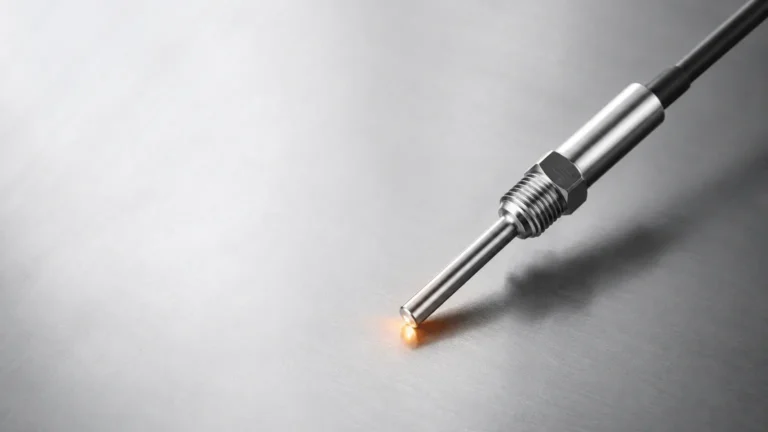
A critical factor in ultrasonic measurement is the dependency of sound velocity on the gas temperature. As temperature increases, the speed of sound increases, which could lead to significant measurement errors if not corrected. Prosonic-class sensors feature integrated temperature sensors that provide real-time data to the processor, allowing for automatic compensation and maintaining accuracy even as process temperatures fluctuate.
Key Features of Prosonic Instrumentation
Instruments in the Prosonic category are designed for versatility across various industries, including water and wastewater treatment, chemical processing, and food production. Their primary advantage lies in their non-contact nature, which eliminates the risk of corrosion or mechanical wear associated with contact-based probes.
1. Non-Contact Measurement: Ideal for corrosive, abrasive, or viscous media that would damage or coat traditional sensors.
2. Integrated Data Processing: Advanced signal processing enables the sensor to distinguish between the true level echo and noise generated by foam, dust, or tank geometry.
3. Ease of Integration: Most units support standard industrial protocols, including 4-20mA HART, PROFIBUS PA, and Foundation Fieldbus, ensuring seamless connectivity with PLC and SCADA systems.
4. Durability: With housings often rated IP68 and constructed from chemically resistant materials like PVDF or PP, these sensors are built for longevity in harsh outdoor and indoor environments.
Technical Selection Criteria
Choosing the right ultrasonic sensor requires a detailed understanding of the application's physical and chemical parameters. Engineers must evaluate several factors to ensure the chosen Prosonic model meets the project requirements.
Selection Table: Application Mapping
| Application Type | Recommended Sensor Features | Typical Range (Meters) | Primary Consideration |
| :— | :— | :— | :— |
| Open Channels/Weirs | High accuracy, flow calculation software | 2m – 8m | Environmental factors (wind/sun) |
| Chemical Storage | PVDF/PTFE wetted parts, ATEX certification | 5m – 15m | Chemical compatibility |
| Solid Silos (Grain/Sand) | High-power transducer, dust filtering | 10m – 40m | Surface angle and dust attenuation |
| Small Process Tanks | Compact design, narrow beam angle | 0.5m – 5m | Dead zone (Blocking distance) |
Measuring Range and Frequency
The frequency of the ultrasonic pulse determines the measuring range and the sensor's ability to penetrate dust or steam. Lower frequencies (e.g., 10 kHz to 30 kHz) are used for long-range applications and bulk solids, as they are less affected by attenuation. Higher frequencies (e.g., 50 kHz to 70 kHz) are used for shorter ranges where high precision and smaller sensor footprints are required.
Installation Guidelines and Best Practices
Proper installation is the most significant factor in the performance of an ultrasonic level meter. Even the most advanced Prosonic sensor will fail if the physical mounting ignores the fundamental physics of sound propagation.
1. Avoiding the Dead Zone (Blocking Distance)
Every ultrasonic sensor has a "dead zone" directly beneath the transducer where measurement is impossible. This is the time required for the transducer to stop vibrating after emitting a pulse so it can act as a receiver. Users must ensure that the maximum possible liquid level never enters this zone. If necessary, a mounting nozzle or standpipe can be used to raise the sensor.
2. Beam Angle and Obstructions
The ultrasonic pulse spreads out in a cone shape. Any internal tank structures (cooling coils, limit switches, or inflow streams) that intersect this cone will create false echoes.
* Rule of Thumb: The sensor should be mounted at a distance from the wall equal to at least 1/6th of the tank height to avoid wall interference.
* Alignment: The transducer face must be parallel to the surface of the medium. For bulk solids with a repose angle, an alignment device may be required to point the sensor at the most representative area of the material.
3. Nozzle Geometry
When mounting on a nozzle, the diameter and height of the nozzle must be considered. If the nozzle is too narrow or too long, the ultrasonic pulse may reflect off the internal edges of the pipe before reaching the tank. Smooth internal surfaces and beveled edges on the nozzle can help mitigate this issue.
Limitations and Environmental Considerations
While highly versatile, Prosonic technology is not a universal solution. Certain process conditions can attenuate or scatter the sound signal, leading to signal loss.
* Vacuum Applications: Sound requires a medium (gas) to travel. In a vacuum, ultrasonic sensors cannot function. For these applications, guided wave radar or through-air radar is recommended.
* Heavy Foam: Dense, thick foam can absorb the ultrasonic pulse rather than reflecting it. If foam is present, a radar-based solution or a stilling well may be necessary.
* High Pressure: Changes in pressure alter the density of the gas, which in turn changes the speed of sound. While some compensation is possible, extreme pressures often require alternative technologies.
* Heavy Dust and Steam: While Prosonic sensors can handle moderate dust, extreme concentrations can scatter the signal. In these cases, high-power transducers or radar sensors are often more reliable.

Comparison: Ultrasonic vs. Radar
Engineers often debate between ultrasonic (Prosonic) and radar (Micropilot) technologies.
* Cost: Ultrasonic is generally more cost-effective for standard liquid applications and open-channel flow.
* Process Conditions: Radar is superior for high-pressure, high-temperature, and vacuum environments because electromagnetic waves do not rely on the air as a medium.
* Setup: Ultrasonic sensors are often easier to commission for simple applications, whereas radar may require more sophisticated echo mapping in complex vessels.
For a detailed comparison of available hardware and application-specific advice, engineers should consult the Main Page of professional measurement instrument manufacturers.
Maintenance and Troubleshooting
One of the primary benefits of the Prosonic series is the minimal maintenance required. However, periodic checks ensure long-term reliability.
* Transducer Cleaning: In applications with heavy condensation or crystallization, the transducer face may need occasional cleaning with a soft cloth and mild detergent. Avoid abrasive tools that could damage the sensitive membrane.
* Signal Loss (E0x codes): If the device reports a loss of echo, check for surface turbulence, foam, or whether the material has entered the dead zone.
* Accuracy Drift: If the level reading is consistently off, verify the temperature compensation settings and ensure the sensor is not exposed to direct, intense sunlight, which can overheat the internal temperature probe.
Frequently Asked Questions (FAQ)
Q: Can Prosonic sensors be used in hazardous areas?
A: Yes, many models are available with ATEX, FM, or CSA certifications for use in explosive atmospheres (Zone 0, 1, or 2).
Q: How does wind affect open-channel measurement?
A: Strong wind can deflect the ultrasonic pulse or cause surface ripples. In outdoor installations, a protective cover and signal averaging settings are recommended to stabilize readings.
Q: Can I use an ultrasonic sensor for liquid-liquid interface measurement?
A: Generally, no. Ultrasonic pulses reflect off the first surface they encounter. For interface measurement (e.g., oil over water), guided wave radar is the industry standard.
Q: What is the maximum temperature for a Prosonic sensor?
A: Standard models typically handle up to +80°C (176°F). For higher temperatures, specialized transducers or radar technology should be considered.
Conclusion
The Prosonic class of ultrasonic level transmitters remains a cornerstone of industrial instrumentation. By understanding the physics of sound, respecting installation boundaries like the dead zone and beam angle, and correctly identifying the limitations of the technology, engineers can implement highly accurate and maintenance-free level control systems. For those looking to explore specific product configurations or seek customized OEM/ODM support for level measurement projects, visiting the Main Page provides access to a wide range of industrial-grade solutions tailored for global automation needs.