Capacitance Probe
Capacitance Probe
In the field of industrial process control, the capacitance probe remains one of the most versatile and robust instruments for level measurement. Whether utilized for simple point-level detection or sophisticated continuous level monitoring, capacitance-based technology offers a reliable solution across a wide array of industries, including water treatment, chemical processing, and oil and gas. This guide provides a technical deep dive into the principles, selection, and application of capacitance probes to assist engineers in making informed procurement and design decisions.
Understanding the Measurement Principle
The operation of a capacitance probe is based on the fundamental electrical principle of a capacitor. A capacitor consists of two conductive plates separated by an insulating material known as a dielectric. The ability of this setup to store an electrical charge is defined as capacitance (C).
In an industrial level measurement application, the capacitance probe itself acts as one "plate" of the capacitor, while the vessel wall (if metallic and grounded) acts as the second "plate." If the tank is non-metallic, a secondary reference electrode or a ground rod is used. The material stored within the tank—whether liquid, slurry, or solid—functions as the dielectric material between these two plates.
The Capacitance Formula
The capacitance of the system is determined by the following relationship:
C = ε × (A / d)
Where:
* C is the capacitance.
* ε (Epsilon) is the dielectric constant (permittivity) of the material between the plates.
* A is the surface area of the plates.
* d is the distance between the plates.
In a fixed installation, the surface area (A) and the distance (d) remain constant. Therefore, the only variable that changes the capacitance is the dielectric constant (ε) of the medium filling the space between the probe and the tank wall. Since most process materials have a dielectric constant significantly higher than air (ε ≈ 1.0), the total capacitance increases as the material rises and covers more of the probe. The electronics in the probe head convert this change in capacitance into a proportional electrical signal, such as a 4-20mA output or a relay switch point.
Types of Capacitance Probes and Their Applications
Capacitance technology is broadly categorized into two functional types based on the requirements of the application: point level detection and continuous level measurement.
1. Point Level Capacitance Switches
Point level probes are used to detect the presence or absence of material at a specific height. These are commonly used for high-level alarms to prevent overfills or low-level alarms to protect pumps from running dry. They are highly effective in powders, granules, and liquids. Modern versions often utilize RF Admittance technology, a variation of capacitance that ignores the effects of material buildup on the probe, ensuring the switch only triggers when the actual bulk material is present.
2. Continuous Level Transmitters
Continuous capacitance probes provide a constant reading of the level throughout the height of the vessel. These probes are typically rod-shaped or cable-based (for very tall silos). As the level moves up or down the length of the probe, the capacitance changes linearly. These are ideal for process tanks where precise inventory management is required. For more information on the full range of instrumentation available, engineers can consult the Main Page of the Welk technical catalog.
Engineering Selection Criteria
Selecting the correct capacitance probe requires an analysis of the physical and chemical properties of the medium, as well as the vessel geometry. Use the following criteria to evaluate a probe for your specific application.
Dielectric Constant (DK)
The dielectric constant of the medium is the most critical factor. Materials with a high DK (e.g., water, ε ≈ 80) are very easy to measure. Materials with a low DK (e.g., hydrocarbons or dry bulk solids, ε ≈ 1.5 to 5) produce smaller changes in capacitance and require more sensitive electronics and potentially larger probe surface areas.
Conductivity of the Medium
* Non-Conductive Liquids: For oils and pure solvents, a standard bare metal probe can often be used, provided the tank is metallic.
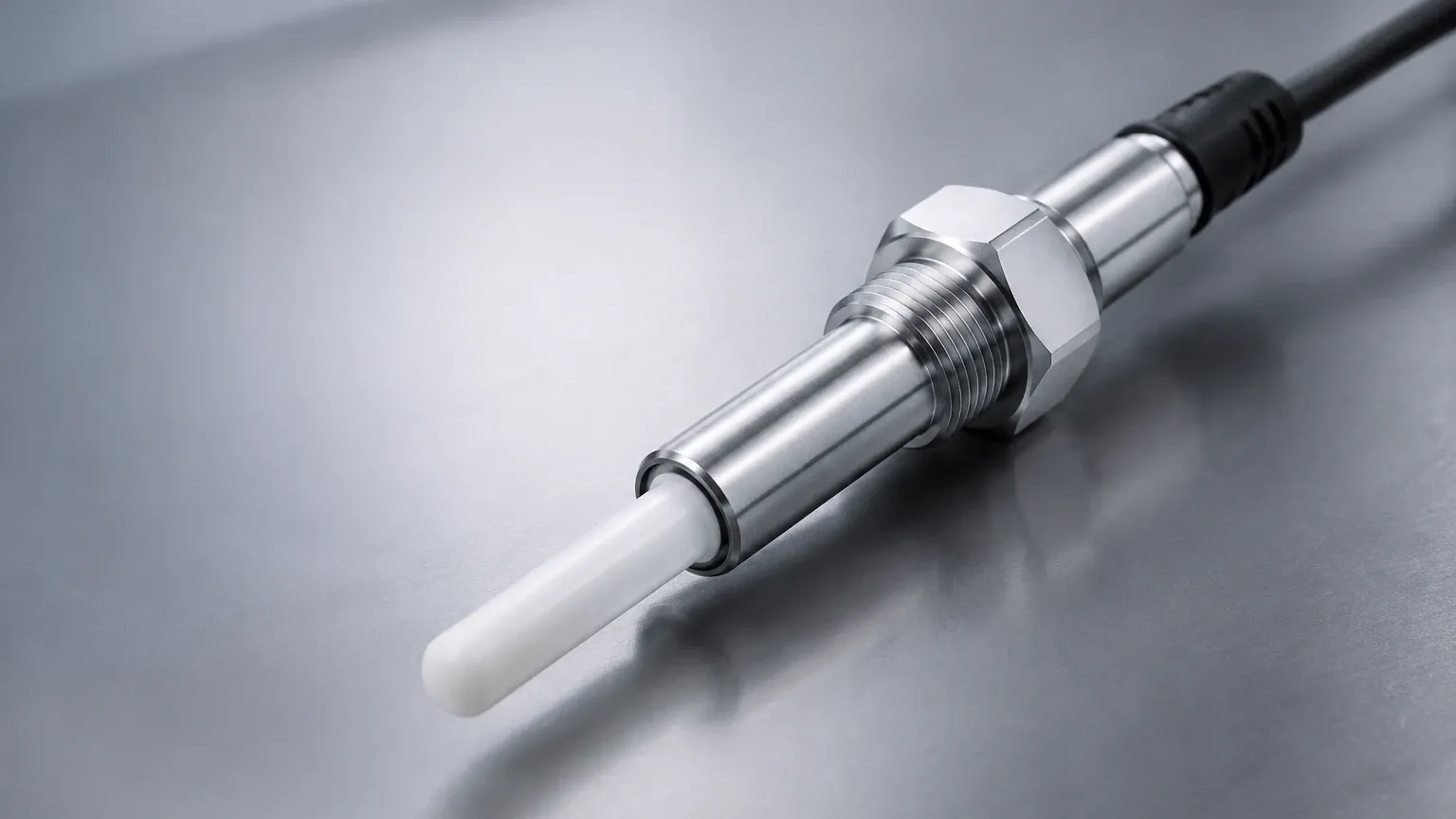
* Conductive Liquids: For water-based liquids or acids, the probe must be insulated (usually with PTFE, PFA, or FEP). Without insulation, a conductive liquid would create a short circuit between the probe and the ground, making measurement impossible.
Selection Reference Table
| Application Type | Recommended Probe Type | Typical Materials | Key Consideration |
| :— | :— | :— | :— |
| Water Treatment | Insulated Rod (PTFE/PFA) | Wastewater, treated water | High DK; requires corrosion resistance. |
| Chemical Storage | Fully Insulated Probe | Acids, Alkalis, Solvents | Chemical compatibility of insulation. |
| Oil & Gas | Bare or Coaxial Probe | Crude oil, Diesel, Condensate | Low DK; may require high-pressure seals. |
| Dry Bulk Solids | Heavy-duty Cable Probe | Grain, Cement, Sand | Mechanical pull-down forces on the probe. |
| High Temp/Pressure | Ceramic Insulated Probe | Steam drums, Bitumen | Thermal expansion and seal integrity. |
Installation and Calibration Considerations
Proper installation is paramount to ensuring the accuracy and longevity of a capacitance probe. Engineers should follow these practical guidelines:
1. Grounding: In metallic tanks, ensure the probe housing has a solid electrical connection to the tank wall. In plastic or fiberglass tanks, a "twin-rod" probe or a metallic ground strap must be installed to provide the reference plate for the capacitor.
2. Avoid the Inflow Stream: Never install a probe directly in the path of the material entering the tank. The turbulence and direct impact can cause false readings and physical damage.
3. Proximity to Walls: While the tank wall acts as the ground, the probe should not be placed too close to the wall (typically a minimum of 100 mm to 300 mm distance is recommended) to prevent bridging or excessive parasitic capacitance.
4. No-Load Calibration: Calibration is usually performed in two steps: "Zero" calibration when the tank is empty and "Span" calibration when the tank is at a known level (ideally full). Many modern Welk probes feature auto-calibration routines to simplify this process.
Limitations and Environmental Factors
While highly versatile, capacitance probes have specific limitations that must be managed:
* Material Buildup: In sticky or viscous applications, material may coat the probe. If the material is conductive, standard capacitance probes may continue to "see" the material even after the level has dropped. RF Admittance probes are the preferred solution for these environments as they can distinguish between the coating and the actual level.
* Changes in Dielectric Constant: If the composition of the liquid changes significantly (e.g., switching from a high-water-content fluid to an oil-based fluid), the probe will require recalibration because the base ε value has changed.
* Vapor Space Variations: In high-pressure gas applications, changes in the density of the vapor space can slightly affect the capacitance, though this is usually negligible in atmospheric liquid applications.
Frequently Asked Questions (FAQs)
Q: Can a capacitance probe be used in a non-metallic tank?
A: Yes, but it requires a ground reference. This is usually achieved by using a probe with an integrated ground tube (coaxial) or by installing a second rod that serves as the ground.
Q: What is the maximum length for a capacitance probe?
A: Rod probes are typically limited to 3 to 6 meters due to mechanical stability. For deeper tanks or silos, cable-style probes can extend up to 30 meters or more.
Q: How does temperature affect the measurement?
A: Temperature can affect the dielectric constant of some materials and the physical dimensions of the probe. High-quality transmitters include temperature compensation circuits to maintain accuracy across the operating range.
Q: Is capacitance technology suitable for interface measurement?
A: Yes. Capacitance probes are excellent for measuring the interface between two immiscible liquids with different dielectric constants, such as the oil-water interface in separators.
Conclusion
The capacitance probe remains a cornerstone of industrial level sensing due to its lack of moving parts, high pressure and temperature capabilities, and adaptability to various media. By understanding the dielectric properties of the process material and ensuring proper grounding and insulation, engineers can implement a measurement solution that is both cost-effective and highly reliable. For specific product specifications and customized OEM/ODM level measurement solutions, please refer to the Main Page for technical support and product selection tools.