Chemical Tank Level Sensors
Chemical Tank Level Sensors
In the landscape of industrial automation, the accurate monitoring of liquid levels within chemical storage and processing vessels is a fundamental requirement. Chemical tank level sensors are specialized instruments designed to withstand the aggressive nature of acids, bases, solvents, and other hazardous reagents while providing real-time data for inventory management, process control, and safety interlocking. Selecting the appropriate technology requires a deep understanding of both the physical properties of the chemical and the mechanical constraints of the tank environment.
As a professional manufacturer of industrial level measurement instruments, Welk provides a comprehensive suite of solutions, including radar level meters, ultrasonic sensors, and hydrostatic transmitters. This guide explores the engineering principles, selection criteria, and installation best practices for chemical tank level sensors to assist engineers in optimizing their process reliability.
Measurement Principles for Chemical Applications
Before selecting a sensor, it is essential to understand the underlying physics of the various measurement technologies available. Each principle offers distinct advantages depending on the chemical’s volatility, viscosity, and corrosiveness.
Radar Level Measurement (Time-of-Flight)
Radar level meters utilize high-frequency electromagnetic waves (typically 26GHz or 80GHz). The sensor emits a microwave pulse that travels to the liquid surface, reflects, and returns to the receiver. The distance is calculated based on the time-of-flight. Because radar waves do not require a physical medium, they are unaffected by vacuum, pressure, or temperature fluctuations. For chemical tanks, non-contact radar is often preferred as the sensor can be isolated from the medium using PTFE or PVDF flanges.
Ultrasonic Level Measurement
Ultrasonic sensors emit acoustic pressure waves. These waves reflect off the liquid surface and return to the transducer. While cost-effective, ultrasonic measurement is sensitive to the composition of the air space. In chemical tanks, the presence of heavy vapors, foam, or significant temperature gradients can alter the speed of sound, leading to measurement errors. Consequently, ultrasonic sensors are best suited for stable, non-fuming chemicals.
Hydrostatic Level Measurement
This principle relies on the relationship between liquid height and the pressure exerted at the base of the tank ($P = \rho · g · h$). A pressure transmitter, either submerged or mounted to a bottom flange, measures the head pressure. In chemical applications, the diaphragm must be constructed from corrosion-resistant materials like Hastelloy C, Tantalum, or ceramic to prevent degradation.
Magnetic Level Gauges and Switches
Magnetic level gauges use a float containing an internal magnet assembly that moves with the liquid level inside a bypass chamber. This magnet acts upon external flags or a transmitter sensing element. This is a robust "visual+electronic" solution for high-pressure chemical storage where a physical breach of the primary vessel must be minimized.
Key Evaluation Criteria for Chemical Sensors
When specifying chemical tank level sensors, engineers must look beyond basic range and accuracy. The chemical environment introduces variables that can cause premature instrument failure or signal loss.
1. Chemical Compatibility and Wetted Materials
The most critical factor is the compatibility of the sensor’s wetted parts with the stored medium. Standard stainless steel (304 or 316L) is often insufficient for concentrated acids like hydrochloric or sulfuric acid.
- PTFE (Teflon) and PVDF: Preferred for antenna cladding and diaphragms due to their near-universal chemical resistance.
- Ceramic Diaphragms: Highly resistant to abrasion and chemical attack in hydrostatic applications.
- PP (Polypropylene): A cost-effective choice for less aggressive caustic solutions.
2. Vapor, Condensation, and Foam
Chemical reactions often produce vapors or foam.
- Vapor: Can attenuate ultrasonic signals but typically has a negligible effect on high-frequency radar (80GHz).
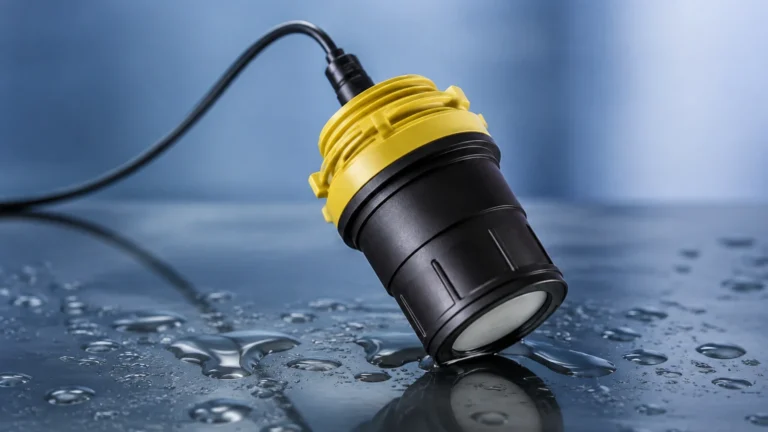
- Condensation: Droplets on the sensor face can cause "ringing" or signal interference. Modern radar sensors with convex lens antennas are designed to shed condensation effectively.
- Foam: Thick, dense foam can absorb radar and ultrasonic pulses. In these instances, guided wave radar (GWR) or hydrostatic sensors may be more reliable.
3. Tank Geometry and Internal Obstructions
Many chemical tanks contain agitators, heating coils, or baffles. Non-contact sensors with wide beam angles may pick up false reflections from these structures. Using high-frequency radar with a narrow beam angle (e.g., 3 degrees) allows the signal to avoid internal obstructions, ensuring a clear return from the liquid surface.
Technology Selection Table
The following table provides a general comparison of technologies commonly used for chemical tank level monitoring.
| Technology | Best Use Case | Max Range (Typical) | Pros | Cons |
| :— | :— | :— | :— | :— |
| 80GHz Radar | Corrosive acids, fuming liquids, small tanks | 30m – 120m | Extremely accurate, narrow beam, ignores vapor | Higher initial cost |
| Ultrasonic | Water-based chemicals, open sumps | 10m – 15m | Low cost, easy to install | Affected by foam, vapor, and wind |
| Hydrostatic | Deep tanks, pressurized vessels | 200m | Simple, no moving parts | Sensitive to density changes |
| Guided Wave Radar | Low dielectric liquids, bypass pipes | 30m | Unaffected by foam or turbulence | Contacting probe; cleaning required |
| Magnetic Gauge | High pressure, visual indication | 6m | No power needed for visual, robust | Moving parts (float) can stick |
Installation Considerations for Chemical Environments
Proper installation is as vital as sensor selection. Even the most advanced radar meter will fail if mounted incorrectly.
1. Nozzle Height and Diameter: For non-contact radar and ultrasonic sensors, the nozzle should be as short as possible. If a long nozzle is required, the sensor antenna must extend past the bottom of the nozzle to prevent signal ringing.
2. Dead Zone (Blocking Distance): Every sensor has a minimum distance it cannot measure (the "dead zone"). Ensure the tank's maximum fill level does not enter this zone, or the sensor will lose track of the level.
3. Positioning: Sensors should never be mounted in the center of a tank (to avoid multiple reflections) or directly above the fill inlet (to avoid turbulence and false readings). The ideal position is usually 1/2 to 1/3 of the tank radius from the wall.
4. Isolation Valves: For hazardous chemicals, installing the sensor behind a ball valve or a PTFE isolation shield allows for maintenance without depressurizing or emptying the tank.
For engineers seeking specific product configurations, technical drawings, and application support, please refer to the Main Page of our instrumentation catalog.

Limitations and Common Risks
While modern chemical tank level sensors are highly advanced, they are not infallible. Awareness of these limitations prevents operational downtime.
* Dielectric Constant (Dk): Radar sensors rely on the dielectric difference between air and the liquid. Non-polar solvents (like hexane or benzene) have low Dk values, which result in weaker reflections. In these cases, guided wave radar or high-sensitivity 80GHz radar is necessary.
* Crystallization and Buildup: Some chemicals, such as brine or certain polymers, tend to crystallize or build up on surfaces. If a sensor face becomes heavily coated, the signal will be lost. Non-contact sensors with air purge connections can help mitigate this.
* Ambient Temperature Extremes: While the radar signal is unaffected by temperature, the electronics in the sensor housing have limits (typically -40°C to +80°C). In extreme environments, remote-mounted electronics or cooling jackets are required.
Frequently Asked Questions (FAQs)
Q: Can I use an ultrasonic sensor for concentrated Hydrochloric Acid (HCl)?
A: It is generally not recommended. HCl fumes heavily. These fumes change the density of the air, which significantly alters the speed of sound and causes the ultrasonic sensor to provide inaccurate readings. A non-contact radar sensor with a PTFE-sealed antenna is the industry standard for this application.
Q: How do I measure the level if the chemical is stored in a plastic (IBC) tank?
A: Radar signals can penetrate plastic. It is often possible to mount a radar sensor *above* a plastic tank and measure the level through the top wall without ever making an opening, provided the plastic is not carbon-filled or metallic-lined.
Q: What is the benefit of 80GHz radar over 26GHz radar for chemicals?
A: The 80GHz frequency allows for a much smaller antenna and a narrower beam. This is crucial for chemical tanks which often have small mounting ports (e.g., 1.5" or 2" nozzles) and internal structures that a wider 26GHz beam might hit.
Q: Does the density of the chemical affect radar measurement?
A: No. Radar is a distance-based measurement and is independent of the liquid's density. This makes it superior to hydrostatic sensors in processes where the chemical concentration or temperature (and thus density) changes frequently.
Conclusion
Selecting chemical tank level sensors is a balancing act between chemical compatibility, environmental conditions, and budget. While hydrostatic and ultrasonic sensors remain viable for many utility-grade applications, the industry is increasingly shifting toward high-frequency radar due to its non-contact nature and immunity to vapor and pressure. By following the principles of material compatibility and precise installation, plant operators can ensure long-term accuracy and safety in their chemical storage facilities. For more information on custom OEM/ODM services and specific sensor models, visit the Welk Main Page.