Co2 Mass Flow Meter
Co2 Mass Flow Meter
In industrial process control, the accurate measurement of carbon dioxide (CO2) is critical for operational efficiency, safety, and regulatory compliance. Unlike volumetric flow measurement, which can be significantly affected by changes in temperature and pressure, a co2 mass flow meter provides a direct measurement of the gas mass. This distinction is vital because CO2 is highly compressible and often exists near its critical point in industrial applications.
Whether used in carbon capture and storage (CCS), food and beverage carbonation, or chemical synthesis, selecting the right mass flow technology requires an understanding of fluid dynamics and instrument physics. This guide explores the principles, selection criteria, and installation requirements for CO2 mass flow measurement, while highlighting how these systems integrate with broader industrial monitoring solutions found on the Main Page.
Understanding the Principles of CO2 Mass Flow Measurement
Mass flow measurement is defined as the movement of a mass of fluid per unit of time (e.g., kg/h or g/s). For gases like CO2, mass flow is preferred over volume flow because gas volume expands and contracts dramatically with environmental changes. To achieve mass measurement without the need for separate pressure and temperature compensation, two primary technologies are utilized: Thermal Dispersion and Coriolis.
Thermal Dispersion Principle
Thermal mass flow meters operate based on the thermal conductivity of the gas. The instrument typically features two RTD (Resistance Temperature Detector) sensors immersed in the flow stream. One sensor is heated to a constant temperature differential above the other, which acts as the reference sensor. As CO2 molecules pass over the heated sensor, they carry away heat. The electrical power required to maintain the temperature differential is directly proportional to the mass flow rate of the gas.
Coriolis Principle
Coriolis meters measure mass flow through the effect of inertia. The meter contains one or more vibrating tubes. As CO2 flows through these tubes, the mass movement induces a Coriolis force that causes the tubes to twist or shift in phase. Sensors at the inlet and outlet of the tubes measure this phase shift, which is directly proportional to the mass flow. This method is independent of the fluid's physical properties, such as density or viscosity.
Key Technologies: Thermal vs. Coriolis Mass Flow Meters
Choosing between these two technologies depends on the specific requirements of the CO2 application, including the physical state of the gas and the required precision.
Thermal Mass Flow Meters for CO2
Thermal meters are highly effective for gaseous CO2 at low to moderate pressures. They are particularly valued for their high turndown ratios (often 100:1 or better) and their ability to detect very low flow velocities. This makes them ideal for leak detection or monitoring CO2 blankets in storage tanks.
* Advantages: No moving parts, low pressure drop, and excellent sensitivity at low flow rates.
* Limitations: Highly sensitive to moisture. If liquid droplets (condensate) hit the heated sensor, it can cause significant measurement errors.
Coriolis Mass Flow Meters for CO2
Coriolis meters are the "gold standard" for high-accuracy applications. They are frequently used when CO2 is in a high-pressure gaseous state, a liquid state, or even a supercritical state (where CO2 exhibits properties of both a gas and a liquid).
* Advantages: Extremely high accuracy (typically ±0.1% to ±0.5%), measures density and temperature simultaneously, and is unaffected by flow profile disturbances.
* Limitations: Higher initial capital cost and potential for significant pressure drop in high-velocity lines.
Selection Criteria for Industrial CO2 Applications
When specifying a co2 mass flow meter, engineers must evaluate several technical parameters to ensure long-term reliability.
1. Process State and Phase
CO2 has a unique phase diagram. At 5.1 bar (73.9 psi) and -56.6°C, it reaches its triple point. In many industrial cooling or storage applications, CO2 is kept in a liquid state under pressure. If the pressure drops, it can flash into gas or form dry ice. A Coriolis meter is generally required for liquid or supercritical CO2, while thermal meters are reserved for the purely gaseous phase.
2. Accuracy Requirements
For internal process monitoring, a thermal meter with ±1.0% accuracy may suffice. However, for custody transfer—where CO2 is being sold or traded, such as in carbon credit verification—the high precision of a Coriolis meter is mandatory.
3. Flow Range and Pipe Size
Thermal meters are available in both inline and insertion styles. Insertion meters are cost-effective for large pipe diameters (DN200 and above), whereas Coriolis meters become prohibitively expensive and heavy at those sizes.
4. Gas Purity
Industrial CO2 is rarely 100% pure. It may contain traces of nitrogen, methane, or water vapor. Thermal meters must be calibrated for the specific gas composition, as different gases have different thermal properties. Coriolis meters are less sensitive to composition changes but can be affected by "two-phase" flow (gas bubbles in liquid CO2).
| Feature | Thermal Mass Flow Meter | Coriolis Mass Flow Meter |
| :— | :— | :— |
| Best State | Gaseous | Liquid, High-Pressure Gas, Supercritical |
| Accuracy | ±1% to ±5% | ±0.1% to ±0.5% |
| Turndown | 100:1 | 20:1 to 50:1 |
| Pressure Drop | Negligible | Moderate to High |
| Pipe Size | DN15 to DN1000+ (Insertion) | Typically up to DN200 |
Installation Guidelines and Best Practices
Proper installation is as important as instrument selection for maintaining the integrity of the measurement.
Straight Run Requirements
Thermal mass flow meters are sensitive to the flow profile. To ensure a stable, laminar flow, they typically require at least 10 to 20 diameters (10D–20D) of straight pipe upstream and 5 diameters (5D) downstream. If space is limited, flow conditioners may be necessary. Coriolis meters, conversely, are largely immune to flow profiles and require little to no straight pipe runs.
Orientation and Moisture Control
For gaseous CO2, the meter should be installed in a way that prevents moisture accumulation on the sensors. In horizontal pipes, thermal sensors should be mounted on the side or top of the pipe. For liquid CO2, the meter should be installed at a low point in the piping to ensure the tubes remain full, preventing "slug flow" which can disrupt Coriolis measurements.
Calibration and Zeroing
Coriolis meters must be "zeroed" at process pressure and temperature under zero-flow conditions during commissioning. Thermal meters should be factory-calibrated for the specific CO2 concentration used in the facility.
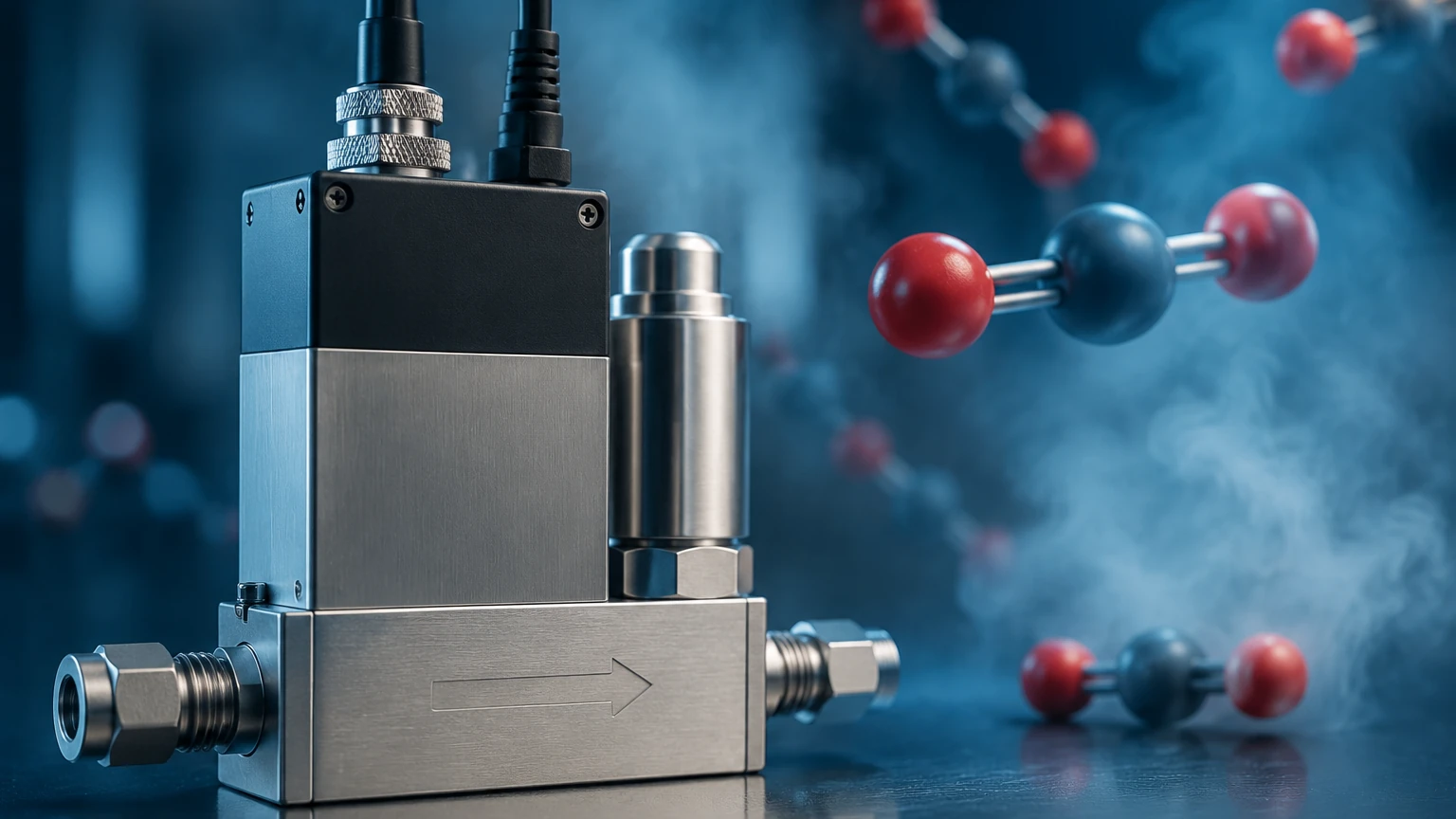
The Relationship Between Level and Flow in CO2 Storage
In many industrial setups, a co2 mass flow meter works in tandem with level measurement instruments. For example, in a refrigerated liquid CO2 bulk tank, hydrostatic or ultrasonic level sensors provide a volumetric inventory of the stored liquid. For a complete overview of these complementary technologies, engineers often consult the Main Page to select compatible level transmitters.
While the flow meter tracks the consumption or discharge rate, the level meter provides the absolute inventory. Discrepancies between the integrated flow data and the level change can alert operators to leaks in the distribution system or inaccuracies in the billing of delivered gas.
Limitations and Maintenance Requirements
Despite their robustness, these instruments are not "set and forget."
* Coating and Contamination: In some chemical processes, CO2 may carry particulates or oils. If these coat the sensors of a thermal meter, they act as insulation, leading to under-measurement of flow.
* Vibration: Coriolis meters are sensitive to external mechanical vibrations. They must be properly supported and isolated from pumps or compressors that might vibrate at frequencies near the meter's resonant frequency.
* Calibration Drift: Over time, electronic components or sensor surfaces may degrade. Annual calibration verification is recommended for high-stakes applications like carbon emissions reporting.
Frequently Asked Questions (FAQs)
Q: Can I use a standard air flow meter for CO2?
A: No. Thermal mass flow meters must be calibrated specifically for CO2 because it has a different thermal conductivity and heat capacity than air. Using an air-calibrated meter for CO2 will result in significant errors.
Q: How does supercritical CO2 affect measurement?
A: Supercritical CO2 (above 31.1°C and 73.8 bar) has the density of a liquid but the diffusivity of a gas. Coriolis meters are the preferred choice here because they measure mass directly and are not confused by the rapid density changes occurring near the critical point.
Q: Is a pressure regulator needed before the flow meter?
A: While mass flow meters are designed to handle pressure fluctuations, extreme turbulence from a regulator placed too close to the meter can affect accuracy. It is best to place the regulator at least 20 diameters upstream of a thermal meter.
Q: How do I handle moisture in the CO2 line?
A: If moisture is present, use a coalescing filter upstream of the meter. For thermal meters, ensure the probe is heated sufficiently to prevent condensation, or opt for a Coriolis meter which is unaffected by moisture as long as the fluid remains a single phase.
By integrating a high-quality co2 mass flow meter with reliable level measurement systems, industrial facilities can achieve a high degree of process transparency, ensuring that every kilogram of CO2 is accounted for in the production cycle.