High Temperature Thermocouples
High Temperature Thermocouples
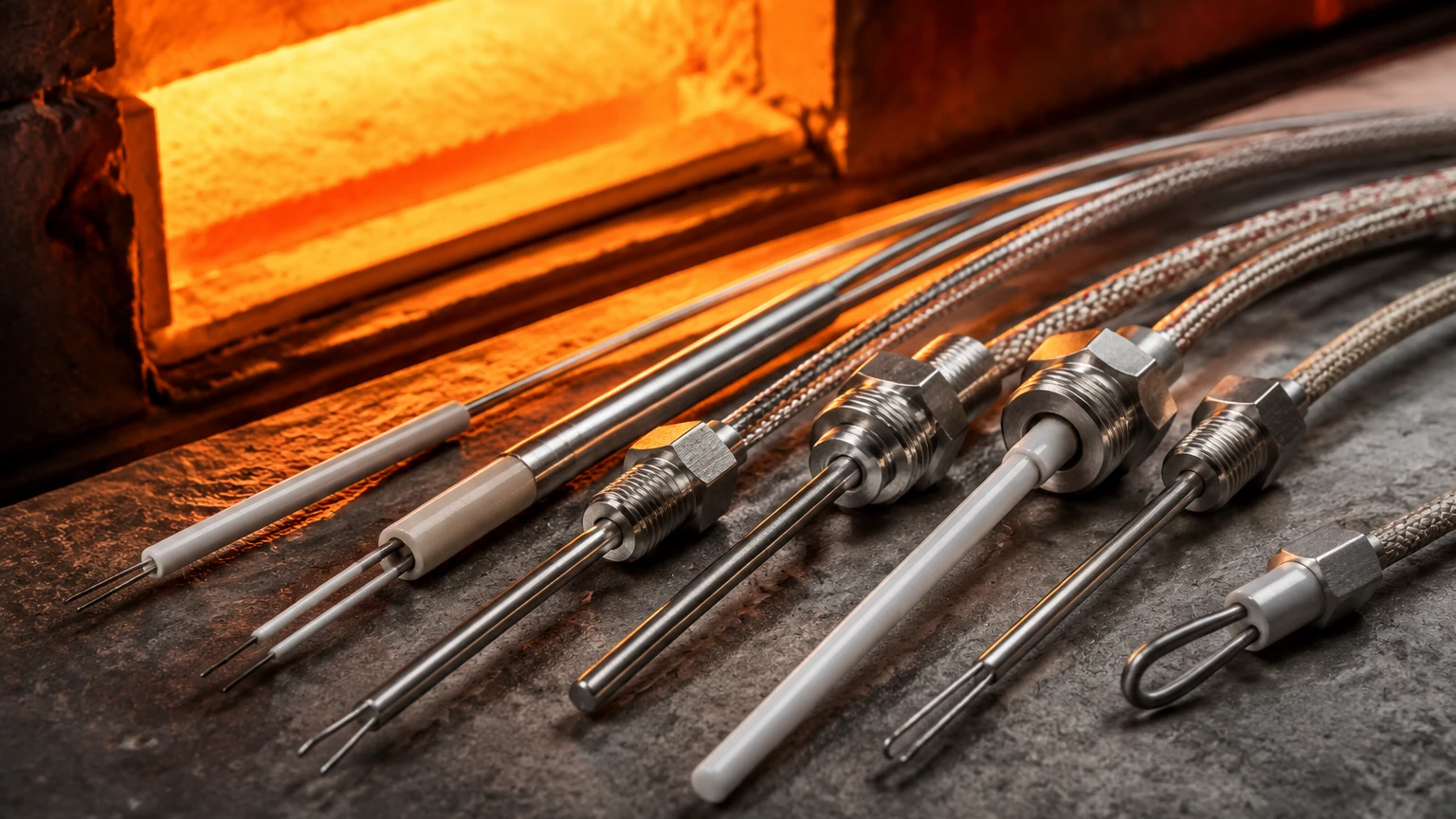
In industrial process control, the accurate measurement of extreme thermal energy is a fundamental requirement for safety, efficiency, and product quality. High temperature thermocouples are specialized sensors designed to withstand and quantify temperatures that would typically destroy standard sensing equipment. While standard industrial processes often operate within the range of 0°C to 400°C, heavy industries such as glass manufacturing, steel production, and aerospace testing require instruments capable of operating reliably above 1,000°C (1,832°F) and sometimes exceeding 2,000°C (3,632°F).
Understanding the selection, installation, and maintenance of these sensors is critical for engineers managing complex thermal systems. This guide explores the technical principles of thermoelectric measurement and provides a framework for evaluating high temperature thermocouples in demanding B2B environments.
Measurement Principles of Thermocouples
The operation of any thermocouple, including high temperature variants, is based on the Seebeck Effect, discovered by Thomas Johann Seebeck in 1821. This physical phenomenon occurs when two dissimilar metal conductors are joined at one end (the "hot junction") and exposed to a temperature gradient. This gradient generates a small voltage (electromotive force or EMF) at the open end (the "cold junction").
The magnitude of the voltage is proportional to the temperature difference between the hot and cold junctions. By measuring this voltage and knowing the specific thermoelectric properties of the metal alloys used, a controller can calculate the temperature at the hot junction.
For high-temperature applications, the challenge lies in the material science. As temperatures rise, metals undergo oxidation, grain growth, and chemical contamination, all of which can alter the thermoelectric output and lead to measurement drift. High temperature thermocouples utilize specific noble metals (such as Platinum and Rhodium) or specialized base metal alloys (such as Nicrosil and Nisil) to maintain stability in these harsh conditions.
Classification of High Temperature Thermocouples
Thermocouples are categorized by "Types" defined by international standards (IEC or ASTM). For high-heat applications, these are generally divided into base metal thermocouples and noble metal (refractory) thermocouples.
Base Metal Thermocouples (Types K and N)
Base metal sensors are cost-effective but have lower maximum temperature limits compared to noble metal versions.
* Type K (Chromel/Alumel): Perhaps the most common industrial thermocouple. It is suitable for oxidizing atmospheres up to approximately 1,260°C (2,300°F). However, it is susceptible to "green rot" (selective oxidation of chromium) if used in reducing atmospheres at high temperatures.
* Type N (Nicrosil/Nisil): Developed to overcome the instabilities of Type K. It offers superior oxidation resistance and better stability against thermoelectric drift at temperatures up to 1,200°C (2,192°F).
Noble Metal Thermocouples (Types R, S, and B)
Noble metal thermocouples use platinum and rhodium. They are significantly more expensive but offer the highest levels of accuracy and stability at extreme temperatures.
* Type S (Platinum 10% Rhodium / Platinum): The standard for laboratory calibration and high-end industrial furnaces, capable of reaching 1,480°C (2,700°F).
* Type R (Platinum 13% Rhodium / Platinum): Similar to Type S but offers slightly higher mechanical strength and a marginally higher signal output. It is used in glass and steel industries up to 1,480°C.
* Type B (Platinum 30% Rhodium / Platinum 6% Rhodium): Designed for the highest industrial ranges, Type B can operate up to 1,700°C (3,100°F) and is less susceptible to grain growth than Types R and S.
Selection Table: Temperature and Environment
| Thermocouple Type | Max Continuous Temp | Atmosphere Compatibility | Typical Applications |
| :— | :— | :— | :— |
| Type K | 1,260°C (2,300°F) | Oxidizing, Inert | Heat treating, Kilns |
| Type N | 1,200°C (2,192°F) | Oxidizing, Reducing, Vacuum | Gas turbines, Smelting |
| Type R/S | 1,480°C (2,700°F) | Oxidizing, Inert | Glass melting, Semiconductors |
| Type B | 1,700°C (3,100°F) | Oxidizing, Inert | Steel production, Research |
| Tungsten-Rhenium | 2,315°C (4,200°F) | Vacuum, Hydrogen, Inert | Aerospace, Nuclear research |
Material Science: Protection Tubes and Sheaths
A high temperature thermocouple is only as durable as its protective housing. At temperatures exceeding 1,000°C, standard stainless steel sheaths fail due to melting or rapid oxidation. Engineers must select appropriate protection tubes based on the chemical and thermal environment.
1. Ceramic Protection Tubes: Most noble metal thermocouples require ceramic primary protection. Alumina (99.7% Al2O3) is the gold standard because it is gas-tight and prevents "silica poisoning," where silicon vapors contaminate the platinum wires and cause them to become brittle.
2. Exotic Metal Sheaths: For applications involving high pressure or mechanical stress, materials like Inconel 600, Haynes 230, or Molybdenum are used. Molybdenum is excellent for vacuum furnaces but will oxidize instantly if exposed to air at high temperatures.
3. Silicon Carbide: Often used as a secondary outer protection tube in harsh environments like aluminum smelting or waste incineration due to its excellent thermal shock resistance and abrasion resistance.
Selection Criteria for Industrial Applications
When specifying high temperature thermocouples, B2B procurement and engineering teams should evaluate the following criteria:
* Temperature Range: Determine both the continuous operating temperature and the peak excursion temperature. Noble metals are required if the process frequently exceeds 1,200°C.
* Atmospheric Chemistry: Is the environment oxidizing (excess oxygen), reducing (excess fuel/hydrogen), or vacuum? Type K fails in reducing atmospheres, while Tungsten-Rhenium fails in oxidizing ones.
* Response Time vs. Durability: Thicker protection tubes increase the lifespan of the sensor but slow down the thermal response time. In dynamic processes like gas turbine exhaust monitoring, a balance must be struck.
* Accuracy Requirements: Noble metal thermocouples (R, S, B) offer much tighter tolerances (standard limits of error are often ±0.25% or better) compared to base metals (±0.75%).
In many industrial setups, temperature monitoring is part of a broader instrumentation strategy. For instance, in high-temperature chemical reactors, level measurement accuracy is often dependent on temperature data. To explore how integrated instrumentation impacts process efficiency, you can Review product options and application support on our Main Page.
Installation and Maintenance Best Practices
Proper installation is essential to ensure the longevity of high temperature thermocouples and the accuracy of the data they provide.
Immersion Depth
To avoid conduction errors (where heat escapes along the protection tube), the sensor must be immersed to a sufficient depth. A general rule of thumb is an immersion depth equal to 10 times the diameter of the protection tube. For example, a 20mm diameter probe should be immersed at least 200mm into the process.
Thermal Shock
Ceramic protection tubes are brittle. Rapidly inserting a cold ceramic probe into a 1,400°C furnace will cause the tube to shatter. Probes should be pre-heated or inserted slowly (e.g., 25mm to 50mm per minute) to allow the ceramic to expand gradually.
Lead Wire Selection
The wire connecting the thermocouple head to the controller must be "Extension Grade" or "Compensating" wire that matches the thermoelectric characteristics of the thermocouple type. Using standard copper wire will create a new, unwanted thermocouple junction at the terminal head, leading to massive measurement errors.
Limitations and Common Risks
Despite their robustness, high temperature thermocouples face several failure modes:
* Drift: Over time, the chemical composition of the wires changes due to the diffusion of impurities or the evaporation of alloying elements. This causes the voltage output to change, meaning the reported temperature is no longer accurate. Regular calibration is mandatory.
* Contamination: Metal vapors in a furnace can penetrate the protection tube and alloy with the thermocouple wires. This is a common cause of failure in noble metal sensors used in glass or metal processing.
* Electromagnetic Interference (EMI): Because thermocouples produce very low millivolt signals, they are susceptible to electrical noise from nearby high-power furnace heating elements. Shielded cables and proper grounding are necessary.
Integration with Level Measurement Systems
In heavy industrial applications, temperature and level measurement are often inextricably linked. For example, in molten glass or metal processing, the density of the material changes significantly with temperature. If a plant is using a hydrostatic level transmitter or a radar level meter, the temperature data from high temperature thermocouples is used to compensate the level reading in real-time.
Without accurate temperature compensation, level readings can drift by several percentage points, leading to tank overflows or process inconsistencies. Professional manufacturers like Welk provide a range of instruments that work in tandem with thermal sensors to ensure high-precision automation. For more information on how these technologies integrate, visit the Main Page.
Frequently Asked Questions (FAQ)
Q: How often should I calibrate my high temperature thermocouple?
A: This depends on the operating temperature. For noble metal sensors running at 1,400°C, many facilities perform a check every 3 to 6 months. Base metal sensors used near their limit may need replacement rather than calibration due to the low cost and high drift rate.
Q: Can I use a Type K thermocouple in a vacuum furnace?
A: It is not recommended for high temperatures in a vacuum. The chromium in the Chromel wire can vaporize, leading to rapid drift and eventual failure. Type N or Tungsten-Rhenium are better suited for vacuum environments.
Q: Why is my Type B thermocouple reading 0°C at room temperature?
A: Type B thermocouples have a very low millivolt output at low temperatures. In fact, their output is nearly flat between 0°C and 40°C, making them unsuitable for measurements below 50°C (122°F).
Q: What is the difference between an ungrounded and a grounded junction?
A: A grounded junction is physically attached to the sheath, providing a faster response time but making the sensor vulnerable to electrical noise. An ungrounded junction is electrically isolated, which is preferred for high-temperature furnaces with electrical heating elements.
Conclusion
High temperature thermocouples are indispensable tools in the modern industrial landscape. By selecting the correct type—whether it be the robust Type N for gas turbines or the precise Type B for platinum smelting—and pairing it with the correct protection materials, engineers can maintain control over even the most extreme thermal processes. When combined with advanced level measurement solutions available on the Main Page, these sensors form the backbone of safe and efficient high-heat industrial automation.