Coriolis Flow Meter Calibration
Coriolis Flow Meter Calibration
Coriolis flow meters are widely regarded as the gold standard for mass flow measurement in industrial automation. Unlike volumetric flow meters, which require compensation for temperature and pressure, Coriolis meters measure mass directly by utilizing the principles of fluid mechanics and inertia. However, the high inherent accuracy of these instruments—often reaching ±0.1% or better—is only as reliable as the calibration protocols supporting them.
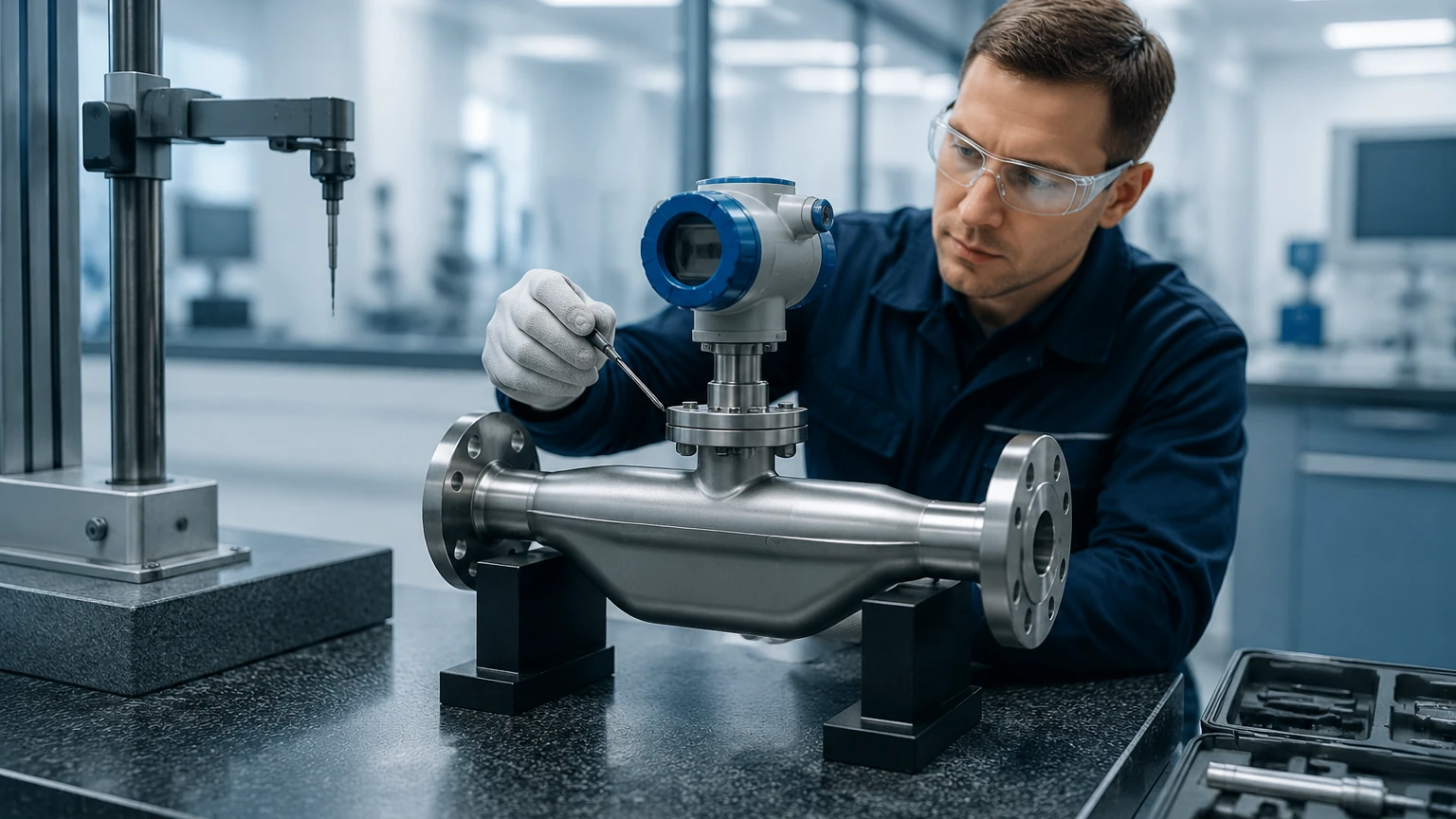
Coriolis flow meter calibration is the process of verifying and adjusting the instrument against a traceable reference standard to ensure its output aligns with the actual mass flow passing through the sensor. For process engineers and plant managers, understanding the nuances of this procedure is essential for maintaining custody transfer standards, ensuring chemical dosing precision, and meeting stringent regulatory requirements.
Understanding the Coriolis Measurement Principle
Before delving into calibration techniques, it is necessary to understand how these meters function. A Coriolis meter consists of one or more vibrating tubes, typically driven by an electromagnetic coil. When a fluid (liquid or gas) flows through these vibrating tubes, it induces a Coriolis force. This force causes a slight distortion or "twist" in the tube's vibration pattern.
Sensors located at the inlet and outlet of the tubes measure this vibration. When there is no flow, the tubes vibrate in phase. As flow begins, the Coriolis effect causes the inlet and outlet sections to vibrate out of phase. This phase shift (measured in time, usually microseconds) is directly proportional to the mass flow rate. Simultaneously, the frequency of the vibration is used to calculate the fluid's density, as a denser fluid increases the mass of the tube system, lowering the resonant frequency.
Because the measurement relies on the physical properties of the tube and the resulting inertia, Coriolis flow meter calibration focuses on two primary factors: the flow factor (slope) and the zero offset (intercept).
The Importance of Coriolis Flow Meter Calibration
While Coriolis meters have no moving parts to wear out, their calibration can shift due to several factors. Over time, internal coating, erosion of the tube walls, or extreme mechanical stress can alter the stiffness or mass of the measuring tubes.
Regular calibration is critical for:
1. Regulatory Compliance: Many industries, such as pharmaceutical and food production, require documented traceability to national standards (NIST, PTB, etc.).
2. Custody Transfer: In oil and gas applications, small errors in mass flow measurement can result in significant financial discrepancies over time.
3. Process Efficiency: In chemical blending, precise mass ratios are required to ensure product quality and reduce waste.
4. Safety: Accurate measurement of hazardous materials prevents overfilling or incorrect reactor charging.
For those seeking comprehensive instrumentation solutions, including advanced measurement technology and technical support, visiting the Main Page of a professional manufacturer provides a broader context for integrating these meters into industrial systems.
Primary Calibration Methodologies
There are several recognized methods for coriolis flow meter calibration, each with distinct advantages depending on the required uncertainty levels and the operating environment.
1. Gravimetric (Weight-Scale) Method
This is the most accurate method and is typically performed in a laboratory setting. The fluid (usually water) passes through the Coriolis meter and is collected in a vessel situated on a high-precision weigh scale.
* Process: The mass measured by the scale is compared to the totalized mass reported by the meter over a specific time interval.
* Considerations: Corrections must be made for air buoyancy and the "static start-stop" or "dynamic diverter" errors. This method offers the lowest uncertainty, often better than 0.03%.
2. Master Meter Method
In this setup, the meter under test (MUT) is placed in series with a "Master Meter" that has a significantly higher accuracy and a known, documented calibration history.
* Process: The readings from both meters are compared across various flow rates.
* Advantage: This method is faster than gravimetric calibration and can often be performed in the field (in-situ) using a mobile calibration rig.
* Requirement: The Master Meter must typically be 3 to 4 times more accurate than the meter being calibrated.
3. Transfer Standard (Piston Prover)
Commonly used in the oil and gas industry, a piston prover uses a precisely machined cylinder and a piston to displace a known volume of fluid. When combined with high-precision density measurement, it provides a highly accurate mass flow reference.
Key Evaluation Criteria for Calibration Services
When selecting a calibration partner or designing an internal protocol, several criteria must be evaluated to ensure the validity of the results:
| Criterion | Description | Importance |
| :— | :— | :— |
| Uncertainty Ratio | The ratio between the accuracy of the reference standard and the meter under test. | High: Ensures the calibration is statistically significant. |
| Traceability | The unbroken chain of comparisons to national or international standards. | Essential for legal and ISO compliance. |
| Flow Range (Turndown) | The ability to calibrate the meter across its entire operating range, not just a single point. | High: Ensures accuracy at low and high flow rates. |
| Fluid Properties | The viscosity, density, and temperature of the calibration fluid. | Moderate: Coriolis meters are mostly independent of fluid properties, but extremes can affect results. |
| Repeatability | The ability of the calibration system to produce the same result under identical conditions. | High: Indicates the stability of the calibration process. |
Factors Affecting Calibration Accuracy and Common Risks
Achieving a successful coriolis flow meter calibration requires the mitigation of environmental and process-related variables.
Zero Stability
One of the most critical aspects of Coriolis calibration is the "Zero Offset." If the meter does not read exactly zero when there is no flow, this error will be added to every subsequent measurement. Zeroing must be performed at process temperature and pressure, with the meter completely full of stagnant fluid.
Entrained Gas and Cavitation
Coriolis meters are sensitive to multi-phase flow. If air bubbles are trapped in a liquid (or liquid droplets in a gas), the vibration of the tubes becomes erratic, leading to high uncertainty. During calibration, it is vital to ensure the fluid is single-phase and that back-pressure is sufficient to prevent cavitation.
Mechanical Stress and Vibration
Since the meter operates on vibration, external mechanical noise or piping stress can interfere with the sensor signals. If a meter is calibrated in a lab but installed in a high-vibration environment without proper damping, the calibration may not hold its integrity.
Temperature and Pressure Effects
While Coriolis meters are designed to compensate for temperature (using internal RTDs), extreme pressures can slightly stiffen the flow tubes. High-end meters include pressure compensation factors, which must be verified during the calibration process if the operating pressure differs significantly from the calibration pressure.
Installation Considerations for Maintaining Calibration Integrity
To ensure that the calibrated accuracy is maintained after the meter is returned to service, follow these installation guidelines:
1. Stress-Free Mounting: Use robust supports and ensure the piping is aligned. Do not use the meter to pull misaligned pipes together, as this puts torque on the sensor tubes.
2. Orientation: For liquid applications, the "tubes down" (flag) orientation is preferred to prevent gas trapping. For gas applications, "tubes up" is preferred to prevent condensate accumulation.
3. Straight Runs: While Coriolis meters are less sensitive to flow profiles than ultrasonic or turbine meters, placing them away from heavy turbulence (like pumps or half-open valves) is still considered best practice.
4. Electrical Grounding: Ensure the meter is properly grounded to prevent electrical noise from interfering with the low-voltage phase shift signals.
Practical Selection Table for Calibration Approaches
Engineers should choose their calibration frequency and method based on the criticality of the application.
| Application Type | Recommended Method | Frequency | Target Uncertainty |
| :— | :— | :— | :— |
| Custody Transfer | Gravimetric / Piston Prover | Annually | < 0.1% |
| Chemical Dosing | Master Meter | Every 2 Years | 0.2% – 0.5% |
| General Process Control | In-situ Verification | Every 2-3 Years | 0.5% – 1.0% |
| Waste Water / Utilities | Electronic Verification | As needed | > 1.0% |
Frequently Asked Questions (FAQs)
Q: How often should a Coriolis flow meter be calibrated?
A: Frequency depends on the industry and application. For critical custody transfer, annual calibration is standard. For stable process applications, every 2 to 3 years may suffice, provided regular "zero checks" and internal diagnostics (verification) are performed.
Q: Can I calibrate a Coriolis meter with water if it usually measures oil?
A: Yes. One of the primary advantages of Coriolis technology is that the mass flow calibration is largely independent of the fluid's physical properties. A meter calibrated on water will typically maintain its accuracy when measuring other liquids, provided the Reynolds number and density are within the meter's design limits.
Q: What is the difference between calibration and verification?
A: Calibration is a physical comparison against a known standard and involves adjusting the meter's factors. Verification is an internal diagnostic check (often automated) that ensures the meter's electronics and sensor integrity have not drifted, but it does not replace a traceable calibration.
Q: Does pipe vibration affect calibration?
A: Yes, excessive vibration at or near the resonant frequency of the meter tubes can cause measurement errors. High-quality meters use dual tubes and advanced filtering to minimize this, but it remains a factor to monitor during installation.
Conclusion
Coriolis flow meter calibration is a fundamental requirement for any facility prioritizing precision and reliability. By understanding the underlying physics of the Coriolis effect and the variables that influence measurement stability—such as zero offset, mechanical stress, and fluid phase—engineers can implement effective maintenance strategies. Whether utilizing laboratory-grade gravimetric systems or field-based master meters, maintaining a rigorous calibration schedule ensures that these sophisticated instruments continue to provide the accurate data necessary for modern industrial automation. For more information on selecting the right measurement technology for your specific application, Review product options and application support to find the most cost-effective and reliable solutions.