Coriolis Flujometro
Coriolis Flujometro
In the landscape of industrial process control, precision is the primary driver of efficiency and profitability. Among the various technologies available for measuring fluid dynamics, the Coriolis flujometro (Coriolis flow meter) stands out as a premier solution for direct mass flow measurement. Unlike volumetric flow meters, which require compensation for temperature and pressure to calculate mass, a Coriolis meter measures the actual mass of the fluid passing through the system. This capability makes it indispensable in sectors ranging from chemical processing to oil and gas, where exact mass balance is critical.
This guide provides a technical overview of Coriolis technology, its operational principles, and practical considerations for engineers and procurement professionals. While specialized instruments like radar and ultrasonic sensors are vital for tank inventory, as seen in the comprehensive range of solutions on the Main Page, the Coriolis flujometro serves as the high-precision "cash register" for flowing processes.
Understanding the Coriolis Measurement Principle
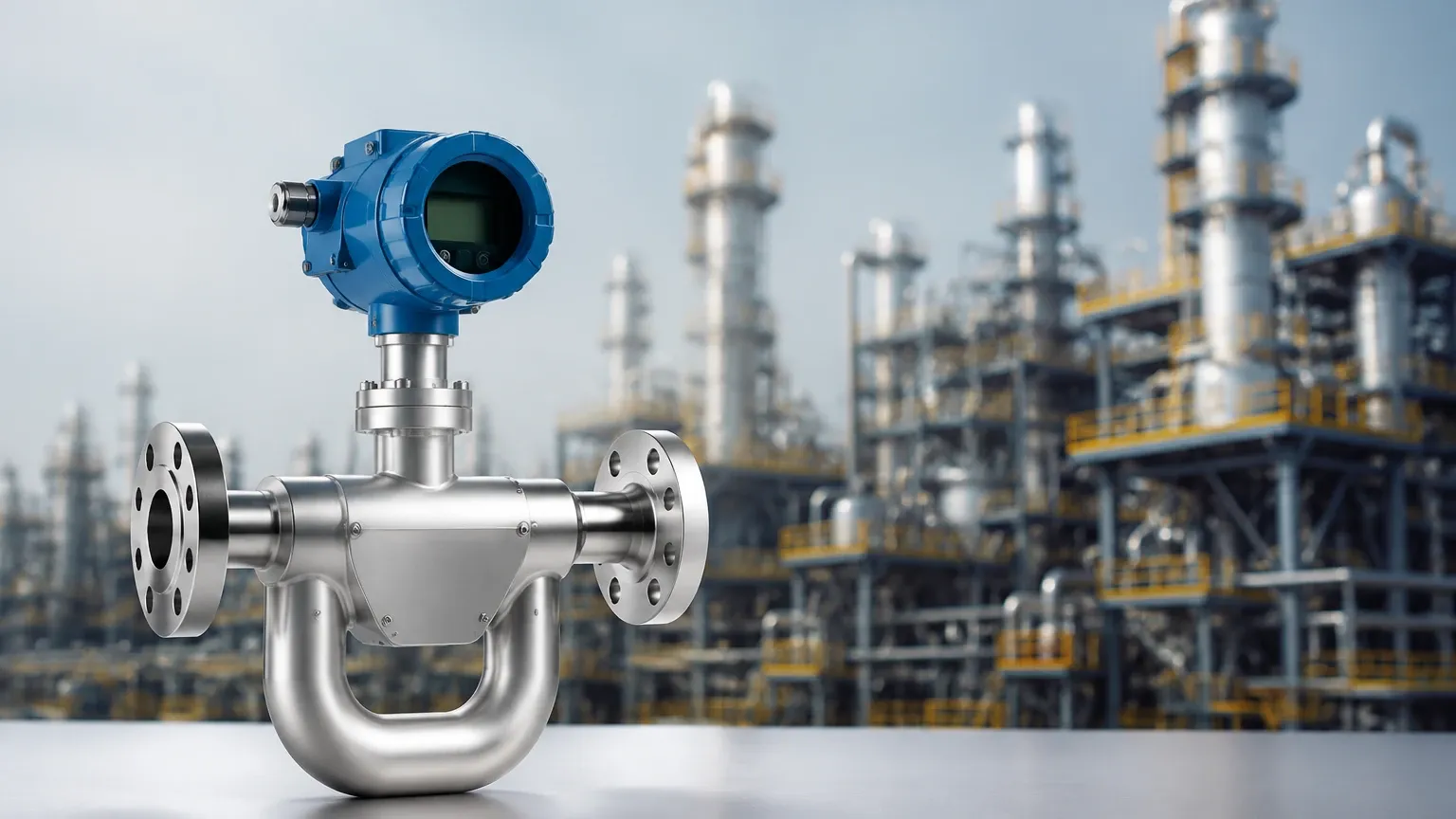
The operation of a Coriolis flujometro is based on the principles of classical mechanics, specifically the Coriolis effect. To understand how this works in an industrial instrument, one must visualize the internal components of the meter.
The Vibrating Tube Mechanism
Inside the meter, there are typically one or two measuring tubes. An internal drive coil causes these tubes to vibrate at their resonant frequency. When there is no flow, the tubes vibrate in a uniform, symmetrical manner. Sensors (pick-offs) located at the inlet and outlet sides of the tubes record this vibration as a consistent sine wave.
The Coriolis Effect in Action
When a fluid (liquid or gas) begins to flow through the vibrating tubes, the mass of the fluid introduces a secondary motion. According to the Coriolis law, an inertial force is generated whenever a mass moves linearly within a rotating or vibrating system.
1. Inlet Side: The fluid moving into the vibrating tube resists the upward motion, effectively pushing down on the tube.
2. Outlet Side: The fluid exiting the tube resists the downward motion, pushing up on the tube.
This opposing force causes the measuring tubes to twist. This twist results in a phase shift between the sine waves recorded by the inlet and outlet sensors. The time delay (delta-T) between these two waves is directly proportional to the mass flow rate. Because the vibration frequency is also affected by the density of the fluid, the Coriolis flujometro can simultaneously measure density and temperature, providing a multivariable output from a single device.
Why Use a Coriolis Flujometro in Industrial Processes?
The adoption of Coriolis technology is driven by its unique ability to provide high-accuracy data without the need for extensive straight-run piping or frequent recalibration.
Unmatched Accuracy
Most high-quality Coriolis meters offer mass flow accuracy of ±0.1% or better. Because they measure mass directly, they are unaffected by changes in fluid viscosity, conductivity, or flow profile. This is a significant advantage over electromagnetic or ultrasonic flow meters, which may require specific Reynolds numbers to maintain accuracy.
Multivariable Data Acquisition
A single Coriolis flujometro provides three primary measurements:
* Mass Flow: The primary measurement for chemical reactions and custody transfer.
* Density: Critical for quality control and identifying fluid composition changes.
* Temperature: Used for internal compensation and process monitoring.
Reduced Maintenance
Since there are no moving parts in the fluid stream (such as rotors or gears), mechanical wear is virtually non-existent. Provided the materials of construction are compatible with the process fluid, these meters can operate for years with minimal intervention.
Technical Selection Criteria
Selecting the right Coriolis flujometro requires a detailed understanding of the process conditions. Engineers must look beyond the pipe size and evaluate the specific dynamics of the application.
Material Compatibility
The measuring tubes are the most critical component. Standard meters often use 316L stainless steel, but for highly corrosive fluids, alloys like Hastelloy C22 or Tantalum may be required. Selecting the wrong material can lead to tube pitting or stress corrosion cracking, which compromises both safety and accuracy.
Pressure Drop Considerations
Unlike full-bore magnetic flow meters, Coriolis meters often involve a reduction in the flow path or a split into two tubes. This can create a pressure drop. It is essential to calculate the allowable pressure drop at maximum flow rates to ensure the process remains within its design limits.
Flow Range and Turndown Ratio
Coriolis meters have an exceptional turndown ratio, often exceeding 100:1. However, accuracy typically degrades at the very low end of the flow range. Selecting a meter where the nominal flow rate sits at approximately 50-70% of the meter's capacity is generally considered best practice.
Selection Table for Coriolis Flow Meters
| Parameter | Standard Industrial | High-Precision / Custody Transfer | Harsh Chemical |
| :— | :— | :— | :— |
| Accuracy (Liquid) | ±0.2% to ±0.5% | ±0.05% to ±0.1% | ±0.1% |
| Accuracy (Gas) | ±0.75% | ±0.35% to ±0.5% | ±0.5% |
| Tube Material | 316L Stainless Steel | 316L / Titanium | Hastelloy / Tantalum |
| Pressure Rating | Up to 40 bar | Up to 100 bar | Varies by Alloy |
| Typical Size Range | DN15 – DN100 | DN1 – DN300 | DN15 – DN50 |
Synergy Between Flow and Level Measurement
In complex industrial systems, the Coriolis flujometro does not work in isolation. It is part of a broader instrumentation ecosystem that includes level measurement. While a Coriolis meter measures what enters or leaves a vessel, level sensors—such as the radar and hydrostatic transmitters found at Welk—measure the current inventory within that vessel.
Mass Balance Verification
By combining the mass flow data from a Coriolis meter with the volume/level data from a radar level meter, engineers can perform a real-time mass balance. If the mass entering the tank (measured by flow) does not match the increase in mass within the tank (calculated by level and density), it can indicate a leak, a measurement error, or an unexpected change in fluid density.
Redundancy and Safety
In safety-instrumented systems (SIS), having two different technologies (flow and level) provide data on the same process variable (inventory change) adds a layer of redundancy. This diversity in measurement technology reduces the risk of common-cause failures.
Installation and Maintenance Guidelines
Proper installation is the most significant factor in ensuring the long-term performance of a Coriolis flujometro. Despite their robustness, these instruments are sensitive to how they are integrated into the piping system.
Orientation Matters
The orientation of the meter depends on the phase of the fluid:
* Liquids: The meter should ideally be installed in a "U" down position or in a vertical pipe with upward flow. This ensures the tubes remain full and prevents air bubbles from becoming trapped, which can cause measurement noise.
* Gases: The meter should be installed in a "U" up position or in a vertical pipe with downward flow. This allows any condensed liquids to drain out of the tubes rather than pooling and causing errors.
Vibration and Stress
Because the meter relies on internal vibration, external mechanical vibration from pumps or agitators can interfere with the signal. It is crucial to support the piping on both the inlet and outlet sides of the meter. Furthermore, the meter should never be used to support the weight of the pipe; flange alignment must be precise to avoid putting mechanical stress on the sensor body.
Zeroing the Meter
Upon installation and under full process pressure and temperature, the meter must be "zeroed." This involves stopping the flow completely (using valves on both sides of the meter) and allowing the transmitter to calibrate the zero-flow signal. This step is essential for maintaining accuracy at low flow rates.
Practical Limitations and Challenges
While the Coriolis flujometro is highly versatile, it is not a universal solution for every application. Engineers must be aware of its limitations.
1. Initial Cost: Coriolis meters are generally more expensive than vortex, turbine, or electromagnetic meters. The investment must be justified by the need for high accuracy or multivariable data.
2. Size and Weight: High-capacity Coriolis meters (e.g., DN250 and above) are extremely heavy and bulky, requiring significant structural support.
3. Entrained Gas: While modern digital signal processing has improved performance in two-phase flow (liquid with gas bubbles), excessive entrained gas can still cause the tubes to stall or produce erratic readings.
4. Pressure Drop: As mentioned previously, the internal geometry of some Coriolis meters can cause a higher pressure drop compared to straight-through technologies.
Frequently Asked Questions (FAQ)
Q: Can a Coriolis flujometro measure steam?
A: While technically possible, Coriolis meters are rarely used for steam due to the high velocities and relatively low mass of steam compared to liquids. Vortex flow meters are generally more cost-effective for steam applications.
Q: Does the viscosity of the fluid affect the accuracy?
A: No. One of the primary advantages of Coriolis technology is that it is immune to changes in viscosity. It can measure everything from water to heavy crude oil or molasses with the same level of precision.
Q: How often should a Coriolis meter be calibrated?
A: In many stable industrial applications, a Coriolis meter can go 2 to 5 years without a full wet calibration. However, many users perform annual "verification" checks using internal diagnostic software to ensure the tubes have not suffered from erosion or coating.
Q: Is a straight run of pipe required before the meter?
A: Unlike most other flow technologies, Coriolis meters do not require long straight runs of pipe. They are unaffected by flow profile disturbances like elbows or valves, although it is still good practice to avoid placing a control valve immediately upstream of the meter to prevent cavitation.
Conclusion
The Coriolis flujometro remains the gold standard for mass flow measurement in modern industry. Its ability to provide direct mass, density, and temperature data with high precision makes it a cornerstone of efficient process engineering. By understanding the underlying physics, adhering to strict installation standards, and selecting the appropriate materials, facilities can achieve unparalleled control over their fluid processes. When integrated with reliable level measurement systems, such as those provided by Welk, the Coriolis meter ensures that every kilogram of material is accounted for, driving both safety and profitability in the B2B industrial sector.