Coriolis Mass Meter
Coriolis Mass Meter
In the landscape of industrial process control, the Coriolis mass meter stands as one of the most versatile and accurate instruments available. Unlike volumetric flow meters, which require secondary measurements of temperature and pressure to calculate mass, a Coriolis meter measures mass flow directly. This capability makes it an essential tool for high-precision applications in the chemical, pharmaceutical, and oil and gas industries. At Welk, while our primary focus remains on advanced level measurement technologies found on our Main Page, understanding the integration of flow and level systems is critical for comprehensive process automation.
Understanding the Coriolis Measurement Principle
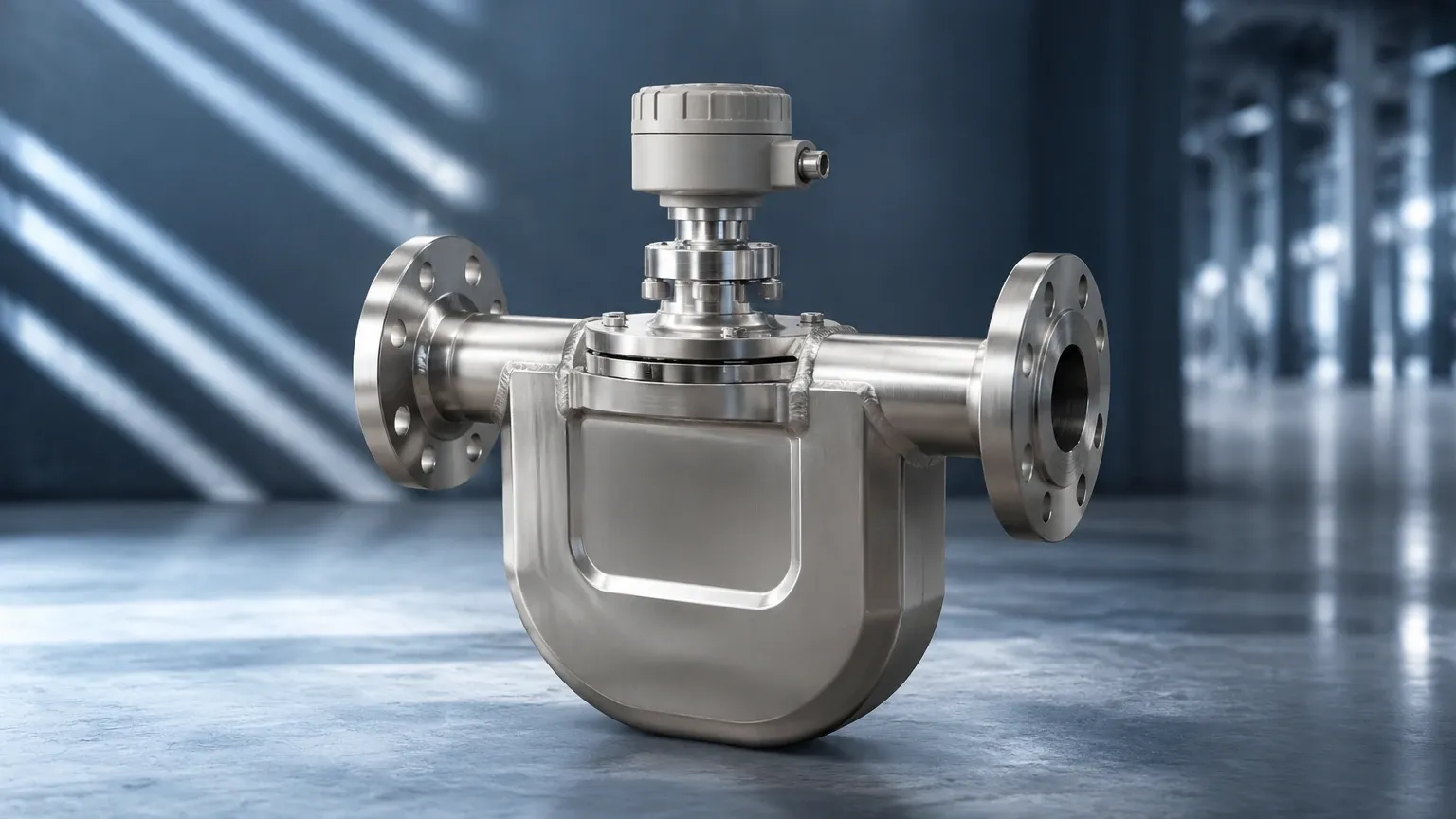
The operation of a Coriolis mass meter is rooted in the principles of classical mechanics, specifically the Coriolis effect. The device typically consists of one or two vibrating tubes through which the process fluid flows.
The Mechanics of Oscillation
An internal drive coil causes the measuring tubes to oscillate at their resonant frequency. When there is no flow, the tubes vibrate in a uniform, symmetrical manner. However, when a fluid (liquid or gas) moves through these vibrating tubes, it introduces a Coriolis force. This force acts in opposition to the vibration: it resists the upward motion as the fluid enters the tube and resists the downward motion as it exits.
Phase Shift and Mass Flow
This resistance causes a slight twisting or distortion in the tubes, known as a phase shift. Sensors located at the inlet and outlet of the tubes (pick-off coils) measure the time difference between the oscillations of the two ends. This time delay ($Δt$) is directly proportional to the mass flow rate. Because mass is an intrinsic property that does not change with temperature or pressure, the Coriolis meter provides an exceptionally stable and accurate reading regardless of changing process conditions.
Density and Temperature Measurement
Beyond mass flow, these meters are inherently multi-parameter devices:
* Density: The resonant frequency at which the tubes vibrate is a function of the total mass of the tubes and the fluid inside them. By measuring this frequency, the meter can calculate the fluid's density in real-time.
* Temperature: To compensate for changes in the elasticity of the measuring tubes caused by temperature fluctuations, an internal Resistance Temperature Detector (RTD) is integrated into the sensor. This temperature data is also available as an output for process monitoring.
Key Advantages of Mass Flow Measurement
For engineering teams managing complex fluid systems, the Coriolis mass meter offers several distinct advantages over traditional technologies like turbine meters or differential pressure (DP) cells.
1. Direct Measurement: It eliminates the need for complex flow computers and external sensors to compensate for fluid expansion or contraction.
2. High Accuracy: Standard industrial Coriolis meters typically offer accuracies of ±0.1% for liquids and ±0.5% for gases, with some high-end models reaching ±0.05%.
3. Low Maintenance: Since there are no moving parts in the fluid stream (such as rotors or bearings), mechanical wear is virtually non-existent, leading to a long service life.
4. Bi-directional Flow: These meters can measure flow in both directions without any loss of accuracy, which is useful for loading and unloading operations.
5. Viscosity Independence: The measurement is largely unaffected by changes in fluid viscosity, making it ideal for non-Newtonian fluids or processes where the product grade changes frequently.
Technical Selection Criteria for Industrial Applications
Choosing the right Coriolis mass meter requires a detailed analysis of the process environment. The following table provides a comparison of common tube geometries and their typical applications.
Selection Matrix: Tube Geometry
| Feature | U-Shaped Tubes | Straight-Through Tubes |
| :— | :— | :— |
| Sensitivity | High; better for low flow rates | Lower; requires higher velocities |
| Pressure Drop | Higher due to bends | Lower; ideal for gravity-fed systems |
| Cleanability | Difficult; potential for entrapment | Excellent; suitable for CIP/SIP (Hygienic) |
| Compactness | Bulky; requires more vertical space | Compact; easy to install in tight pipe runs |
| Solids Handling | Risk of erosion at bends | Superior for slurries and abrasive fluids |
Material Compatibility
The wetted parts of the meter must be compatible with the process fluid. Common materials include:
* 316L Stainless Steel: The standard for most water-based and mildly corrosive chemical applications.
* Hastelloy C-22: Used for highly aggressive chemicals and acids.
* Tantalum: Reserved for the most extreme corrosive environments where even Hastelloy fails.
Installation Guidelines and Best Practices
Proper installation is paramount to ensuring the long-term accuracy and reliability of a Coriolis mass meter. While these devices are robust, they are sensitive to external mechanical influences.
Orientation
* Liquids: For liquid service, the meter should ideally be installed with the tubes pointing downward (in a "U" configuration) to prevent gas bubbles from becoming trapped, which can interfere with the vibration frequency.
* Gases: For gas service, the tubes should point upward to prevent condensate or liquids from pooling in the bottom of the tubes.
* Slurries: Vertical installation with upward flow is preferred to prevent solids from settling and to ensure the tubes remain full.
Vibration and Stress
Coriolis meters operate by measuring minute vibrations. Consequently, external vibrations from pumps or heavy machinery can introduce noise into the signal. It is essential to:
* Use rigid supports and brackets on both the inlet and outlet piping.
* Avoid installing the meter directly adjacent to high-vibration equipment without flexible couplings.
* Ensure the piping is properly aligned to avoid mechanical stress on the meter body, which can distort the tubes and cause zero-point drift.
Zeroing the Meter
After installation and before the first run, the meter must be "zeroed." This process involves filling the meter with the process fluid, ensuring there is zero flow (usually by closing valves on both sides), and then running the transmitter's zero-calibration routine. This accounts for any residual stresses from the installation.
Limitations and Operational Constraints
Despite their versatility, Coriolis mass meters are not a "one-size-fits-all" solution. Engineers should be aware of the following limitations:
* Initial Cost: The capital expenditure for a Coriolis meter is significantly higher than for an ultrasonic or electromagnetic flow meter. However, the total cost of ownership (TCO) is often lower due to reduced maintenance and high accuracy.
* Line Size Limits: While technology is advancing, Coriolis meters for very large pipes (above 300 mm or 12 inches) become extremely heavy, bulky, and expensive.
* Gas Entrainment: While modern digital signal processing (DSP) has improved performance in "slug flow" conditions, a high percentage of entrained air in a liquid stream can still cause the tubes to stop vibrating (stalling), leading to measurement errors.
* Pressure Drop: U-tube designs can introduce a significant pressure drop in high-velocity applications, which may require upsizing the pump or the meter itself.
Integration with Level Measurement Systems
In many industrial setups, mass flow meters and level sensors work in tandem. For instance, in a chemical reactor, a radar level meter from Welk provides the primary volume measurement, while a Coriolis meter monitors the precise mass of reactants being added. This redundancy allows for mass-balance calculations that can detect leaks, evaporation, or changes in product density that a single instrument might miss. For more information on how to select the right level instruments to complement your flow systems, visit our Main Page.
Frequently Asked Questions (FAQ)
Q: Can a Coriolis meter measure the flow of steam?
A: While theoretically possible, it is rarely practical. The low density of steam requires very high velocities to generate enough Coriolis force for an accurate reading, often leading to excessive pressure drops. Vortex or DP meters are generally preferred for steam.
Q: Does the meter need to be recalibrated often?
A: In most stable applications, a Coriolis meter can maintain its factory calibration for several years. However, in abrasive or corrosive services, the tube wall thickness may change over time, shifting the density and mass flow calibration. Annual verification is recommended for critical custody transfer applications.
Q: How does entrained air affect the reading?
A: Small amounts of air (under 5%) can usually be handled by modern transmitters. However, larger amounts cause a "damping" effect on the vibration. If the air is not evenly distributed, it can cause the meter to report erratic values. Using an air eliminator upstream is the best practice.
Q: Are Coriolis meters suitable for high-pressure applications?
A: Yes, many models are designed to operate at pressures exceeding 400 bar (approx. 5800 psi), provided the wall thickness of the measuring tubes is specified correctly for the application.
Conclusion
The Coriolis mass meter remains the gold standard for precision fluid measurement in the modern factory. By providing direct mass, density, and temperature data in a single device, it simplifies system architecture and enhances process transparency. When combined with reliable level measurement solutions, such as those detailed on our Main Page, industrial operators can achieve unparalleled control over their production and inventory management.