Dielectric Constant for Metals
Dielectric Constant for Metals
In the field of industrial level measurement, understanding the electrical properties of the media being measured is essential for selecting the correct sensor technology. One of the most frequently discussed parameters is the dielectric constant ($ε_r$), also known as relative permittivity. While this value is straightforward for non-conductive materials like oils, plastics, or pure water, the concept of a dielectric constant for metals requires a deeper technical exploration. For process engineers and technicians, recognizing how metallic properties influence electromagnetic waves and electrical circuits is the key to ensuring accurate and reliable level monitoring.
Understanding the Dielectric Constant in Industrial Level Measurement
The dielectric constant is a dimensionless measure of a material's ability to store electrical energy in an electric field compared to a vacuum. In a vacuum, the value is defined as 1.0. Air is very close to this, typically rated at approximately 1.0006. When a material has a higher dielectric constant, it polarizes more easily, which affects how electromagnetic signals—such as those from radar level meters—interact with the surface.
In level measurement, the dielectric constant determines the strength of the reflected signal. A significant difference in the dielectric constant between the upper medium (usually air or gas) and the lower medium (the liquid or solid being measured) results in a stronger reflection at the interface. This principle is fundamental to the operation of Time-of-Flight (ToF) sensors, including guided wave radar (GWR) and non-contact radar.
The Theoretical Dielectric Constant for Metals: Why It Matters for Sensors
From a strict physics perspective, metals are conductors rather than dielectrics. Dielectrics are insulators that can be polarized, whereas metals possess free electrons that move easily in response to an electric field. Because of this high conductivity, the internal electric field within a metal in equilibrium is zero.
When applying the mathematical formulas used in electromagnetic wave theory, the dielectric constant for metals is often treated as infinite (∞). This is because the conductivity (σ) of metals is so high that the imaginary part of the complex permittivity dominates the equation. In practical industrial applications, this means that metals do not allow electromagnetic waves to penetrate them; instead, they act as near-perfect reflectors.
For a level sensor, a material with an "infinite" dielectric constant is the ideal target for reflection. Whether the metal is in liquid form (such as molten aluminum or mercury) or solid form (such as metal powders or ores), the radar signal will bounce off the surface with maximum intensity. This high signal-to-noise ratio allows for extremely precise measurements, even in challenging environments.
How Radar Level Meters Interact with Metallic Surfaces
Radar level meters, such as those manufactured by Welk, rely on the reflection of microwave pulses. The reflection coefficient ($R$) at the boundary of two materials is calculated based on their dielectric constants. Since the dielectric constant for metals is effectively infinite, the reflection coefficient is 1.0 (or 100%).
Non-Contact Radar
Non-contact radar sensors emit a signal through the air. When this signal hits a metallic surface, almost 100% of the energy is reflected back to the antenna. This makes radar an excellent choice for measuring the level of liquid metals or metallic grains. However, the high reflectivity of the metal tank walls themselves can sometimes cause "multipath interference," where the signal bounces off the walls before returning to the sensor. Advanced signal processing and narrow beam angles (common in 80GHz radar) are used to mitigate these effects.
Guided Wave Radar (GWR)
In GWR, the microwave pulse travels along a probe. When the pulse encounters a change in the dielectric constant, a portion of the energy is reflected. If the probe is immersed in a metallic powder or a highly conductive liquid, the reflection is instantaneous and strong. Because the dielectric constant for metals is so high, GWR can accurately track the level even if the material has a low bulk density, provided the metallic content is sufficient to create a conductive interface.
Capacitance Level Sensing: The Role of Conductive Media
Capacitance level sensors operate on a different principle. They treat the sensor probe and the tank wall as two plates of a capacitor, with the process material acting as the dielectric. The total capacitance ($C$) is calculated by the formula:
$$C = ε_0 ε_r (A / d)$$
Where:
* $ε_0$ is the permittivity of free space.
* $ε_r$ is the dielectric constant of the material.
* $A$ is the area of the plates.
* $d$ is the distance between them.
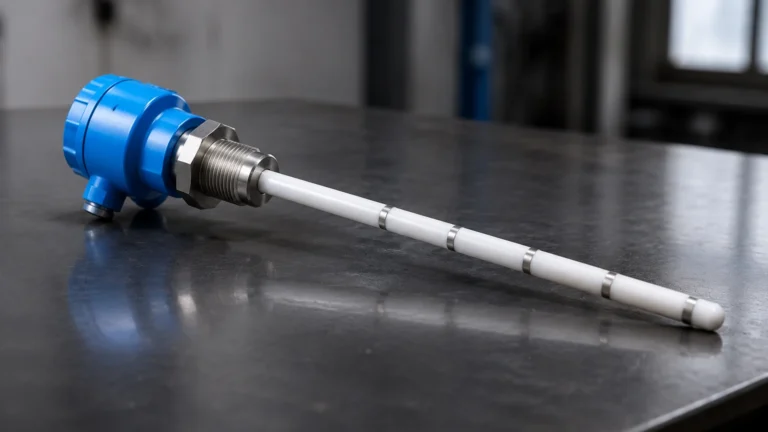
When measuring non-conductive liquids (like oil), the liquid serves as the dielectric. However, when the medium is metallic or highly conductive, the material does not act as a dielectric; instead, it acts as an extension of the electrode. In these cases, the probe must be insulated (usually with PTFE or PFA). The measurement then depends on the thickness of the insulation rather than the dielectric constant for metals. The sensor essentially measures the capacitance of the insulation layer as it is "covered" by the conductive metal.
Practical Selection Guide for Level Measurement Technologies
Choosing the right technology depends on the physical state of the metal and the process conditions. Below is a comparison of how different technologies handle materials with high dielectric properties or metallic conductivity.
| Technology | Interaction with Metals | Best Used For | Limitations |
| :— | :— | :— | :— |
| Non-Contact Radar | Excellent reflection due to infinite $ε_r$. | Liquid metals, metal ores, large silos. | Can be affected by heavy foam or extreme dust. |
| Guided Wave Radar | Very strong signal reflection at the interface. | Small tanks, low-dielectric powders with metallic flakes. | Probe can be damaged by heavy mechanical loads. |
| Ultrasonic | Reflects off the physical surface (acoustic). | Ambient temperature metal liquids or solids. | Affected by vacuum, high pressure, or vapors. |
| Capacitance | Acts as a conductor; requires insulated probes. | High-temperature conductive liquids. | Requires recalibration if material composition changes significantly. |
| Hydrostatic | Independent of dielectric constant. | Molten metals in pressurized vessels. | Requires knowledge of the material's density. |
Installation Considerations for Metallic Environments
When installing level instruments in environments where the dielectric constant for metals is a factor—specifically inside metal tanks or when measuring metallic media—several engineering factors must be considered:
1. Nozzle Interference: In radar applications, the mounting nozzle should be as short as possible. Because the metal nozzle has an infinite dielectric constant, it can create "ringing" or false echoes if the sensor is not properly tuned or if the nozzle is too long and narrow.
2. Faraday Cage Effect: Metal tanks act as Faraday cages, shielding the interior from external electromagnetic interference. This is beneficial for radar accuracy but means that wireless sensors must have their antennas positioned correctly to communicate with external gateways.
3. Grounding: For capacitance and hydrostatic sensors, proper grounding to the metallic tank wall is essential. The tank wall often serves as the reference ground for the electrical circuit.
4. Stilling Wells: If the metallic liquid surface is turbulent, a metallic stilling well can be used. The radar signal will be guided down the pipe, and the high reflectivity of the pipe walls ensures the signal remains concentrated on the target surface.
Limitations and Challenges
While a high dielectric constant generally makes level measurement easier for radar, there are specific limitations to keep in mind:
* Skin Effect: In high-frequency applications, the electromagnetic signal only penetrates the very surface of the metal. If a metallic powder is extremely aerated, the "effective" dielectric constant may drop, though it remains much higher than that of organic powders.
* Conductive Coating: If a metallic slurry or liquid metal splashes onto the sensor lens or probe, it creates a conductive coating. Since the dielectric constant for metals is effectively infinite, this coating can completely block or "short out" the signal. Welk offers specialized air purge systems and PTFE-coated lenses to prevent this issue.
* Temperature Extremes: Many metallic processes (like smelting) involve extreme heat. While the dielectric constant remains high, the sensor must be protected using cooling jackets or high-temperature wave guides.
Frequently Asked Questions
Q: Does the specific type of metal (e.g., Aluminum vs. Steel) change the dielectric constant?
A: For the purposes of level sensing, no. All metals have high enough conductivity that they are treated as having an infinite dielectric constant. The reflection of a radar signal will be equally strong from any solid metallic surface.
Q: Can I use a radar sensor to measure the level of metal scraps?
A: Yes, but the irregular surface of scrap metal will cause the signal to scatter in many directions. While the dielectric constant for metals ensures a strong reflection, the geometry requires a sensor with sophisticated signal processing to identify the "true" level from the scattered echoes.
Q: Why is water's dielectric constant (80) compared to metals (∞)?
A: Water is a polar molecule and a poor conductor when pure, giving it a high but finite dielectric constant. Metals are conductors. In radar level measurement, both provide strong reflections, but metals provide the strongest possible theoretical reflection.
Conclusion
Understanding the dielectric constant for metals is vital for optimizing process control in industries ranging from mining to metallurgy. Because metals act as perfect reflectors for electromagnetic signals, they are ideally suited for radar-based measurement. However, their conductive nature requires specific hardware considerations, such as insulated probes for capacitance sensors or specialized mounting for non-contact radar.
Welk provides a comprehensive range of level measurement solutions designed to handle the unique challenges of metallic and high-dielectric media. By selecting the appropriate technology and following rigorous installation standards, engineers can achieve precise, maintenance-free level monitoring in even the most demanding industrial environments. For detailed technical specifications and to explore the full range of instrumentation, visit the Main Page of our product catalog to review product options and application support.