Dielectric Constant of 4-cyanostyrene
Dielectric Constant of 4-cyanostyrene
In the field of industrial process control, the accurate measurement of liquid levels within storage tanks and reactor vessels is paramount for safety, efficiency, and quality assurance. For specialized chemical compounds such as 4-cyanostyrene, the selection of an appropriate measurement technology hinges heavily on its physical properties. Among these, the dielectric constant of 4-cyanostyrene stands out as a critical parameter. This value determines how the material interacts with electromagnetic fields, directly influencing the performance of radar-based and capacitive level sensors.
4-cyanostyrene (C9H7N) is a functionalized monomer used extensively in the production of specialized polymers and electronic materials. Because it contains a highly polar nitrile (-CN) group attached to the styrene ring, its electrical properties differ significantly from standard hydrocarbons. For engineers and plant managers, understanding these properties is the first step in designing a reliable level monitoring system. For a comprehensive overview of available technologies, professionals often consult the Main Page of industrial instrumentation providers to compare sensor specifications against chemical compatibility charts.
Understanding the Dielectric Constant (Relative Permittivity)
The dielectric constant, or relative permittivity ($\epsilon_r$), is a dimensionless measure of a substance's ability to store electrical energy in an electric field. In practical terms for level measurement, it describes how "reflective" or "conductive" a material appears to a sensor.
The Physics of Reflection
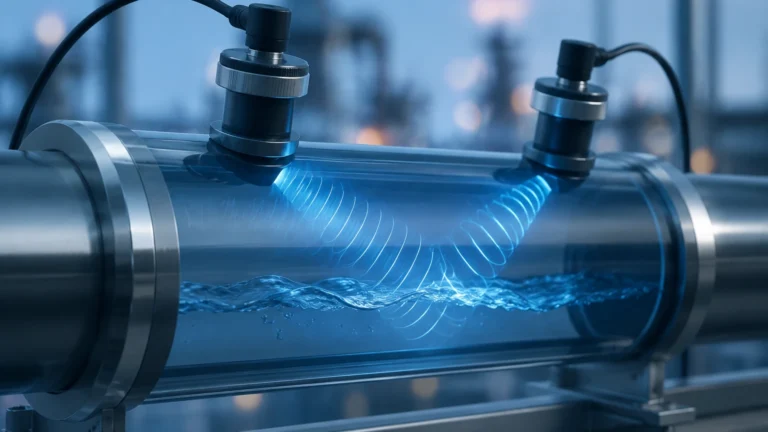
For non-contact radar level meters, the strength of the reflected signal (the echo) is proportional to the difference between the dielectric constant of the air (approximately 1.0) and the dielectric constant of the process medium. The reflection coefficient ($\Gamma$) can be simplified as:
$$\Gamma = \frac{\sqrt{\epsilon_r} – 1}{\sqrt{\epsilon_r} + 1}$$
A higher dielectric constant results in a stronger reflection. Water, with an $\epsilon_r$ of approximately 80 at room temperature, provides a very strong echo. In contrast, non-polar hydrocarbons like hexane ($\epsilon_r \approx 1.9$) provide very weak echoes, requiring highly sensitive equipment or guided wave structures.
Capacitance and Energy Storage
In capacitive level measurement, the process medium acts as the dielectric between two "plates" (the sensor probe and the tank wall). The capacitance ($C$) is calculated as:
$$C = \epsilon_0 \epsilon_r \frac{A}{d}$$
Where $\epsilon_0$ is the vacuum permittivity, $A$ is the area of the plates, and $d$ is the distance between them. If the dielectric constant of 4-cyanostyrene shifts due to temperature or purity changes, the capacitance reading will shift accordingly, potentially leading to measurement errors if not properly compensated.
Estimated Dielectric Constant of 4-cyanostyrene
While styrene itself has a relatively low dielectric constant (approximately 2.4 to 2.6), the addition of the cyano group at the para-position increases the molecular dipole moment. This chemical structure makes 4-cyanostyrene a polar organic liquid.
In industrial conditions, the dielectric constant of 4-cyanostyrene is generally estimated to be in the range of 7.0 to 12.0 at 20°C (68°F). This places it in the "medium dielectric" category.
Factors Influencing the Value
1. Temperature: As temperature increases, the molecular agitation increases, which typically causes the dielectric constant to decrease. In polymerization reactors where 4-cyanostyrene might be heated to 60°C or 80°C, the $\epsilon_r$ may drop toward the lower end of the range.
2. Purity: The presence of solvents (like toluene) or inhibitors can alter the effective dielectric constant of the bulk liquid.
3. Frequency: For radar applications, the $\epsilon_r$ is measured at gigahertz (GHz) frequencies. While most organic liquids show stable permittivity across the standard radar bands (6GHz to 80GHz), extreme high-frequency applications should verify the "high-frequency dielectric" value.
Impact on Level Measurement Technologies
Choosing the right instrument requires matching the technology to the medium's dielectric profile. For 4-cyanostyrene, several options are viable, each with specific advantages.
1. Non-Contact Radar (80 GHz)
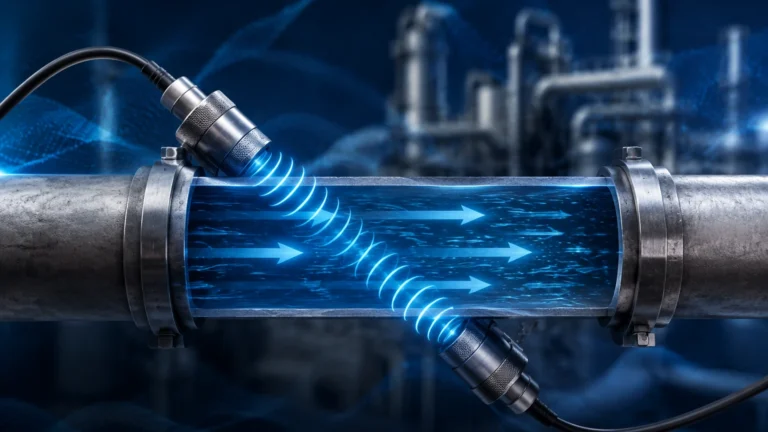
Modern 80 GHz high-frequency radar is the preferred choice for 4-cyanostyrene. Because the dielectric constant is above 7.0, the liquid provides a reliable and clear reflection. The high frequency allows for a narrow beam angle, which minimizes interference from tank internals or agitator blades.
* Advantage: No contact with the medium prevents polymerization on the sensor.
* Requirement: Ensure the signal sensitivity is set for a medium dielectric (Class B or C).
2. Guided Wave Radar (GWR)
GWR uses a physical probe to guide the microwave signal. This technology is extremely robust for low dielectric fluids because it concentrates the energy along the probe.
* Advantage: Highly accurate even if there is surface turbulence or foam.
* Limitation: 4-cyanostyrene is a monomer. There is a risk of the material polymerizing or "skinning" on the probe over time, which can create a coating that attenuates the signal or causes a false level reading.
3. Ultrasonic Level Sensors
Ultrasonic sensors rely on sound waves rather than electromagnetic waves. Therefore, the dielectric constant of 4-cyanostyrene does not affect the measurement.
* Limitation: 4-cyanostyrene has a significant vapor pressure. Changes in vapor concentration or temperature gradients in the "ullage" (the space above the liquid) can change the speed of sound, leading to inaccuracies. Furthermore, if the tank is under vacuum or high pressure, ultrasonic technology cannot be used.
Selection Guide for 4-cyanostyrene Level Measurement
| Technology | Suitability | Dielectric Dependency | Primary Concern |
| :— | :— | :— | :— |
| 80 GHz Radar | Excellent | High | Signal attenuation in heavy foam. |
| Guided Wave Radar | Good | High | Polymer buildup on the probe. |
| Capacitance | Fair | Very High | Requires constant $\epsilon_r$ for accuracy. |
| Ultrasonic | Moderate | None | Affected by vapors and pressure changes. |
| Hydrostatic | Good | None | Affected by changes in liquid density. |

Installation Considerations for 4-cyanostyrene Applications
When installing level instruments in a 4-cyanostyrene environment, engineers must account for the chemical's reactivity and physical behavior.
1. Nozzle Geometry: For non-contact radar, ensure the nozzle height does not exceed the diameter in a way that creates "ringing" or signal interference. A 50 mm (2-inch) or 80 mm (3-inch) nozzle is standard, but the sensor should be mounted so the antenna extends slightly past the nozzle bottom if possible.
2. Agitation: 4-cyanostyrene is often processed in stirred-tank reactors. If the surface is turbulent, a radar with a high update rate and sophisticated software filtering is required. Alternatively, a stilling well can be used, though this increases the risk of polymerization inside the well.
3. Vapor Management: To protect the electronics, use a process seal or a second line of defense (like a glass or ceramic seal) in the instrument flange. This prevents 4-cyanostyrene vapors from migrating into the sensor housing.
4. Dead Zones: Every sensor has a "dead zone" or "blocking distance" at the top. Ensure the maximum fill level of the tank does not enter this zone, typically 50 mm to 200 mm depending on the frequency and model.
Limitations and Risks
While the dielectric constant of 4-cyanostyrene makes it a good candidate for radar measurement, there are two primary risks to consider:
* Polymerization: 4-cyanostyrene can polymerize if exposed to heat or if inhibitors are depleted. If a layer of solid polymer forms on a radar antenna or a GWR probe, the dielectric properties of that solid layer will differ from the liquid. A solid polymer coating may have a lower $\epsilon_r$ (around 2.5), which can cause the radar to "lock" onto the coating rather than the liquid level.
* Temperature Compensation: If using capacitance-based sensors, the system must include a temperature probe to adjust the calibration. A 10°C shift in temperature can change the dielectric constant enough to cause a 1-3% error in level measurement.
Frequently Asked Questions (FAQs)
Q: Can I use a standard styrene level setting for 4-cyanostyrene?
A: It is not recommended. The dielectric constant of 4-cyanostyrene is higher than that of standard styrene due to the nitrile group. Using a styrene setting ($\epsilon_r \approx 2.5$) on a radar meter might result in the sensor being overly sensitive or misinterpreting noise as a signal. It is better to calibrate for a dielectric of approximately 8.0.
Q: What is the best way to handle foam on the surface of 4-cyanostyrene?
A: If the foam is light and airy, 80 GHz radar can usually penetrate it. If the foam is dense and conductive, a Guided Wave Radar (GWR) is more reliable, as the probe ensures the signal reaches the liquid interface. However, ensure the probe is coated (e.g., with PFA) to reduce polymer adhesion.
Q: How does pressure affect the dielectric constant measurement?
A: Pressure has a negligible effect on the dielectric constant of the liquid itself. However, high-pressure gases in the vapor space can slightly increase the dielectric constant of the "air" space, which can cause a small travel-time delay for radar signals. This is usually only significant above 20 bar (290 psi).
Conclusion
Accurate level measurement of 4-cyanostyrene requires a nuanced understanding of its electrical and chemical properties. With a dielectric constant typically ranging between 7.0 and 12.0, it is well-suited for high-frequency non-contact radar technology. However, engineers must remain vigilant regarding the risks of polymerization and the influence of temperature on the medium's permittivity. By selecting the correct instrumentation and following rigorous installation standards, facilities can ensure long-term, maintenance-free level monitoring. For further technical specifications and to explore the full range of industrial level sensors, visit the Main Page for expert guidance and product selection.