Durable Ph Probe
Durable Ph Probe
In industrial process control, the longevity and reliability of analytical sensors are paramount. A durable ph probe is not merely a high-quality sensor; it is a precision-engineered instrument designed to withstand the rigors of aggressive chemical environments, high pressures, and fluctuating temperatures. For engineers and plant managers, selecting a probe that can maintain accuracy over extended periods without frequent replacement is critical for reducing the Total Cost of Ownership (TCO) and ensuring process safety.
This guide examines the technical architecture of industrial pH sensors, the principles that govern their operation, and the selection criteria necessary to identify a truly durable solution for demanding applications.
Principles of pH Measurement
Before evaluating the durability of a probe, it is essential to understand the electrochemical principles that facilitate pH measurement. Industrial pH measurement is typically performed using a potentiometric method, which involves measuring the potential difference between two electrodes: a sensing electrode and a reference electrode.
The Glass Electrode and the Nernst Equation
The sensing electrode consists of a pH-sensitive glass membrane. When this membrane comes into contact with an aqueous solution, a hydrated gel layer forms on both the inner and outer surfaces. Hydrogen ions ($H^+$) in the solution exchange with metal ions in the gel layer, creating a potential. This potential is governed by the Nernst Equation:
$$E = E_0 + \frac{2.303 RT}{nF} \log(aH^+)$$
Where:
* E is the measured potential.
* E₀ is the standard potential.
* R is the gas constant.
* T is the absolute temperature in Kelvin.
* F is the Faraday constant.
* aH⁺ is the activity of hydrogen ions.
The Reference System
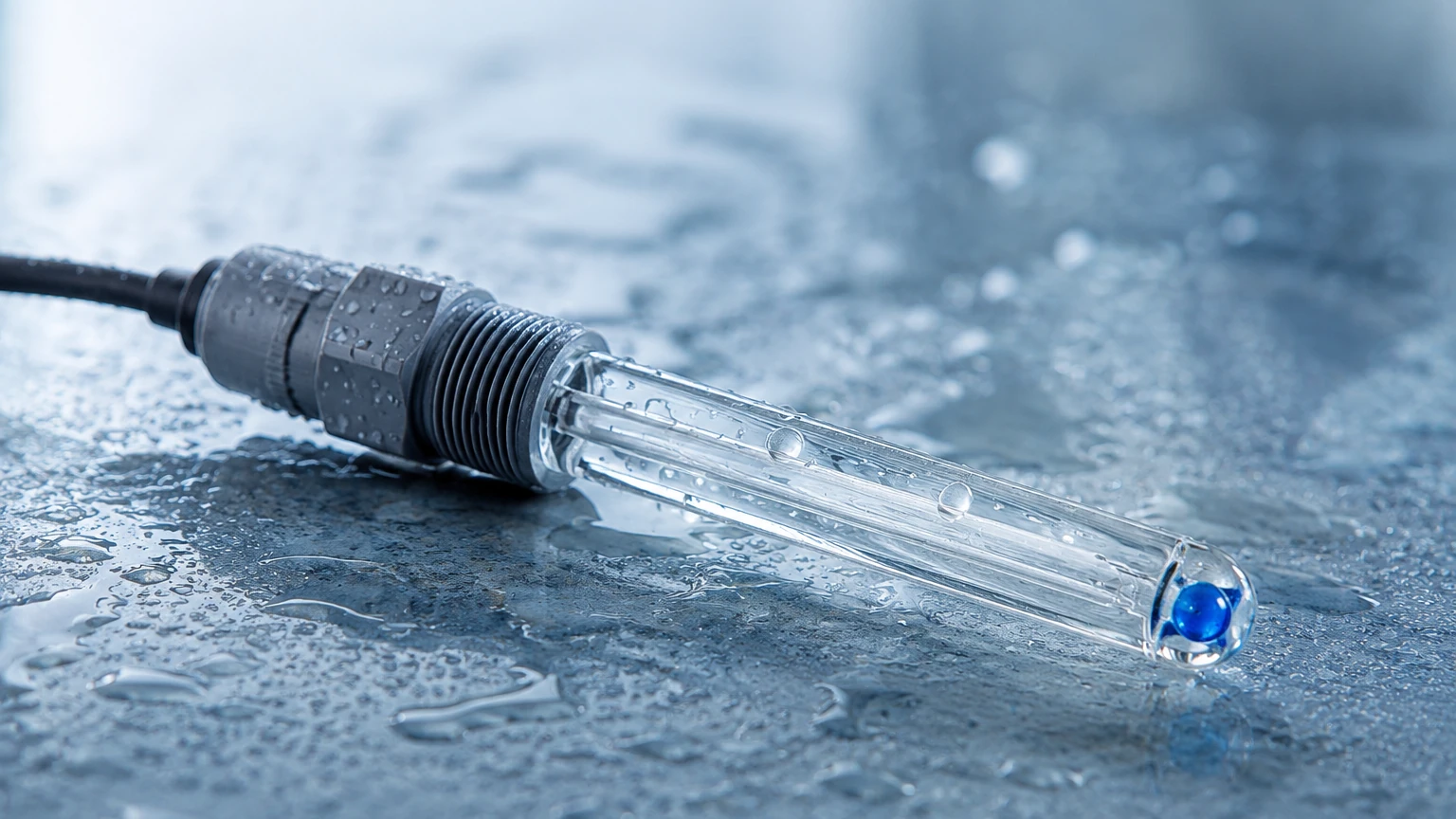
To complete the circuit, a reference electrode provides a stable, known potential that remains independent of the solution's pH. Most durable pH probes utilize a Silver/Silver Chloride (Ag/AgCl) reference system. The reference electrode is housed in an electrolyte (usually Potassium Chloride, KCl) and makes contact with the process medium through a junction. The integrity of this junction and the stability of the reference electrolyte are the most common points of failure in industrial sensors.
Engineering Features of a Durable Ph Probe
Durability in a pH probe is achieved through material science and structural design. Standard laboratory probes are often made of thin glass and utilize simple junctions that quickly clog or poison in industrial settings. In contrast, a durable ph probe incorporates several ruggedized features.
1. Robust Body Materials
Industrial probes are often encased in chemically resistant plastics or alloys to protect the internal glass components. Common materials include:
* Ryton (PPS): Excellent chemical resistance and mechanical strength at high temperatures.
* PVDF (Kynar): High purity and resistance to strong acids and oxidants.
* Stainless Steel (316L): Used for hygienic applications or where high pressure is a concern.
2. Advanced Junction Designs
The junction is the interface where the reference electrolyte meets the process fluid. A durable ph probe will often utilize specialized junctions to prevent fouling:
* PTFE (Teflon) Junctions: Large surface areas that resist clogging from oils and suspended solids.
* Ceramic Junctions: Porous structures suitable for general-purpose high-pressure applications.
* Double Junction Systems: An additional internal chamber that prevents process contaminants (like heavy metals or sulfides) from reaching and poisoning the primary Ag/AgCl reference wire.
3. Specialized Glass Formulations
The pH-sensitive glass itself can be tailored for specific environments. "High-temp glass" is designed to resist the etching effects of caustic solutions at temperatures exceeding 80°C (176°F), while "low-impedance glass" is used for faster response times in cold water or low-conductivity applications.
Practical Selection Table
Choosing the right durable ph probe requires matching the sensor's technical specifications to the process conditions. The following table provides a baseline for selection based on common industrial scenarios.
| Application | Recommended Junction | Body Material | Temperature Range | Key Feature |
| :— | :— | :— | :— | :— |
| Wastewater Treatment | Large Surface PTFE | Ryton (PPS) | -5°C to 80°C | Fouling resistance |
| Chemical Processing | Double Junction Ceramic | PVDF | -10°C to 110°C | Chemical compatibility |
| Pure Water/Power | Refillable Liquid Junction | Glass/SS | 0°C to 60°C | Low conductivity stability |
| Pulp and Paper | Flat Surface PTFE | Ryton (PPS) | 0°C to 100°C | Abrasion resistance |
| High Pressure (Up to 10 bar) | Solid Polymer Electrolyte | Stainless Steel | -5°C to 130°C | Pressure compensation |
Installation and Mounting Considerations
Even the most durable ph probe will fail prematurely if installed incorrectly. Engineering teams must account for the physical dynamics of the process stream.
Mounting Angle
pH probes should never be installed horizontally or upside down. A minimum angle of 15° above the horizontal plane is required to ensure that the internal electrolyte stays in contact with the pH glass and that air bubbles do not become trapped at the sensor tip.
Flow Rate and Velocity
While some flow is necessary to ensure a representative sample, excessive velocity can cause "streaming potentials" (noise) or physical erosion of the glass membrane. In abrasive slurries, the probe should be positioned where the flow is laminar rather than turbulent.
Integration with Level Systems
In many chemical dosing applications, pH monitoring is paired with level measurement to automate the treatment process. For instance, in a neutralization tank, a durable ph probe triggers the dosing pumps, while level sensors ensure the tank does not overflow. Engineers looking to optimize these integrated systems can Review product options and application support to find compatible instrumentation for a complete automation loop.
Common Risks and Limitations
Despite their name, durable pH probes are not indestructible. Understanding their limitations is key to maintaining process uptime.
* Poisoning: Certain ions, such as cyanide, bromide, and sulfide, can react with the silver ions in the reference electrolyte, forming precipitates that clog the junction.
* Dehydration: If a pH probe is allowed to dry out, the hydrated gel layer on the glass membrane collapses. While some probes can be rehydrated in a storage solution (typically 4M KCl), permanent loss of sensitivity may occur.
* Scaling and Coating: In lime softening or mineral-rich processes, scale can build up on the glass. This increases the response time and can lead to "drift." Durable probes with flat-surface designs use the process flow to provide a self-cleaning effect.
* Temperature Extremes: For every 10°C increase in temperature, the chemical aging of the pH glass doubles. High-temperature applications require probes specifically rated for those conditions to avoid a shortened lifespan.
Maintenance and Calibration Protocols
To maximize the life of a durable ph probe, a structured maintenance schedule is required.
1. Cleaning: Depending on the process, probes should be cleaned weekly or monthly using a mild detergent or a 5% HCl solution to remove mineral deposits.
2. Calibration: Use fresh buffer solutions (typically pH 4.0, 7.0, and 10.0). Always calibrate at the process temperature if the transmitter does not have Automatic Temperature Compensation (ATC).
3. Slope and Offset: Monitor the probe's "slope" during calibration. A new probe should have a slope between 95% and 102%. If the slope falls below 85%, the probe is nearing the end of its functional life and should be replaced.
Frequently Asked Questions (FAQ)
Q: How long should a durable ph probe last?
A: In mild water treatment applications, a durable probe can last 12 to 24 months. In harsh chemical processes with high temperatures or extreme pH levels, a lifespan of 3 to 6 months is often considered excellent.
Q: Can I use a durable ph probe in deionized (DI) water?
A: Standard durable probes may struggle in DI water due to low conductivity. A specialized probe with a high-flow reference junction or a refillable electrolyte is recommended for these applications to maintain a stable electrical path.
Q: What is the maximum pressure a durable ph probe can handle?
A: Most standard industrial probes are rated for up to 6 or 7 bar (approx. 100 psi). Specialized versions with reinforced bodies and solid-state electrolytes can handle up to 10-15 bar.
Q: Does the cable length affect the measurement?
A: Yes. Because pH probes produce a high-impedance signal, long cable runs are susceptible to electromagnetic interference (EMI). If the distance between the sensor and the transmitter exceeds 10-15 meters, a pre-amplifier or a digital sensor (like Memosens or Modbus) should be used.
By prioritizing material compatibility and understanding the specific stresses of the application, engineers can select a durable ph probe that provides reliable data for years. When combined with robust level measurement technologies found on the Main Page, these sensors form the backbone of efficient and safe industrial liquid processing.