E&h Coriolis Flow Meter
E&h Coriolis Flow Meter
In the landscape of modern industrial process control, the Coriolis mass flow meter stands as one of the most versatile and accurate instruments available. Among the leading solutions in this category, the E&H Coriolis flow meter—specifically the Promass series—is widely recognized for its ability to provide simultaneous measurements of mass flow, density, temperature, and viscosity. For engineers and plant managers, understanding the technical nuances of these devices is essential for optimizing production efficiency and ensuring fiscal accuracy in custody transfer applications.
This guide examines the fundamental principles of Coriolis technology, the specific advantages of the E&H product line, and the practical considerations required for selection and installation in demanding industrial environments.
The Principle of Coriolis Mass Flow Measurement
Before selecting an E&H Coriolis flow meter, it is vital to understand the physics that allow it to measure mass directly without the need for external pressure or temperature compensation. Unlike volumetric flow meters (such as ultrasonic or electromagnetic meters), which calculate flow based on velocity and cross-sectional area, the Coriolis meter relies on the inertia of the fluid itself.
The Coriolis Effect in Practice
Inside the meter, one or two measuring tubes are induced to vibrate at their resonant frequency by an electromagnetic drive coil. When a fluid (liquid or gas) flows through these vibrating tubes, it is subjected to a Coriolis force. This force is a result of the fluid's mass moving through a rotating (or in this case, oscillating) system.
1. Phase Shift: As the fluid moves toward the center of the oscillation, it resists the upward motion of the tube, pushing it down. As it moves away from the center, it resists the downward motion, pushing the tube up. This creates a "twisting" effect or a phase shift between the inlet and outlet sides of the tube.
2. Mass Flow Calculation: Electromechanical sensors at the inlet and outlet pick up these oscillations. The time difference (delta-t) between the two signals is directly proportional to the mass flow rate. The greater the mass flow, the greater the phase shift.
3. Density Measurement: The tubes always vibrate at their natural resonant frequency. Since the frequency of vibration depends on the total mass of the tubes plus the fluid inside them, the meter can determine the fluid's density by measuring the frequency of oscillation. A denser fluid results in a lower frequency.
4. Temperature Integration: A Pt100 temperature sensor is typically integrated into the tube wall to compensate for thermal expansion of the measuring tubes, ensuring the accuracy of the density and mass flow calculations.
Key Advantages of E&H Coriolis Flow Meters
The E&H Coriolis flow meter range is engineered to address specific pain points in process automation. By providing multi-variable data from a single point of entry, these meters reduce the number of process penetrations and simplify wiring.
* High Precision: Standard accuracies for liquids often reach ±0.1% of the reading, with premium models achieving ±0.05%. This is critical for high-value fluids and chemical dosing.
* Direct Mass Measurement: Because mass is not affected by changes in pressure, temperature, or viscosity, the Coriolis meter provides a stable reading even when process conditions fluctuate wildly.
* Maintenance-Free Design: With no moving parts in the fluid stream (unlike turbine or positive displacement meters), there is no mechanical wear and tear, significantly reducing long-term OpEx.
* Advanced Diagnostics: Modern E&H transmitters often include "Heartbeat Technology," which allows for continuous self-monitoring and verification of the instrument's health without interrupting the process.
Selection Criteria for Industrial Applications
Choosing the correct E&H Coriolis flow meter requires a detailed analysis of the process fluid and the environmental conditions. Engineers must balance accuracy requirements against pressure drop and material compatibility.
Material Compatibility
The measuring tubes are the most critical component. While 316L stainless steel is the standard, aggressive chemicals may require more exotic materials. For example, the Promass O is designed for high-pressure applications, while the Promass H offers superior corrosion resistance using Tantalum or Hastelloy C22.
Line Size and Flow Range
It is a common mistake to size a Coriolis meter based solely on the existing pipe diameter. To maintain accuracy and ensure sufficient signal-to-noise ratio, the meter should be sized based on the actual flow rate. This often results in a meter that is one size smaller than the process piping, requiring reducers.
Selection Table: Typical E&H Promass Series Comparison
| Feature | Promass F | Promass E | Promass Q | Promass I |
| :— | :— | :— | :— | :— |
| Primary Application | Universal/High Accuracy | Basic/Cost-Effective | Entrained Gas/High Density | Straight Tube/Low Shear |
| Accuracy (Liquid) | ±0.05% to ±0.1% | ±0.2% | ±0.05% | ±0.1% |
| Max Fluid Temp | +350°C | +150°C | +240°C | +150°C |
| Nominal Diameters | 8mm to 250mm | 8mm to 80mm | 25mm to 100mm | 8mm to 80mm |
| Secondary Variables| Density, Temp | Density, Temp | Density, Temp | Viscosity, Temp |
For broader instrumentation needs, including level monitoring that often complements flow data in tank farm management, you can Review product options and application support on our main site.
Installation Considerations
While Coriolis meters are less sensitive to flow profiles than magnetic or ultrasonic meters, proper installation is paramount to achieving the specified accuracy.
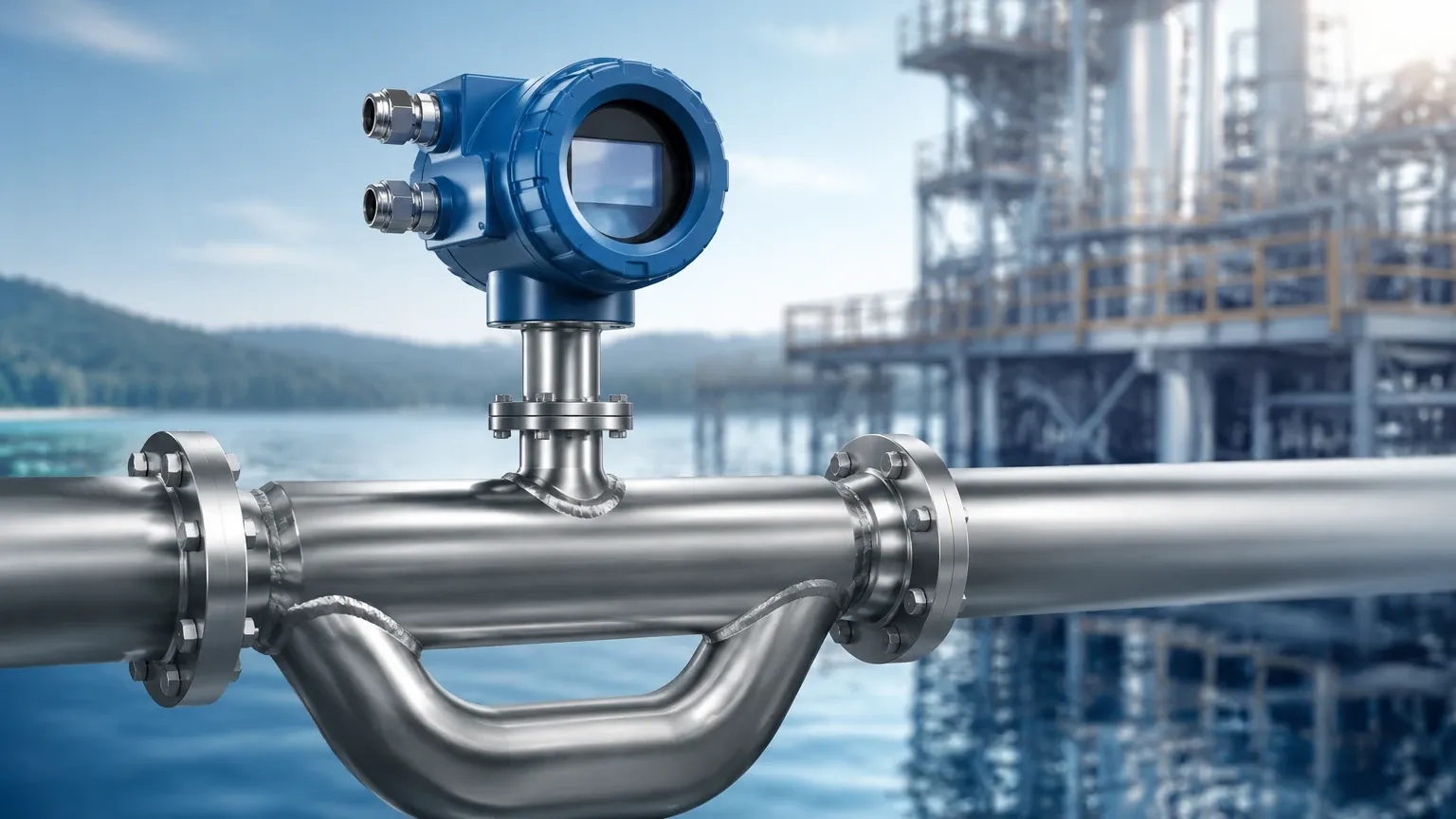
1. Mounting Orientation: For liquid applications, the tubes should ideally point downward (in a "U" shape) to prevent gas bubbles from being trapped. For gas applications, the tubes should point upward to prevent condensate buildup. If the fluid contains solids, a vertical installation with upward flow is preferred to ensure the tubes remain full and self-drain.
2. Mechanical Stress: The meter should not be used to support the weight of the piping. Use pipe supports on both the inlet and outlet sides, approximately 2 to 5 pipe diameters away from the flanges. This prevents mechanical stress from distorting the measuring tubes.
3. Vibration Isolation: Because the meter operates on the principle of vibration, external mechanical vibrations from pumps or motors can interfere with the measurement. Avoid installing the meter directly adjacent to high-vibration equipment without flexible couplings or robust mounting.
4. Zero Point Calibration: After installation and under full-pipe, zero-flow conditions, a zero-point adjustment must be performed. This accounts for the specific mechanical stresses of the installed piping environment.
Limitations and Challenges
Despite their high performance, E&H Coriolis flow meters are not a universal solution for every scenario. Engineers should be aware of the following limitations:
* Initial Cost: The CAPEX for a Coriolis meter is significantly higher than that of an electromagnetic or vortex meter. The investment is usually justified by the high accuracy and multi-variable output.
* Pressure Drop: Because the fluid is often split into two narrower tubes or forced through a curved path, there is a measurable pressure drop across the device. This must be calculated during the design phase to ensure the system pump can handle the additional head loss.
* Entrained Gas: While models like the Promass Q are designed to handle multi-phase flow, excessive gas in a liquid stream (or liquid droplets in a gas stream) can dampen the tube vibrations, leading to measurement errors or "slug flow" conditions.
* Size Constraints: For very large pipe diameters (above 300mm), Coriolis meters become extremely heavy, bulky, and expensive, often making other technologies more practical.
Frequently Asked Questions (FAQs)
Q: Can an E&H Coriolis flow meter measure the flow of non-conductive liquids?
A: Yes. Unlike electromagnetic flow meters, Coriolis meters do not require the fluid to be conductive. They work equally well on deionized water, hydrocarbons, and oils.
Q: How often does the meter need to be recalibrated?
A: In many stable applications, the meter can operate for years without a shift in the factory calibration. However, in regulated industries like pharmaceuticals or oil and gas custody transfer, annual or biennial verification is standard. Tools like Heartbeat Technology can extend these intervals by providing documented proof of performance.
Q: Does the viscosity of the fluid affect the accuracy?
A: Generally, no. Coriolis meters are highly immune to changes in viscosity. In fact, some models (like the Promass I) are specifically designed to measure viscosity in real-time alongside mass flow.
Q: What is the minimum flow rate required?
A: Every meter has a "zero stability" value. At very low flow rates, the phase shift becomes so small that it approaches the noise floor of the electronics. It is recommended to operate the meter in a range where the mass flow is at least 10 times the zero stability value for optimal results.
Conclusion
The E&H Coriolis flow meter remains a gold standard for precision mass flow measurement in the B2B industrial sector. By integrating mass, density, and temperature into a single device, it provides the granular data necessary for advanced process control and accounting. When selecting a unit, engineers must prioritize material compatibility and proper sizing over simple pipe-matching to ensure the longevity and accuracy of the installation. For those integrating these systems into larger process loops involving storage and containment, referring to the Main Page for complementary level measurement technologies is a recommended next step in system design.