Edge-device
Edge-device
In the landscape of modern industrial automation, the integration of localized intelligence has become a prerequisite for efficient process management. The edge-device serves as the critical hardware and software layer that sits between field-level instrumentation—such as radar level meters and ultrasonic sensors—and the broader enterprise network or cloud platform. By processing data at the "edge" of the network, rather than transmitting raw signals to a centralized server, these devices enable real-time decision-making, reduced latency, and enhanced data security.
For engineers and facility managers overseeing complex liquid or solid storage systems, understanding the role of the edge-device is essential. This guide explores the technical principles of integrating level measurement instruments with edge computing, selection criteria for industrial environments, and practical installation considerations.
Understanding the Edge-device in Industrial Level Measurement
An edge-device in a level measurement context is typically an industrial PC (IPC), a smart gateway, or a high-end programmable logic controller (PLC) capable of running localized algorithms. Its primary function is to ingest data from sensors, perform immediate analysis, and output actionable insights or control commands.
In traditional architectures, a level transmitter sends a 4-20mA signal to a centralized PLC located in a control room hundreds of meters away. With an edge-device, the signal is intercepted or directly measured near the source. The device can then filter noise, calculate volume based on tank geometry, and transmit only the necessary data points—such as "High Level Alarm" or "Current Volume in Liters"—to the cloud. This optimization is particularly valuable in remote locations where bandwidth is limited or expensive.
For a comprehensive overview of the sensing technologies that feed into these edge systems, including radar and ultrasonic options, you can visit the Main Page of Welk’s technical catalog.
Integration with Level Measurement Principles
Before selecting an edge-device, it is vital to understand the measurement principles of the connected instruments. The edge-device must be capable of interpreting the specific data formats generated by different sensing technologies.
1. Radar Level Measurement (ToF and FMCW)
Radar level meters, such as those produced by Welk, operate using either Pulse Radar or Frequency Modulated Continuous Wave (FMCW) principles.
- Principle: The sensor emits high-frequency electromagnetic waves (typically 26GHz or 80GHz). These waves reflect off the medium surface and return to the antenna.
- Edge-device Role: The edge-device can process the complex "echo curve" provided by digital radar units. By performing Fast Fourier Transform (FFT) analysis locally, the edge-device can distinguish between the true liquid level and false reflections caused by internal tank structures like agitators or heating coils.
2. Ultrasonic Level Sensing
Ultrasonic sensors utilize sound waves to determine the distance to a surface.
- Principle: A transducer emits an ultrasonic pulse that travels through the air, hits the target, and reflects back. The distance is calculated based on the time of flight and the speed of sound.
- Edge-device Role: Since the speed of sound varies with air temperature (approximately 0.6 m/s per degree Celsius), the edge-device can integrate data from secondary temperature sensors to apply real-time compensation, ensuring accuracy in outdoor tanks subject to diurnal temperature shifts.
3. Hydrostatic Pressure Measurement
Hydrostatic transmitters measure the pressure exerted by a liquid column.
- Principle: $P = \rho \cdot g \cdot h$, where $P$ is pressure, $\rho$ is density, $g$ is gravity, and $h$ is height.
- Edge-device Role: If the density of the liquid changes due to temperature or concentration variations, the edge-device can perform the necessary mathematical corrections to maintain an accurate level reading, which a simple analog display could not achieve.
Key Evaluation Criteria for Edge-device Selection
Selecting the right edge-device requires a balance between processing power, connectivity, and environmental resilience. For industrial level measurement, the following criteria are paramount:
Hardware Connectivity and I/O
The device must support the physical interfaces of your sensors. Common requirements include:
- Analog Inputs: 4-20mA (with HART support) for traditional transmitters.
- Digital Interfaces: RS485 (Modbus RTU) or RS232 for digital sensors.
- Ethernet/Wi-Fi: For upstream communication to the SCADA or Cloud.
- Industrial Protocols: Support for MQTT, OPC UA, or Sparkplug B is essential for IIoT (Industrial Internet of Things) integration.
Environmental Durability
Since an edge-device is often installed near the tank or in the field, it must withstand harsh conditions. Look for:
- Ingress Protection: Minimum IP65 or IP67 ratings if installed outdoors.
- Temperature Range: Ability to operate from -40°C to +85°C in extreme climates.
- Hazardous Area Certification: ATEX or IECEx ratings if the device is located in an explosive atmosphere (e.g., oil and gas storage).
Processing and Storage
Unlike a simple gateway, an edge-device should have sufficient RAM and CPU power to run localized containers (like Docker) or Python scripts. Local storage (e.g., microSD or industrial SSD) is necessary for data logging during network outages.
Selection Table: Edge-device vs. Gateway vs. PLC
| Feature | Standard Gateway | Industrial PLC | Edge-device |
| :— | :— | :— | :— |
| Primary Function | Protocol translation | Real-time logic control | Data processing & Analytics |
| Data Storage | Minimal/None | Limited | Extensive (GBs) |
| Programmability | Fixed configuration | Ladder Logic/ST | Linux, Python, C++, Docker |
| Latency | Low (Pass-through) | Very Low (Microseconds) | Low (Milliseconds) |
| Cloud Integration | Basic | Requires middleware | Native (MQTT/OPC UA) |
| Best Use Case | Simple sensor-to-cloud | High-speed machine control | Complex level monitoring & AI |
Installation Guidelines and Best Practices
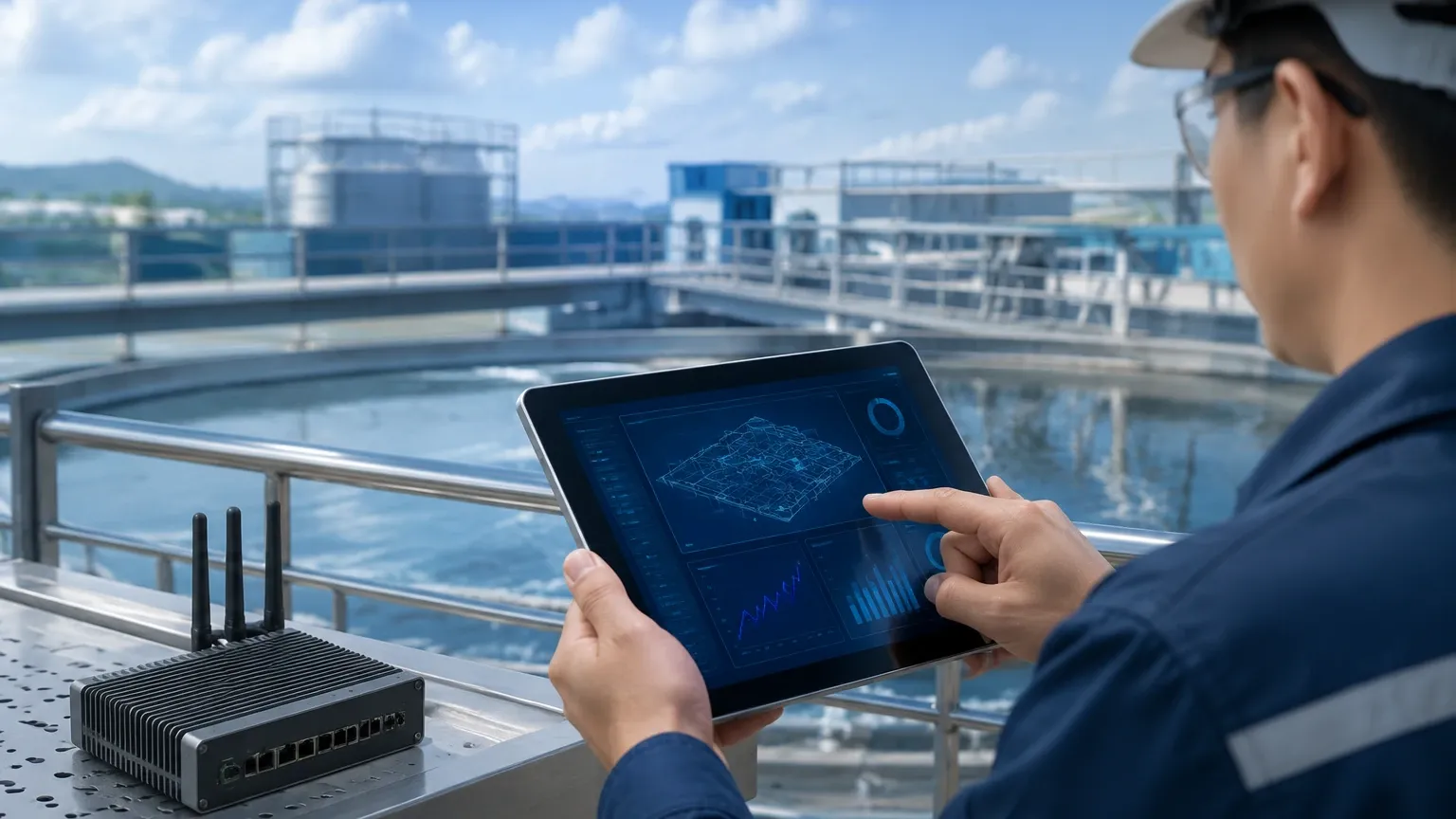
Successful deployment of an edge-device in a level measurement system depends on proper physical and electrical installation.
1. Proximity to Sensors: To minimize signal degradation and electromagnetic interference (EMI), install the device as close to the level sensors as possible, especially when using 4-20mA analog signals. If distances exceed 100 meters, consider using shielded twisted-pair cables.
2. Power Supply Stability: Industrial sensors and edge hardware are sensitive to power fluctuations. Use a regulated 24V DC power supply and consider a small Uninterruptible Power Supply (UPS) or battery backup to ensure data integrity during power dips.
3. Signal Grounding: Ensure that the edge-device and the level meters share a common ground reference. Improper grounding can lead to "ground loops," which introduce significant errors in hydrostatic and ultrasonic measurements.
4. Antenna Placement: If the device uses cellular (4G/5G) or LoRaWAN connectivity, the antenna should be mounted outside of metal enclosures or buildings to ensure a clear line of sight to the base station.
5. Network Security: Change default credentials immediately. Use VPNs or TLS encryption for all data transmitted from the edge-device to external servers.
Limitations and Operational Challenges
While the benefits of edge computing are significant, there are inherent limitations to consider:
* Maintenance Overhead: Unlike a simple mechanical gauge, an edge-device requires firmware updates, security patches, and occasional software debugging.
* Heat Dissipation: High-performance edge computers generate heat. In hot climates, fanless designs with large heat sinks are required to prevent thermal throttling, which can delay critical level alarms.
* Complexity: Implementing an edge solution requires a workforce skilled in both operational technology (OT) and information technology (IT).
* Initial Cost: The CAPEX for an edge-enabled system is higher than a traditional point-to-point analog setup, though the OPEX is often lower due to improved efficiency and reduced data costs.
Frequently Asked Questions (FAQs)
Q: Can an edge-device handle multiple level sensors simultaneously?
A: Yes. Most industrial edge-devices feature multiple I/O ports or can connect to a series of sensors via a Modbus RS485 daisy-chain, allowing one device to monitor an entire tank farm.
Q: How does an edge-device improve the accuracy of a Welk radar level meter?
A: While the radar meter itself is highly accurate (often up to ±2mm), the edge-device can apply advanced filtering to remove "sloshing" effects in agitated liquids or calculate precise volumes in non-linear tanks (e.g., horizontal cylindrical tanks) using look-up tables.
Q: Is it possible to use an edge-device without an internet connection?
A: Absolutely. The device can function as a local data logger and logic controller, providing a local HMI (Human Machine Interface) for operators while storing data for manual retrieval via USB or local Ethernet.
Q: What is the difference between an edge-device and a cloud-based level monitoring system?
A: The edge-device processes data locally (on-site), providing near-instantaneous response times and working offline. A cloud system aggregates data from multiple sites for long-term trend analysis and global inventory management but relies on a continuous internet connection.
By carefully selecting and configuring an edge-device, industrial operators can transform simple level measurement into a robust, intelligent system that enhances safety and operational transparency. For technical specifications on compatible level transmitters, refer to the Main Page for detailed product data sheets.