Emerson Temperature Sensor
Emerson Temperature Sensor
In the landscape of industrial automation and process control, temperature is the most frequently measured physical variable. Accurate temperature data is critical not only for product quality and process efficiency but also for the safety of personnel and the integrity of high-pressure equipment. Among the industry leaders, the Emerson temperature sensor portfolio—primarily marketed under the Rosemount brand—has set the benchmark for reliability in demanding environments. This guide explores the fundamental principles of temperature measurement, the specific capabilities of Emerson instrumentation, and how these sensors integrate into broader process control strategies, including their vital role in level measurement accuracy.
Fundamental Principles of Industrial Temperature Measurement
Before selecting a specific instrument, it is essential to understand the two primary technologies utilized in industrial temperature sensing: Resistance Temperature Detectors (RTDs) and Thermocouples (TC).
Resistance Temperature Detectors (RTDs)
RTDs operate on the principle that the electrical resistance of a metal increases as its temperature rises. Most industrial RTDs utilize platinum (Pt) due to its stability and linear resistance-to-temperature relationship. The most common type is the Pt100, which has a resistance of 100 ohms at 0°C (32°F).
* Advantages: High accuracy, excellent stability over time, and high repeatability.
* Limitations: Slower response time compared to thermocouples, more fragile in high-vibration environments, and a more limited temperature range (typically up to 600°C).
Thermocouples (TC)
Thermocouples consist of two dissimilar metal wires joined at one end (the sensing junction). When there is a temperature gradient between the sensing junction and the reference junction, a small voltage is generated—a phenomenon known as the Seebeck effect. Different metal combinations define the "Type" (e.g., Type K, J, T, or S).
* Advantages: Extremely wide temperature range (up to 1,800°C for precious metal types), fast response times, and rugged construction suitable for heavy vibration.
* Limitations: Lower accuracy than RTDs, susceptible to drift over time, and require cold-junction compensation at the transmitter.
Overview of the Emerson Temperature Sensor Ecosystem
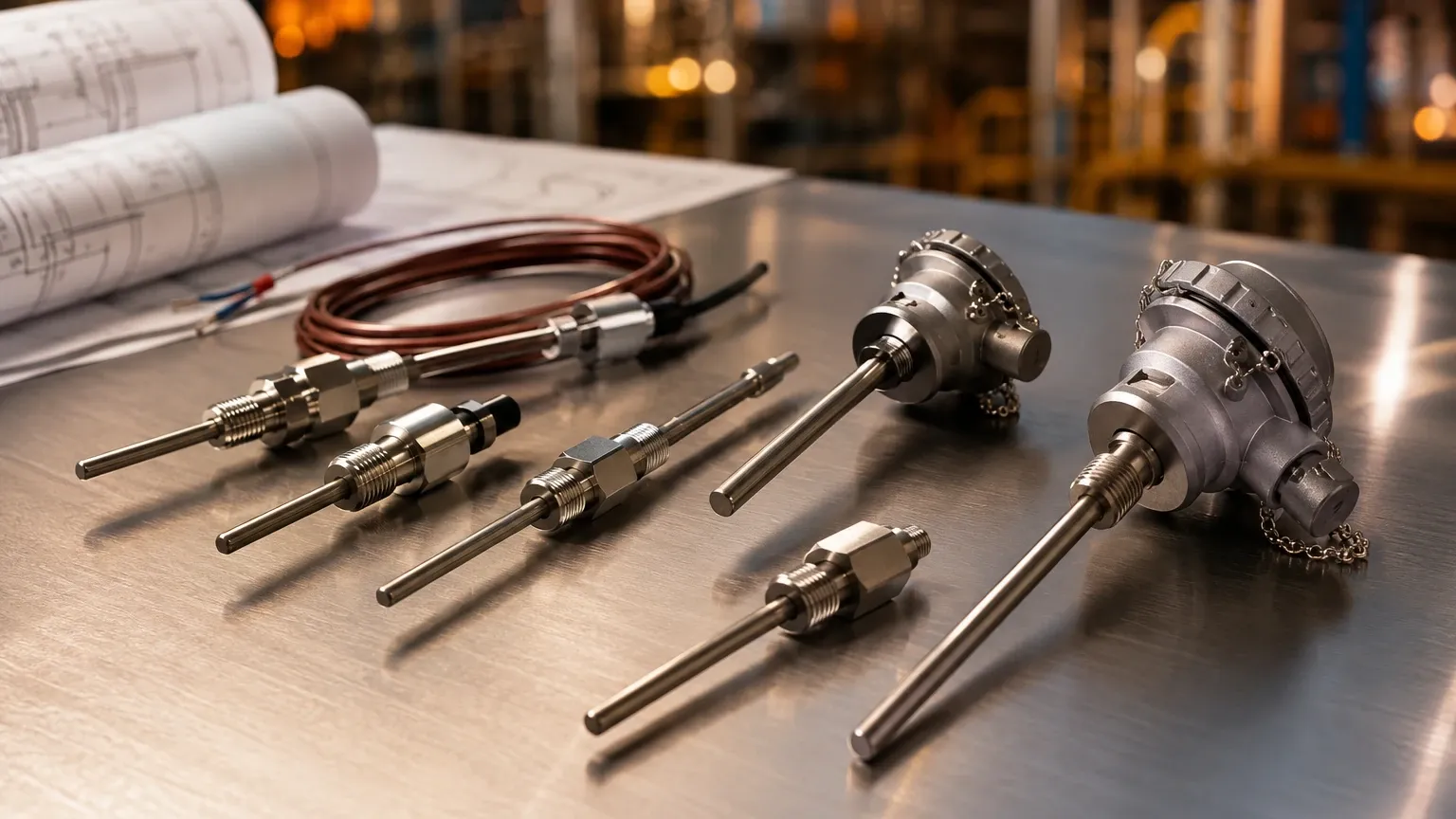
Emerson’s approach to temperature measurement involves a tiered system consisting of the primary sensing element, the thermowell (protective sheath), and the temperature transmitter. This modularity allows for precise tailoring to specific process conditions.
Rosemount 214C Sensors
The Rosemount 214C is a primary example of an Emerson temperature sensor designed for versatility. It is available in both RTD and Thermocouple configurations. These sensors are often provided as "core" elements or as part of a complete assembly with a thermowell. They are engineered to withstand high-vibration environments and are available with various hazardous area approvals (ATEX, IECEx, etc.).
Temperature Transmitters (Rosemount 644 and 3144P)
While a sensor produces a raw signal (ohms or millivolts), a transmitter converts this into a robust 4-20 mA HART, FOUNDATION Fieldbus, or WirelessHART signal.
1. Rosemount 644: A versatile transmitter used in a wide range of applications. It offers a compact design for head-mounting or rail-mounting.
2. Rosemount 3144P: The flagship high-tier transmitter, offering dual-sensor input capabilities. This allows for features like "Hot Backup," where the transmitter automatically switches to a second sensor if the first fails, ensuring process continuity.
Key Evaluation Criteria for Process Temperature Instrumentation
Selecting the right Emerson temperature sensor requires an evaluation of the process environment and the required precision. Engineers should consider the following factors:
1. Accuracy and Stability
In many chemical and pharmaceutical processes, a deviation of 0.5°C can significantly impact yield. RTDs are generally preferred for these applications. Emerson enhances this accuracy through "Sensor-Transmitter Matching." By using Callendar-Van Dusen constants specific to an individual sensor, the transmitter can eliminate the interchangeability error inherent in standard RTDs, improving system accuracy by up to 75%.
2. Response Time
If the process involves rapid temperature fluctuations, the mass of the sensor and the thermowell becomes a critical factor. Thin-film RTDs or grounded thermocouples provide faster response times but may be less durable in high-pressure flows.
3. Environmental and Safety Ratings
Industrial sensors must often operate in explosive atmospheres or corrosive environments. It is vital to confirm that the sensor housing and transmitter meet the required NEMA or IP ratings and hold the necessary intrinsic safety or explosion-proof certifications.
Practical Selection Table: RTD vs. Thermocouple
| Feature | RTD (e.g., Pt100) | Thermocouple (e.g., Type K) |
| :— | :— | :— |
| Temperature Range | -200°C to +600°C | -200°C to +1,260°C (Type K) |
| Accuracy | High (Class A or AA) | Moderate |
| Stability | Excellent (Low drift) | Fair (Prone to aging/drift) |
| Response Time | Slower (5–10 seconds) | Fast (1–3 seconds) |
| Vibration Resistance | Moderate | High |
| Cost | Higher | Lower |
Installation and Maintenance Best Practices
Proper installation is as important as the hardware itself. Incorrect placement can lead to measurement errors caused by heat conduction or insufficient immersion.
Thermowell Selection
Thermowells protect the Emerson temperature sensor from high velocity, pressure, and corrosion. However, they also introduce a thermal lag. Engineers must perform a Wake Frequency Calculation (per ASME PTC 19.3 TW) to ensure the thermowell can withstand the fluid forces within the pipe without vibrating to the point of fatigue failure.
Insertion Depth
A general rule of thumb for accurate measurement is that the sensor should be immersed to a depth at least 10 times the diameter of the thermowell. This minimizes "stem conduction" error, where heat travels along the metal sheath to the cooler (or hotter) ambient environment outside the pipe.
Calibration and Verification
Even high-quality sensors drift over time. Regular calibration using a dry-block calibrator or a specialized oil bath is necessary. For critical loops, the use of a dual-element sensor allows for cross-verification between two independent sensing points, identifying drift before it leads to a process excursion.
The Intersection of Temperature and Level Measurement
In many industrial applications, temperature measurement is not an isolated task; it is a critical input for accurate level measurement. For instance, when using hydrostatic level transmitters or certain ultrasonic level sensors, the density of the liquid or the speed of sound in the vapor space changes with temperature.
For engineers managing complex tank farms, reviewing product options and application support on the Main Page can provide insights into how integrated temperature and level solutions work together. In hydrostatic level measurement, the pressure exerted by a liquid column is a product of height, gravity, and density ($P = \rho gh$). Since density ($\rho$) varies with temperature, an Emerson temperature sensor often provides the compensation data required for the level transmitter to calculate the true volume or mass of the liquid. Without this compensation, a 10°C change in process temperature could result in a significant level measurement error, leading to overfills or dry-run conditions in pumps.
Common Risks and Mitigation Strategies
Despite the advanced technology in Emerson temperature sensors, certain risks remain prevalent in industrial environments:
* Signal Noise: Long lead wires between a sensor and a control room can pick up electromagnetic interference (EMI). This is mitigated by using head-mounted transmitters that convert the weak sensor signal into a robust digital or 4-20mA signal at the point of measurement.
* Corrosion: In chemical processing, even stainless steel thermowells can succumb to pitting or stress corrosion cracking. Selecting exotic materials like Hastelloy, Monel, or Tantalum coatings is a necessary step for longevity.
* Sensor Burnout: Thermocouples eventually fail due to oxidation of the wires. Utilizing transmitters with advanced diagnostics can alert maintenance teams to a "sensor degradation" condition before a total failure occurs.
Frequently Asked Questions (FAQ)
Q: Can I use a 2-wire RTD with an Emerson transmitter?
A: While possible, it is not recommended for industrial accuracy. 2-wire configurations do not compensate for lead-wire resistance. A 3-wire or 4-wire RTD setup is standard for B2B applications to ensure the resistance of the wiring does not skew the temperature reading.
Q: What is the difference between a "Thin Film" and "Wire Wound" RTD?
A: Thin-film RTDs are made by depositing a layer of platinum on a ceramic substrate; they are compact and cost-effective. Wire-wound RTDs consist of a platinum wire coiled around a glass or ceramic core; they are generally more accurate and stable at higher temperatures but are more sensitive to vibration.
Q: How often should an Emerson temperature sensor be calibrated?
A: The frequency depends on the criticality of the process and the historical drift of the sensor. Most industrial facilities perform a verification every 12 to 24 months, though safety-instrumented systems (SIS) may require more frequent proof testing.
By understanding the underlying physics of RTDs and thermocouples and leveraging the diagnostic power of modern transmitters, process engineers can ensure that their temperature measurement strategy supports both operational efficiency and safety. Whether as a standalone measurement or as a compensation factor for level instrumentation, the Emerson temperature sensor remains a cornerstone of modern industrial infrastructure.