Endress Hauser Temperature Sensor
Endress Hauser Temperature Sensor
In the landscape of industrial process automation, temperature measurement is as fundamental as pressure or flow. Among the leading providers of these critical instruments, the Endress Hauser temperature sensor portfolio stands out for its modularity, precision, and integration capabilities. For engineers and plant managers, selecting the right temperature probe is not merely about measuring heat; it is about ensuring process safety, product quality, and energy efficiency.
This guide explores the technical foundations of industrial temperature sensing, the specific categories of sensors available, and how these measurements integrate into broader process control systems, including their relationship with level measurement technologies.
Fundamental Principles of Temperature Measurement
Before selecting a specific sensor model, it is essential to understand the two primary physical principles used in industrial temperature measurement: Resistance Temperature Detectors (RTDs) and Thermocouples.
Resistance Temperature Detectors (RTDs)
RTDs operate on the principle that the electrical resistance of a metal increases as its temperature rises. The most common material used is platinum, leading to the industry-standard Pt100 and Pt1000 sensors (where the number represents the resistance in ohms at 0°C).
* Accuracy: RTDs are highly accurate and provide excellent long-term stability.
* Wiring: They are typically available in 2-wire, 3-wire, or 4-wire configurations. In industrial settings, 3-wire and 4-wire versions are preferred to compensate for lead wire resistance, which can otherwise introduce measurement errors.
* Range: Generally suitable for temperatures between -200°C and +600°C.
Thermocouples (TC)
Thermocouples consist of two dissimilar metal wires joined at one end (the sensing junction). When there is a temperature gradient between the sensing junction and the reference junction, a small voltage (millivolts) is generated via the Seebeck effect.
* Types: Common types include Type K (Chromel/Alumel), Type J (Iron/Constantan), and Type N (Nicrosil/Nisil).
* Range: Thermocouples can measure much higher temperatures than RTDs, often exceeding 1,600°C depending on the materials used.
* Durability: They are more robust against vibration but are generally less accurate and prone to drift over time compared to RTDs.
Key Components of an Industrial Temperature Assembly
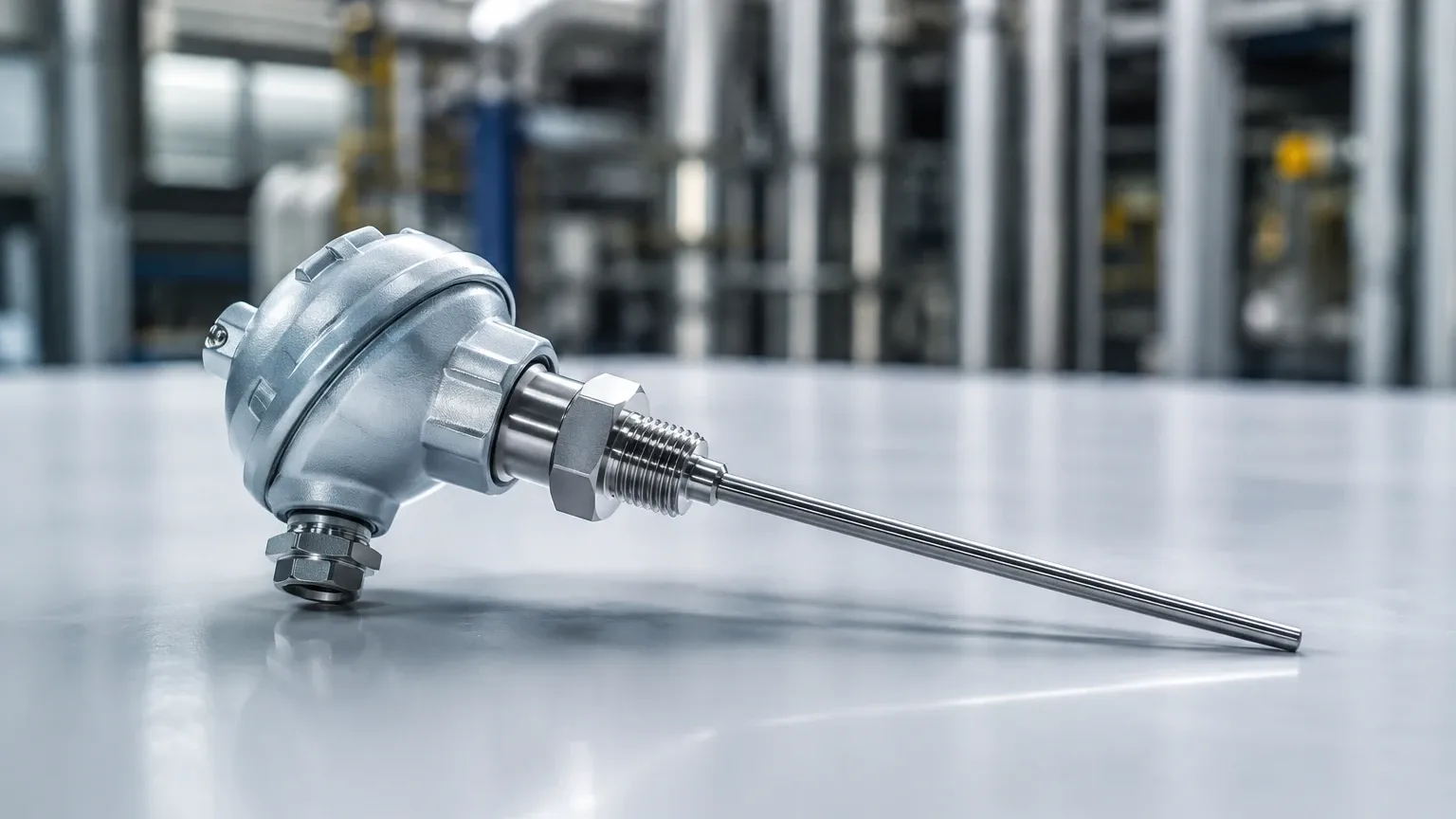
An Endress Hauser temperature sensor is rarely a standalone probe. In professional B2B applications, the sensor is part of an assembly designed to withstand harsh process conditions. The typical assembly includes:
1. The Insert: This is the actual sensing element (RTD or TC) housed in a thin metal tube. It is often spring-loaded to ensure good thermal contact with the bottom of the thermowell.
2. The Thermowell: A heavy-duty metal sleeve that protects the sensor from pressure, corrosion, and high-velocity flow. It allows the sensor to be removed for calibration without opening the process vessel.
3. The Connection Head: A housing (often aluminum, stainless steel, or plastic) that protects the electrical terminals or the temperature transmitter.
4. The Transmitter: This device converts the low-level signal from the sensor (ohms or mV) into a standardized industrial signal, such as 4-20mA, HART, PROFIBUS, or FOUNDATION Fieldbus.
Selection Criteria for Endress Hauser Temperature Sensors
Choosing the correct sensor requires balancing the physical constraints of the process with the required data output. The following table provides a comparison for initial selection:
| Feature | RTD (Pt100) | Thermocouple (Type K/N) |
| :— | :— | :— |
| Temperature Range | -200°C to +600°C | -270°C to +1,300°C+ |
| Accuracy | High (±0.1°C to ±0.3°C) | Moderate (±1.1°C to ±2.2°C) |
| Stability | Excellent (low drift) | Moderate (prone to aging) |
| Response Time | Slower (larger mass) | Fast (small junction) |
| Cost | Higher | Lower |
| Common Use | Food, Pharma, Fine Chem | Power Gen, Metal, Oil & Gas |
Application-Specific Considerations
* Hygienic Applications: For the food and beverage or pharmaceutical industries, sensors must feature electropolished surfaces, 3-A or EHEDG certification, and specialized process connections like Tri-Clamp to prevent bacterial growth.
* High-Pressure Environments: In oil and gas applications, the thermowell must be analyzed for wake frequency (ASME PTC 19.3 TW) to ensure it does not snap off due to fluid-induced vibrations.
* Self-Calibrating Sensors: Some advanced models, like the iTHERM TrustSens, feature a built-in reference based on the Curie point of a material, allowing the sensor to calibrate itself automatically during every CIP (Clean-In-Place) cycle.
Installation Guidelines and Best Practices
Correct installation is critical for measurement accuracy. Even the most precise Endress Hauser temperature sensor will provide false data if installed incorrectly.
Immersion Depth
To avoid "stem conduction" errors—where heat travels up the sensor sheath and dissipates into the ambient air—the sensor must be immersed deep enough into the process. A general rule of thumb is an immersion depth of at least 10 to 15 times the diameter of the thermowell. For pipes, the tip of the sensor should ideally be at the center of the pipe.
Thermal Contact
In dry-well installations, there is an air gap between the sensor insert and the thermowell wall. Air is an insulator and can slow down response times. Using a thermal conductive paste can improve heat transfer, although this is often avoided in high-vibration environments where the paste might migrate.
Orientation
In horizontal pipes, sensors should be installed at an angle or horizontally to prevent the accumulation of sediment or air pockets around the sensing tip. In vertical pipes, the sensor should ideally face against the direction of flow to ensure maximum turbulence and representative measurement.
The Relationship Between Temperature and Level Measurement
In many industrial tanks and vessels, temperature and level measurement are intrinsically linked. Temperature fluctuations can significantly impact the accuracy of level sensors.
For instance, in hydrostatic level measurement, the sensor measures the pressure exerted by a liquid column. Since the density of a liquid changes with temperature, a change in process heat can lead to an incorrect level reading if not compensated. Similarly, in ultrasonic level measurement, the speed of sound through the air space above the liquid is highly dependent on temperature.
Reliable manufacturers like Welk provide advanced level measurement solutions that often work in tandem with temperature data. When configuring a system, it is advisable to Review product options and application support at the Main Page to understand how different level technologies (radar, ultrasonic, or hydrostatic) can be integrated with temperature compensation to ensure total process control.
Limitations and Maintenance Requirements
While industrial temperature sensors are designed for longevity, they are not "fit and forget" devices.
* Sensor Drift: Over time, the physical properties of the platinum wire in an RTD or the metal alloys in a thermocouple will change, leading to measurement drift. Regular calibration against a known standard (dry-block calibrator or oil bath) is necessary.
* Corrosion: Even stainless steel thermowells can succumb to pitting or stress corrosion cracking in aggressive chemical environments. Regular visual inspections and material compatibility checks are vital.
* Vibration: High-frequency vibration can cause the internal wires of a sensor to fatigue and break. In such cases, vibration-resistant inserts (e.g., iTHERM StrongSens) should be utilized.
Frequently Asked Questions (FAQ)
Q: What is the difference between a Pt100 and a Pt1000 sensor?
A: Both are RTDs. A Pt100 has a resistance of 100 ohms at 0°C, while a Pt1000 has 1,000 ohms. Pt1000 sensors are generally better for 2-wire configurations because the lead wire resistance has a proportionally smaller impact on the total measurement, but Pt100 is the most common industrial standard for 3 and 4-wire systems.
Q: When should I use a transmitter instead of wiring the sensor directly to the PLC?
A: You should use a transmitter if the distance between the sensor and the PLC is long. Transmitters convert the sensitive resistance or millivolt signal into a robust 4-20mA or digital signal that is less susceptible to electromagnetic interference (EMI).
Q: Can I cut a temperature sensor to length in the field?
A: Generally, no. Most industrial sensors are sealed units with specific internal wiring. Cutting them will destroy the sensor. However, some manufacturers offer flexible "cut-to-length" versions for specific low-pressure applications, but these are exceptions rather than the rule.
Q: How do I know if my thermowell is safe for high-velocity steam?
A: You must perform a Wake Frequency Calculation according to ASME PTC 19.3 TW. This calculation considers the fluid density, velocity, pressure, and the dimensions/material of the thermowell to ensure the fluid flow won't cause the thermowell to vibrate at its natural frequency, which leads to mechanical failure.
By understanding these technical nuances, procurement and engineering teams can better specify the correct Endress Hauser temperature sensor for their specific needs, ensuring long-term reliability and precise process management.