E&h Mag Flow Meter
E&h Mag Flow Meter
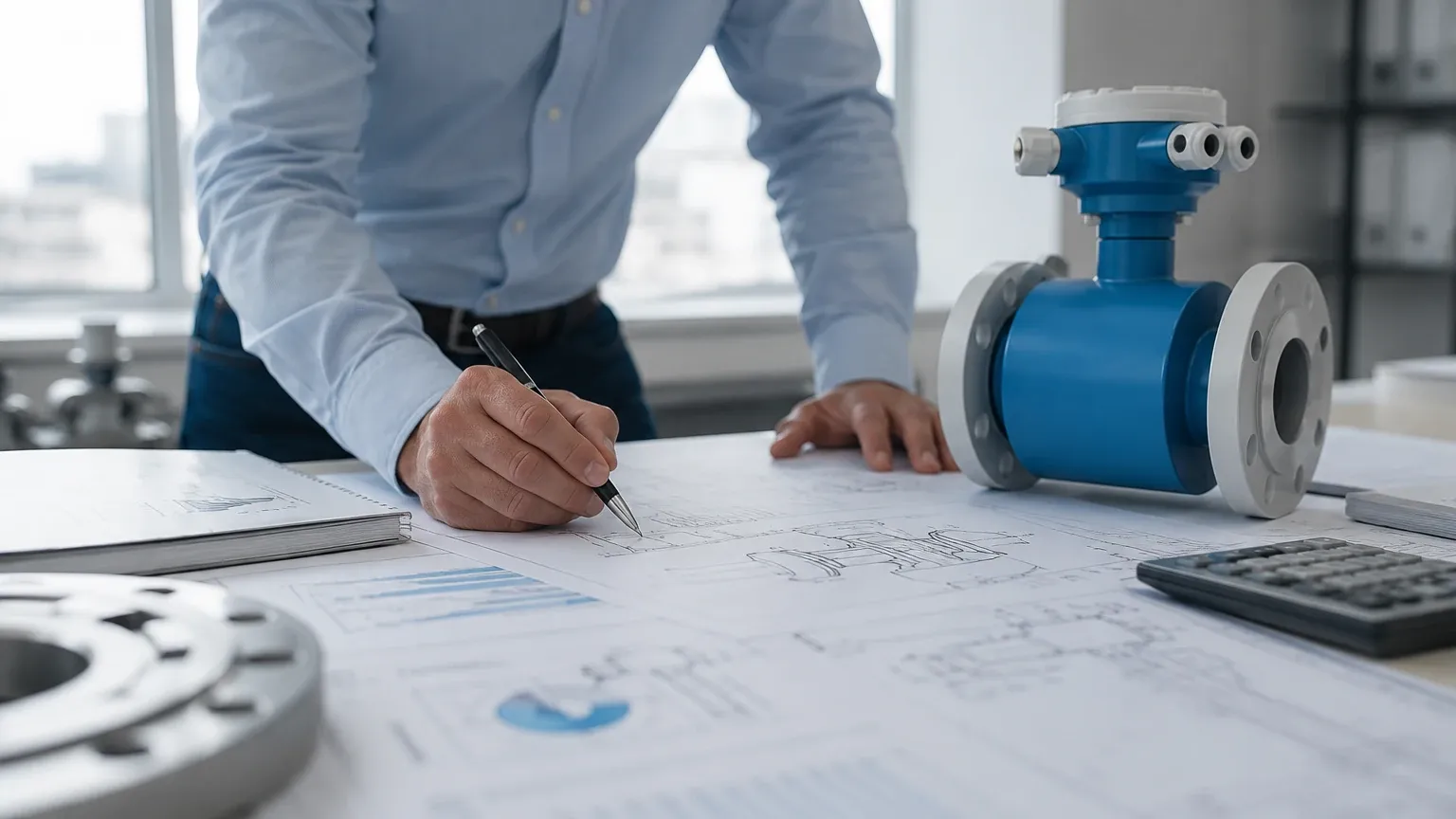
In the landscape of industrial process control, the electromagnetic flow meter, often referred to as a mag meter, stands as a cornerstone for measuring the volumetric flow of conductive liquids. Among the most recognized names in this field is the E&H mag flow meter (Endress+Hauser), specifically the Proline Promag series. These instruments are engineered to provide high-accuracy data in diverse environments, ranging from basic water distribution to complex chemical processing.
For engineers and plant managers, understanding the technical nuances of these meters is essential for ensuring system longevity and process efficiency. This guide explores the measurement principles, selection criteria, and installation requirements for electromagnetic flow meters, while also considering how these flow data points integrate with broader instrumentation strategies, such as the level measurement solutions found on our Main Page.
Measurement Principle: Faraday’s Law of Induction
The operation of an E&H mag flow meter is based on Faraday’s Law of Induction, a fundamental principle of electromagnetism. The law states that a voltage is induced when a conductive fluid moves through a magnetic field.
The Mathematical Foundation
The relationship is expressed by the formula:
U = B · v · d · k
* U (Induced Voltage): The voltage generated across the electrodes.
* B (Magnetic Field Strength): The strength of the magnetic field generated by the meter’s coils.
* v (Flow Velocity): The average speed of the fluid moving through the pipe.
* d (Pipe Diameter): The distance between the electrodes (internal diameter).
* k (Proportionality Constant): A correction factor specific to the meter’s design.
How it Works in Practice
An E&H mag flow meter consists of a flow tube lined with an insulating material and equipped with two electromagnetic coils. When the transmitter energizes these coils, a magnetic field is created perpendicular to the flow direction. As a conductive liquid—such as water, acid, or slurry—passes through this field, it acts as a moving conductor, inducing a voltage. This voltage is picked up by two electrodes mounted on opposite sides of the tube.
Because the magnetic field (B) and the diameter (d) are constant, the induced voltage (U) is directly proportional to the flow velocity (v). The transmitter then converts this signal into a volumetric flow rate (e.g., m³/h or liters per second).
Key Components and Material Selection
Selecting the correct configuration for an E&H mag flow meter requires a deep dive into material compatibility. The two most critical components are the liner and the electrodes.
Liner Materials
The liner protects the meter body from the process fluid and ensures the induced voltage is not shorted to the metal pipe. Common options include:
1. PTFE (Polytetrafluoroethylene): Known for exceptional chemical resistance and high-temperature tolerance (up to 130°C or 266°F). It is ideal for aggressive acids and bases.
2. PFA (Perfluoroalkoxy): Similar to PTFE but offers better mechanical stability at high temperatures and is often used in hygienic applications.
3. Hard Rubber / Polyurethane: These materials offer excellent abrasion resistance, making them suitable for wastewater or slurries containing sand or grit.
4. EPDM: Frequently used in drinking water applications due to its certifications and cost-effectiveness.
Electrode Materials
Electrodes must be conductive and resistant to corrosion. Standard materials include:
* Stainless Steel (316L): Standard for water and mildly corrosive fluids.
* Hastelloy C22: Used for more aggressive chemicals.
* Tantalum or Platinum: Reserved for highly corrosive environments where other metals would fail.
Technical Selection Table
When evaluating an E&H mag flow meter, engineers typically choose between several models within the Promag series. The following table highlights the primary differences between common industrial configurations.
| Feature | Promag W (Water/Wastewater) | Promag P (Chemical/Process) | Promag H (Hygienic/Food) |
| :— | :— | :— | :— |
| Typical Pipe Size | 25 mm to 2400 mm | 15 mm to 600 mm | 2 mm to 150 mm |
| Liner Material | Hard Rubber, Polyurethane | PTFE, PFA | PFA |
| Process Temp. | -20 to +80°C | -40 to +180°C | -20 to +150°C |
| Accuracy | ±0.5% (Standard) | ±0.2% (Optional) | ±0.2% (Optional) |
| Key Application | Water treatment, irrigation | Corrosive chemicals, acids | Dairy, beverage, pharma |
Installation Considerations and Best Practices
To achieve the specified accuracy of an E&H mag flow meter, strict adherence to installation guidelines is required. Even the most advanced meter will provide inaccurate data if hydraulic conditions are poor.
1. Straight Pipe Runs
Turbulence caused by valves, pumps, or elbows can distort the flow profile. Generally, a mag meter requires:
* Upstream: 5 x DN (nominal diameter) of straight pipe.
* Downstream: 2 x DN of straight pipe.
If these distances cannot be met, certain models (like those with restricted bores) may be required to maintain accuracy.
2. Grounding
Since the induced voltage is often in the millivolt range, electrical noise can easily interfere with the signal. Proper grounding is mandatory. If the process pipe is plastic or lined, grounding rings must be installed to ensure the fluid is at the same potential as the meter body.
3. Orientation and Filling
The flow tube must always be completely full of liquid. For this reason:
* Vertical Installation: The preferred orientation is vertical with the flow moving upward. This ensures the pipe remains full and prevents air bubbles from collecting at the electrodes.
* Horizontal Installation: If installed horizontally, the electrode axis must be horizontal to prevent air bubbles (at the top) or sediment (at the bottom) from insulating the electrodes.
4. Empty Pipe Detection
Many E&H mag flow meters include an "Empty Pipe Detection" (EPD) electrode. This feature prevents the meter from displaying erratic values when the pipe is not full, a common issue in batch processing or gravity-fed systems.
Integration with Level Measurement Systems
In many industrial applications, flow measurement is only one half of the equation. For example, in a chemical storage tank, an E&H mag flow meter might measure the outflow to a production line, while a radar level meter or ultrasonic sensor from Welk monitors the remaining inventory.
Combining high-precision flow data with reliable level measurement allows for:
* Mass Balance Calculations: Verifying that the volume entering a system matches the volume leaving it.
* Overfill Prevention: Using flow rates to predict when a tank will reach capacity.
* Pump Control: Automating pump speeds based on both the level in a source tank and the required flow rate at the destination.
For professional-grade level sensors that complement your flow instrumentation, you can explore various technologies at our Main Page.
Limitations and Challenges
While the E&H mag flow meter is highly versatile, it is not a universal solution. Engineers must be aware of the following limitations:
* Conductivity Requirement: The fluid must have a minimum conductivity, typically ≥ 5 μS/cm (or ≥ 20 μS/cm for demineralized water). This means mag meters cannot measure oils, hydrocarbons, or pure steam.
* Vacuum Sensitivity: Certain liners, particularly PTFE, can collapse or peel away from the tube wall under vacuum conditions. If your process involves vacuum cleaning (CIP) or suction lines, a PFA liner with a reinforcing mesh is often necessary.
* Solid Content: While mag meters handle slurries well, extremely high concentrations of solids or magnetic particles (like magnetite) can interfere with the magnetic field and cause measurement errors.
Maintenance and Heartbeat Technology
One of the standout features of modern E&H mag flow meters is Heartbeat Technology. This is an integrated diagnostic suite that allows the meter to perform self-verification without interrupting the process.
* Internal Diagnostics: The system continuously monitors the health of the electronics, coils, and electrodes.
* Verification Reports: Users can generate a formal verification report that complies with ISO 9001 requirements, reducing the need for expensive external wet-calibrations.
* Predictive Maintenance: By monitoring parameters like electrode impedance, the meter can alert operators to coating buildup or corrosion before a failure occurs.
Frequently Asked Questions (FAQ)
Q: Can an E&H mag flow meter measure gas flow?
A: No. Electromagnetic flow meters require a conductive liquid. Gases are non-conductive and cannot be measured using this technology. For gas flow, vortex or thermal mass meters are typically used.
Q: How often does a mag meter need calibration?
A: In many stable applications, a mag meter can operate for years without a significant shift in accuracy. However, in regulated industries (like pharmaceutical or food), annual verification using Heartbeat Technology or a master meter is common.
Q: What happens if the fluid contains air bubbles?
A: Air bubbles are non-conductive. If they pass over the electrodes, they will cause signal noise and measurement errors. If the air content is significant, the meter may provide a reading that is higher than the actual liquid volume (since it measures the total volume of the mixture).
Q: Is the E&H mag flow meter bi-directional?
A: Yes, most modern mag meters can measure flow in both directions. The transmitter can be configured to show a positive or negative flow rate and provide separate totals for each direction.
Conclusion
The E&H mag flow meter remains a benchmark for reliability in conductive fluid measurement. By understanding the interplay between Faraday’s Law, material science, and hydraulic installation requirements, engineering teams can ensure their process data is both accurate and repeatable. When paired with high-quality level measurement instruments, these flow meters provide the visibility needed for sophisticated industrial automation and resource management. For further technical specifications on level measurement and industrial sensors, visit the Main Page of our instrumentation reference guide.