Endress and Hauser Jobs
Endress and Hauser Jobs
In the landscape of industrial automation and process control, the demand for high-precision measurement technology continues to grow. For engineers and technical professionals exploring the sector, including those researching Endress and Hauser jobs, understanding the fundamental principles of level measurement is essential. This field requires a sophisticated grasp of physics, electronics, and mechanical engineering to ensure that industrial processes remain safe, efficient, and compliant with international standards.
Level measurement is a critical component in various industries, ranging from water treatment and chemical processing to oil and gas and food production. Whether a professional is working in a design, sales, or field service capacity, they must be able to navigate the complexities of different sensing technologies to provide the best solution for a specific application.
The Technical Landscape of Level Measurement
Industrial level measurement is not a one-size-fits-all discipline. The choice of technology depends heavily on the physical properties of the medium, the vessel geometry, and the environmental conditions. Professionals in this industry must be proficient in several core technologies.
Radar Level Measurement (ToF)
Radar technology, specifically Time-of-Flight (ToF), is often considered the gold standard for non-contact level measurement. It operates by emitting high-frequency electromagnetic waves (typically in the 26 GHz or 80 GHz range) toward the surface of the medium. The waves reflect off the surface and return to the sensor's antenna. The distance is calculated based on the time it takes for the signal to travel to the surface and back.
There are two primary types of radar systems:
1. FMCW (Frequency Modulated Continuous Wave): These systems emit a continuous signal with a constantly changing frequency. The difference in frequency between the emitted and received signal is proportional to the distance. This method provides high accuracy and is less susceptible to interference.
2. Pulse Radar: This technology sends out short microwave pulses. It is generally more energy-efficient and suitable for simpler applications.
Ultrasonic Level Sensors
Ultrasonic sensors function similarly to radar but use sound waves instead of electromagnetic waves. A transducer emits an ultrasonic pulse that travels through the air, reflects off the liquid or solid surface, and returns.
While cost-effective and reliable for many water and wastewater applications, ultrasonic technology has limitations. Because sound requires a medium (air) to travel, changes in air temperature, pressure, or the presence of heavy vapors and foam can significantly affect the speed of sound and, consequently, the accuracy of the measurement. Most modern sensors, such as those provided by Welk, include temperature compensation to mitigate these effects.
Hydrostatic Level Transmitters
Hydrostatic measurement is a contact-based method that determines the level by measuring the pressure exerted by a liquid column. The principle is based on the formula:
P = ρ × g × h
Where:
* P is the hydrostatic pressure.
* ρ (rho) is the density of the liquid.
* g is the acceleration due to gravity.
* h is the height of the liquid.
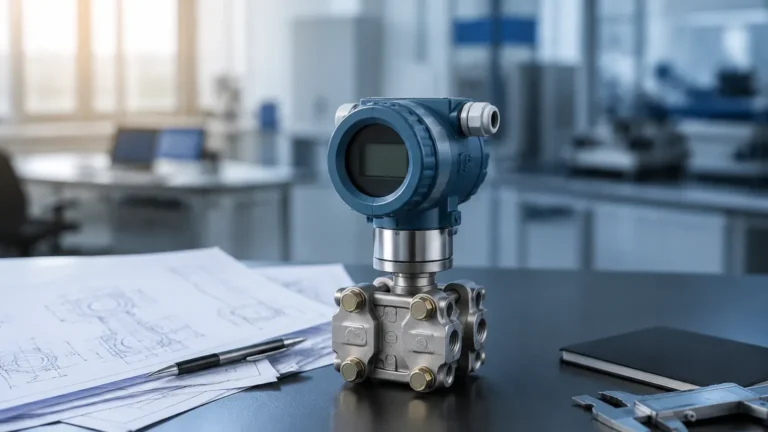
This method is highly effective for vented tanks. In pressurized vessels, a differential pressure transmitter is required to subtract the top-side gas pressure from the total pressure at the bottom of the tank.
Practical Selection Criteria for Level Instrumentation
When evaluating instrumentation for a project, engineers must compare technologies based on performance and environmental constraints. The following table provides a high-level comparison of the most common technologies used by professionals in the field.
| Technology | Medium Type | Contact / Non-Contact | Max Temperature | Pressure Sensitivity | Key Advantage |
| :— | :— | :— | :— | :— | :— |
| Radar (80 GHz) | Liquids/Solids | Non-Contact | Up to 450°C | Low | High precision, ignores foam/vapor |
| Ultrasonic | Liquids | Non-Contact | Up to 80°C | High | Cost-effective for water/waste |
| Hydrostatic | Liquids | Contact | Up to 100°C | Moderate | Simple installation, reliable |
| Guided Wave Radar| Liquids/Solids | Contact | Up to 400°C | Low | Works in narrow tanks/bypass |
| Magnetic Gauge | Liquids | Contact | Up to 400°C | Moderate | Visual indication without power |
Installation Considerations and Best Practices
Successful level measurement depends as much on proper installation as it does on the choice of sensor. Engineers involved in field services or system integration must adhere to strict guidelines to avoid signal interference and mechanical failure.
Nozzle and Mounting Position
For non-contact sensors like radar and ultrasonic, the mounting position is critical. The sensor should be placed away from the tank wall to prevent false reflections (echoes). A general rule of thumb is to maintain a distance from the wall of at least 1/6th of the tank diameter. Furthermore, the sensor must be mounted perpendicular to the liquid surface to ensure the maximum signal return.
Avoiding Obstructions
Internal tank structures such as agitators, heating coils, ladders, and inflow streams can create "false targets." While modern software allows for "false echo suppression" or "mapping," it is always preferable to install the sensor in a clear path. If an agitator is present, the sensor should be positioned where the blades do not cross the signal beam, or a guided wave radar (GWR) should be used to confine the signal to a probe.
Environmental Protection
In chemical or coastal environments, material compatibility is paramount. Sensors should be housed in corrosion-resistant materials like 316L stainless steel or PVDF. For hazardous areas where explosive gases or dust may be present, the equipment must carry the appropriate certifications, such as ATEX, IECEx, or North American Class/Division ratings.
Technical Expertise Required for Endress and Hauser Jobs
Individuals pursuing Endress and Hauser jobs or similar roles at specialized manufacturers like Welk are expected to possess a high degree of technical literacy. These roles often bridge the gap between theoretical physics and practical application.
Key areas of expertise include:
* Signal Processing: Understanding how sensors filter noise and interpret weak return signals in turbulent conditions.
* Digital Communication Protocols: Proficiency in HART, PROFIBUS, Foundation Fieldbus, and Modbus is essential for integrating sensors into modern PLC and SCADA systems.
* Process Knowledge: Understanding the behavior of different fluids—such as dielectric constants, viscosity, and vapor pressure—is vital for selecting the correct instrument.
* Compliance and Safety: Knowledge of Functional Safety (SIL) and pressure vessel regulations (ASME/PED) is mandatory for engineers working in high-risk industries like petrochemicals.
For those looking to deepen their knowledge of available technologies and application support, it is helpful to Review product options and application support at the Main Page of leading industrial providers.

Limitations and Common Challenges
Despite advancements in technology, certain conditions remain challenging for level measurement instruments.
1. Low Dielectric Constants: Radar signals rely on the dielectric constant (εr) of the medium to reflect the signal. Materials with very low dielectrics (like certain oils or liquefied gases) may not reflect enough energy for a standard radar to detect. In these cases, guided wave radar or high-sensitivity 80 GHz radar is required.
2. Heavy Foam: Foam can either absorb a signal (ultrasonic and radar) or be detected as the surface level, leading to inaccuracies. If the foam is thick and dense, hydrostatic or magnetic level gauges are often more reliable.
3. Vacuum Conditions: Ultrasonic sensors cannot function in a vacuum because there is no medium for the sound waves to travel through. Radar or hydrostatic sensors are the only viable options in these environments.
Industry Standards and Safety Requirements
In the B2B sector, reliability is synonymous with safety. Level measurement instruments are often part of a Safety Instrumented System (SIS). For example, a high-level switch might be used to prevent a tank overfill that could lead to environmental contamination or fire.
* SIL (Safety Integrity Level): Instruments used in safety-critical loops must be certified to SIL 2 or SIL 3 standards, ensuring a mathematically calculated low probability of failure on demand.
* Ingress Protection (IP): Most industrial sensors require at least an IP66 or IP67 rating to withstand wash-downs and outdoor exposure. For submersible hydrostatic sensors, IP68 is required.
Frequently Asked Questions (FAQs)
Q: Can a radar level meter measure solids like grain or cement?
A: Yes, but it requires a sensor with a high dynamic range and often a specialized antenna to deal with the uneven surface and dust. 80 GHz radar is particularly effective for solids due to its narrow beam angle.
Q: What is the difference between a level transmitter and a level switch?
A: A level transmitter provides continuous measurement (e.g., 0-100% or 4-20mA signal), allowing for constant monitoring. A level switch provides a discrete output (on/off) when the medium reaches a specific point, typically used for alarm or pump control.
Q: How does temperature affect hydrostatic level measurement?
A: Hydrostatic pressure depends on the density of the liquid. Since density changes with temperature, a significant temperature shift can introduce errors unless the system is compensated with a secondary temperature sensor.
Q: Is guided wave radar better than non-contact radar?
A: Not necessarily "better," but different. Guided wave radar is superior in applications with heavy foam, low dielectric constants, or narrow nozzles, as the probe directs the signal exactly where it needs to go. Non-contact radar is preferred for corrosive or hygienic applications where touching the medium is undesirable.
Conclusion
The field of industrial level measurement offers a dynamic career path for those interested in the intersection of engineering and technology. Whether you are a professional seeking Endress and Hauser jobs or an engineer looking to optimize a local facility, mastering the principles of radar, ultrasonic, and hydrostatic measurement is the first step toward success. By selecting the right technology and adhering to rigorous installation standards, industries can achieve the precision and safety required in the modern era of automation.