Water Flow Meter Calibration Services Near Me
Water Flow Meter Calibration Services Near Me
In industrial process control, the accuracy of liquid measurement is the cornerstone of operational efficiency, regulatory compliance, and cost management. Whether managing a municipal water treatment facility or a complex chemical processing plant, the performance of flow meters directly impacts the bottom line. However, even the most advanced instrumentation is subject to drift, wear, and environmental factors over time. This guide explores the technical landscape of flow measurement and provides a framework for evaluating water flow meter calibration services near me to ensure your systems remain within specified tolerance limits.
Principles of Water Flow Measurement
Before selecting a calibration provider, it is essential to understand the underlying physics of the instruments being serviced. Different measurement technologies react differently to fluid dynamics, and a one-size-fits-all calibration approach is rarely sufficient.
Electromagnetic Flow Meters
Electromagnetic meters operate on Faraday’s Law of Electromagnetic Induction. When a conductive liquid (such as water) flows through a magnetic field generated by the meter, it produces a voltage proportional to the velocity of the fluid. Because there are no moving parts, these meters are highly reliable, but they require periodic calibration to ensure the electrodes remain sensitive and the electronics correctly interpret the millivolt signals.
Ultrasonic Flow Meters
These instruments typically use transit-time or Doppler shift technology. Transit-time meters measure the difference in time it takes for an ultrasonic pulse to travel upstream versus downstream. This technology is highly sensitive to the internal diameter of the pipe and the profile of the fluid flow. Calibration often involves verifying the signal strength and the accuracy of the time-of-flight calculations.
Turbine and Vortex Meters
Mechanical meters, such as turbine meters, rely on the physical rotation of a rotor. The frequency of rotation is proportional to the flow rate. Vortex meters, conversely, measure the frequency of vortices shed by a bluff body placed in the flow stream. Both types are susceptible to mechanical wear or buildup on the sensing elements, making regular verification against a known standard critical.
The Importance of Regular Calibration
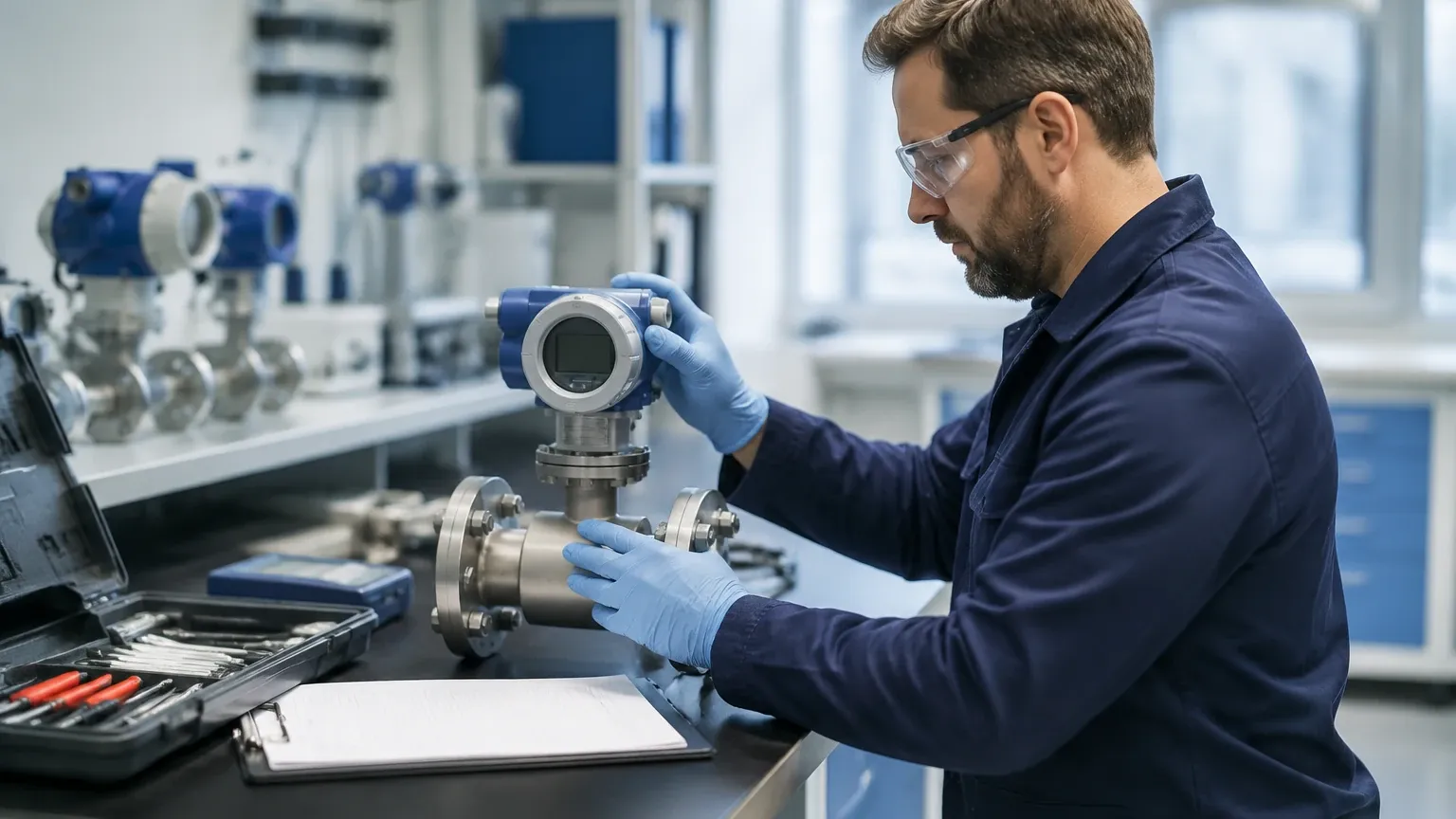
Calibration is the process of comparing the readings of a device under test (DUT) against a reference standard with a known, higher accuracy. In the context of industrial automation, this ensures that the data used for dosing, billing, or process monitoring is valid. For organizations seeking to optimize their entire measurement loop, including tank volumes and vessel monitoring, reviewing Main Page resources from manufacturers like Welk can provide a broader perspective on how level and flow data integrate for total inventory control.
Addressing Sensor Drift
Sensor drift is an inevitable reality in industrial environments. Factors such as temperature fluctuations, pressure surges, and the chemical composition of the water can cause the output of a meter to shift. Regular calibration identifies this drift early, preventing cumulative errors that could lead to process failure or financial loss.
Regulatory and Quality Compliance
Many industries, particularly those involving environmental discharge or food and beverage production, are mandated by law to maintain calibrated instruments. Utilizing accredited water flow meter calibration services near me ensures that the calibration certificates provided will stand up to audits from bodies like the EPA or ISO auditors.
Evaluating Water Flow Meter Calibration Services Near Me
When searching for a local service provider, technical competence must take precedence over proximity. A nearby lab is only useful if it possesses the infrastructure to handle your specific meter type and flow range.
ISO/IEC 17025 Accreditation
The most critical benchmark for any calibration laboratory is ISO/IEC 17025 accreditation. This standard demonstrates that the lab has a documented quality management system and the technical capability to produce valid results. Always request the laboratory's "Scope of Accreditation" to verify that their flow ranges and uncertainty levels match your requirements.
Traceability and Uncertainty
Calibration is meaningless without traceability to national or international standards, such as NIST (National Institute of Standards and Technology). Furthermore, the service provider must be able to define their Measurement Uncertainty. In a B2B context, the Test Uncertainty Ratio (TUR) should ideally be 4:1, meaning the reference standard is four times more accurate than the meter being tested.
On-site vs. Laboratory Calibration
For many facilities, removing a meter from the line causes unacceptable downtime. In these cases, look for providers offering on-site calibration using a "Master Meter" or portable ultrasonic reference. However, for the highest level of accuracy, a laboratory-based gravimetric or volumetric test rig is preferred.
Technical Comparison of Calibration Methods
The following table outlines the common methods used by professional calibration services to verify water flow meters.
| Method | Principle | Typical Accuracy | Best For |
| :— | :— | :— | :— |
| Gravimetric | Weighing the liquid collected over a timed interval. | ±0.01% to ±0.1% | High-precision laboratory standards. |
| Volumetric | Measuring fluid volume in a calibrated tank (prover). | ±0.1% to ±0.25% | Large diameter meters and high flow rates. |
| Master Meter | Comparing the DUT to a highly stable reference meter. | ±0.2% to ±0.5% | On-site verification and rapid turnaround. |
| Transfer Standard | Using a portable clamp-on ultrasonic meter. | ±1.0% to ±2.0% | Non-invasive field checks and troubleshooting. |
Installation and Post-Calibration Considerations
A successful calibration is only effective if the meter is installed correctly once it returns to the field. Even a perfectly calibrated meter will produce erroneous data if the installation environment is poor.
1. Straight Pipe Requirements: Most flow meters require a specific length of straight pipe upstream (typically 10x diameter) and downstream (5x diameter) to ensure a fully developed flow profile. If your facility has tight piping constraints, consider using flow conditioners.
2. Grounding: For electromagnetic flow meters, proper grounding is essential to eliminate electrical noise that can interfere with the small voltage signals generated by the flow.
3. Fluid Properties: Ensure the calibration was performed using a fluid with similar viscosity and density to your process water. While water is a standard medium, significant temperature differences can affect the Reynolds number and, consequently, the accuracy of the meter.
4. Zero-Point Calibration: After re-installation, always perform a "zero-check" under no-flow conditions to ensure the meter is not reporting phantom flow due to ambient vibration or electrical interference.
Limitations and Common Risks
While seeking water flow meter calibration services near me, engineers should be aware of the limitations inherent in the process.
* The "As-Found" vs. "As-Left" Trap: If a meter is found to be significantly out of tolerance, simply adjusting it (the "as-left" state) does not solve the underlying problem. It is vital to analyze the "as-found" data to determine if previous process data was invalid.
* Environmental Mismatch: A meter calibrated in a climate-controlled lab at 20°C may perform differently when installed outdoors in a tropical environment. Always discuss environmental compensation with your service provider.
* Mechanical Degradation: Calibration cannot fix a broken meter. If a turbine's bearings are failing or an ultrasonic transducer's crystal is aging, the calibration will only provide a temporary fix. In such cases, replacement with modern industrial-grade sensors is the only sustainable path.
Frequently Asked Questions (FAQ)
Q: How often should I calibrate my water flow meter?
A: Most industrial standards recommend an annual calibration. However, this interval can be extended or shortened based on the criticality of the measurement, the aggressiveness of the fluid, and historical drift data.
Q: Can I calibrate a flow meter myself?
A: While field verification is possible using a portable master meter, a formal calibration that meets ISO requirements requires specialized rigs and traceable standards that are generally only found in dedicated laboratories.
Q: What information should I provide to the calibration service?
A: You should provide the meter type, size, flow range (min/max), operating pressure, temperature, and the desired calibration points (e.g., 25%, 50%, 75%, and 100% of the flow range).
Q: Does pipe material affect calibration?
A: For inline meters, the pipe material is usually irrelevant as the meter has its own flow tube. For clamp-on ultrasonic meters, the pipe material, wall thickness, and liner type are critical parameters that must be accurately programmed into the device.
By carefully selecting accredited water flow meter calibration services near me and adhering to rigorous installation standards, industrial operators can ensure long-term accuracy and reliability in their water management systems. For those looking to upgrade their entire measurement infrastructure, exploring advanced level and flow solutions is a logical next step in achieving full process automation.
Download Water Flow Meter Calibration Services Near Me as a PDF