Endress Hauser Instrumentation
Endress Hauser Instrumentation
In the landscape of industrial process automation, precision and reliability are the cornerstones of operational efficiency. High-end process control often relies on sophisticated sensing technologies, with endress hauser instrumentation frequently serving as a benchmark for quality in level, pressure, and flow measurement. For engineers and procurement specialists, understanding the technical nuances of these instruments—and the principles that govern them—is essential for optimizing plant performance and ensuring safety in demanding environments such as chemical processing, water treatment, and oil and gas production.
Selecting the right instrumentation requires more than just brand recognition; it necessitates a deep dive into the physics of measurement and the specific constraints of the application. This guide explores the core technologies used in modern level measurement, provides a framework for selection, and outlines the practical considerations required to maintain high accuracy over the long term.
Understanding Level Measurement Principles
Before specifying a particular model from a portfolio like endress hauser instrumentation or exploring alternatives from specialized manufacturers like Welk, it is critical to understand how different technologies interact with the medium being measured.
Radar Level Measurement (Time of Flight)
Radar level transmitters utilize high-frequency electromagnetic waves, typically in the 26GHz or 80GHz range. These waves are emitted by the antenna, reflected off the product surface, and received back by the sensor. The instrument calculates the level based on the "Time of Flight" (ToF).
* Non-Contact Radar: This is ideal for corrosive or abrasive materials because the sensor never touches the medium. 80GHz technology allows for a narrower beam angle, which is particularly useful in narrow tanks with internal obstructions.
* Guided Wave Radar (GWR): This uses a physical probe (cable or rod) to guide the microwave pulse. GWR is highly effective in applications with low dielectric constants or heavy foam, where non-contact signals might be lost.
Ultrasonic Level Sensing
Ultrasonic sensors emit mechanical sound pulses that bounce off the surface of the liquid or solid. The time it takes for the echo to return is proportional to the distance. While cost-effective, ultrasonic measurement is sensitive to the speed of sound, which can be affected by temperature fluctuations, heavy dust, or vapors in the tank headspace.
Hydrostatic Level Measurement
This principle relies on the relationship between the height of a liquid column and the pressure it exerts at the base of the vessel. Using the formula $P = \rho \cdot g \cdot h$ (where $P$ is pressure, $
ho$ is density, $g$ is gravity, and $h$ is height), the sensor determines the level by measuring the head pressure. This method is highly reliable for vented tanks but requires a constant or compensated density to maintain accuracy.
Magnetic Level Gauges and Switches
For high-pressure or high-temperature applications, such as steam boilers, magnetic level gauges provide a clear visual indication. A float containing a magnet moves with the liquid level, flipping bi-color flaps or triggering external switches. This mechanical approach offers a fail-safe secondary check for electronic systems.
Key Evaluation Criteria for Industrial Instrumentation
When evaluating endress hauser instrumentation or comparable professional solutions, several technical factors must be weighed against the project budget and maintenance capabilities.
1. Media Characteristics: The dielectric constant (DC), viscosity, and corrosiveness of the fluid are the primary drivers of technology choice. For instance, liquids with a DC below 1.4 often require guided wave radar for reliable tracking.
2. Process Conditions: Standard instruments may fail under extreme temperatures (above 200°C / 392°F) or high pressures (above 40 bar / 580 psi). Specialized housings and cooling elements are necessary for these environments.
3. Accuracy and Repeatability: In custody transfer or chemical dosing, an accuracy of ±1mm (0.04 in) may be required. For simple overflow protection, ±10mm (0.4 in) might suffice.
4. Digital Integration: Modern plants utilize HART, Profibus, or Foundation Fieldbus protocols. Ensure the instrumentation is compatible with the existing Distributed Control System (DCS) or Programmable Logic Controller (PLC).
For those seeking a balance between advanced technical specifications and cost-effectiveness, manufacturers like Welk provide a robust range of radar and ultrasonic sensors designed for global industrial standards. You can Review product options and application support to compare specific technical data sheets against your project requirements.
Practical Selection Guide for Process Applications
The following table provides a generalized comparison of common level measurement technologies to assist in the initial screening process.
| Technology | Typical Accuracy | Max Range | Best Suited For | Major Limitation |
| :— | :— | :— | :— | :— |
| 80GHz Radar | ±1 mm | 30m – 120m | Small nozzles, narrow tanks | Higher initial cost |
| Ultrasonic | ±0.25% of range | 15m – 20m | Water, wastewater, open channels | Affected by foam and vacuum |
| Hydrostatic | ±0.1% to 0.5% | No limit (depth) | Deep wells, vented tanks | Requires constant density |
| Guided Wave Radar | ±2 mm | 30m – 45m | Low DC liquids, interface measurement | Probe can be damaged by agitators |
| Magnetic Gauge | Visual | 6m (modular) | High temp/pressure boilers | Clean liquids only; no solids |
Installation Best Practices and Geometric Considerations
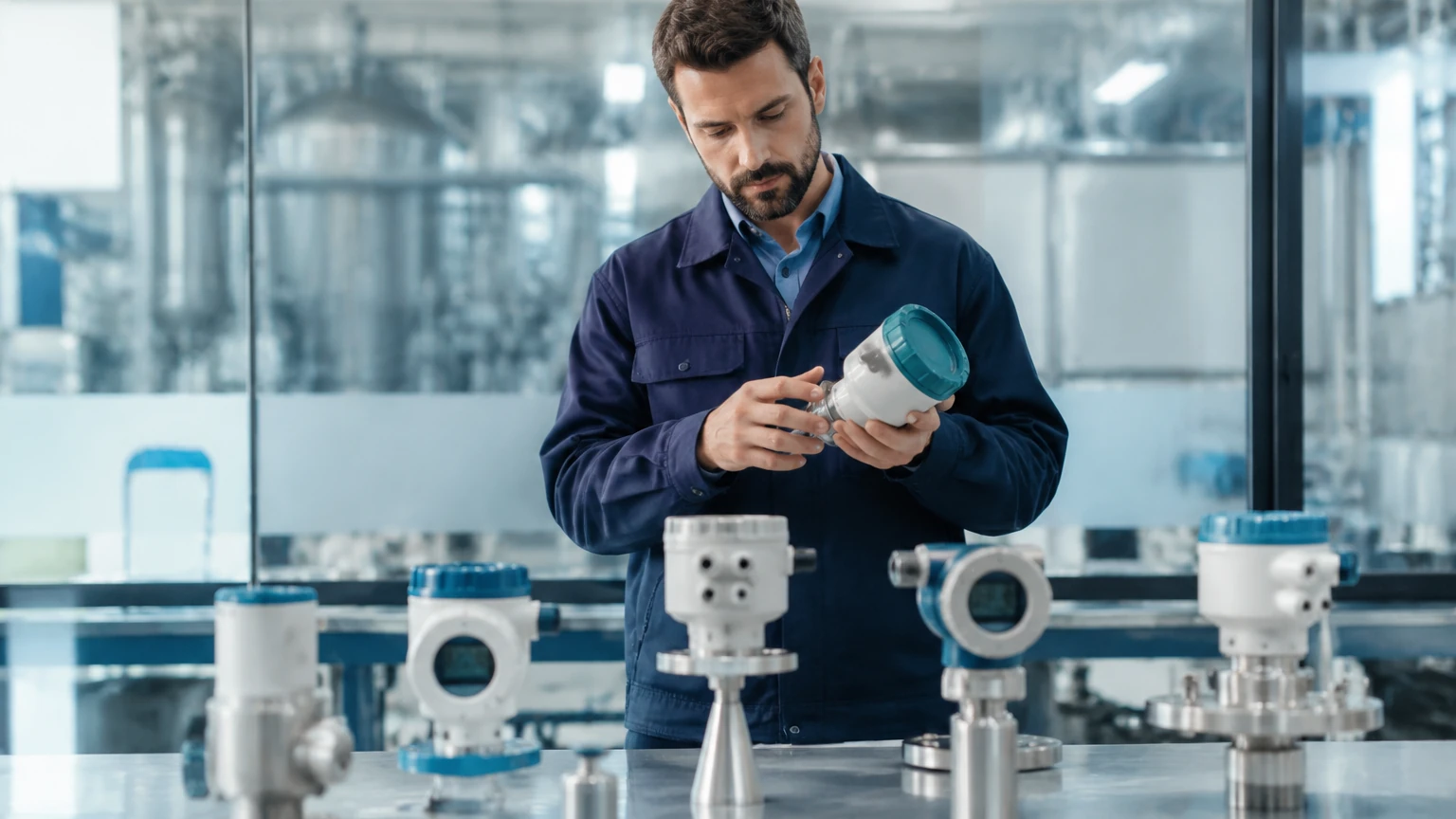
Even the most advanced endress hauser instrumentation will underperform if the installation geometry is ignored. Proper placement is the most effective way to eliminate "false echoes" and signal attenuation.
* The 1/6th Rule: For non-contact radar and ultrasonic sensors, the device should generally be installed at a distance of 1/6th of the tank diameter from the tank wall. This avoids interference from wall reflections while staying clear of the center, where multiple reflections can converge.
* Nozzle Geometry: The internal diameter and length of the mounting nozzle can act as a waveguide. If the nozzle is too long or narrow, it may create a "ringing" effect that masks the signal near the top of the tank (the "dead zone").
* Obstruction Mapping: Modern instruments allow for "False Signal Suppression." During commissioning, the sensor scans the empty tank to identify and ignore static reflections from agitators, heating coils, or ladders.
* Perpendicular Alignment: Ultrasonic sensors must be mounted perfectly perpendicular to the liquid surface. A tilt of even a few degrees can cause the sound wave to bounce away from the receiver, leading to a loss of signal.
Limitations and Operational Risks
While industrial instrumentation is designed for longevity, several factors can compromise performance over time:
* Build-up and Coating: In wastewater or slurry applications, material can accumulate on the sensor face or probe. While some radar algorithms can compensate for light coating, heavy build-up will eventually cause a "high-level" false alarm.
* Vapor and Condensation: Extreme condensation can form droplets on the antenna. Some radar sensors utilize PTFE (Teflon) drip-off lenses to mitigate this, but in heavy steam environments, a purge air connection may be required.
* Turbulence and Foam: Rapidly boiling liquids or high-speed agitators create surface turbulence that scatters radar and ultrasonic signals. In these cases, a stilling well (a bypass pipe) is often necessary to provide a calm surface for measurement.
Frequently Asked Questions (FAQ)
Q: Can I use radar for solids measurement?
A: Yes, but it requires specific considerations. Solids like grain, cement, or plastic pellets have an angle of repose. 80GHz radar is preferred here because its narrow beam can be aimed at the highest point of the pile, and its high frequency better penetrates dust.
Q: What is the difference between "Accuracy" and "Repeatability"?
A: Accuracy is how close the measurement is to the actual true level. Repeatability is the instrument's ability to provide the same result under the same conditions consistently. In many process control loops, high repeatability is actually more important than absolute accuracy.
Q: How often should level transmitters be calibrated?
A: This depends on the industry. For regulated chemical or pharmaceutical processes, annual calibration is standard. For general water treatment, a functional check every 2-3 years may be sufficient, provided there is no significant drift or build-up.
Q: Is it possible to measure the interface between two liquids?
A: Yes, Guided Wave Radar (GWR) is the primary technology for interface measurement (e.g., oil over water). The pulse reflects off the top layer and continues through the first liquid to reflect off the second, denser liquid.
By carefully matching the measurement principle to the specific environmental challenges of the site, engineers can ensure that their investment in instrumentation—whether it be endress hauser instrumentation or high-quality alternatives from specialized manufacturers—yields the data precision required for modern industrial excellence. For further technical specifications and to explore a wide range of industrial level sensors, visit the Main Page of the Welk product catalog.