Flow Cell Enclosure for Inline Raman Probes
Flow Cell Enclosure for Inline Raman Probes
In the landscape of modern process analytical technology (PAT), the ability to monitor chemical compositions in real-time is a significant advantage for industrial efficiency. Raman spectroscopy has emerged as a leading technique for this purpose, offering non-destructive, molecular-specific analysis without the need for complex sample preparation. However, the accuracy of an inline Raman probe is heavily dependent on the environment in which it operates. A flow cell enclosure for inline raman probes serves as the critical interface between the process stream and the sensitive optical instrumentation, ensuring that measurements are both stable and representative of the bulk material.
For engineers managing complex liquid processes, integrating analytical probes often goes hand-in-hand with robust level measurement. While a Main Page for level instrumentation provides the necessary data on volume and inventory, the flow cell enclosure facilitates the qualitative data required for reaction monitoring and quality control.
Principles of Inline Raman Spectroscopy and Flow Cell Integration
Raman spectroscopy is based on the inelastic scattering of monochromatic light, typically from a laser source. When the laser light interacts with molecular vibrations, the energy of the photons is shifted up or down. This shift provides a unique "fingerprint" of the substances present in the sample.
In an inline configuration, a probe is inserted directly into a pipe or a bypass loop. The flow cell enclosure for inline raman probes is designed to hold the probe tip at a fixed distance from the sample, creating a controlled optical path. The primary measurement principles involved in this integration include:
1. Optical Focusing: The enclosure must maintain the probe at the precise focal point where the laser intensity is highest and the collection optics are most efficient.
2. Sample Presentation: The flow cell ensures that a continuous, representative volume of the process fluid passes through the laser’s path, minimizing "dead zones" where stagnant material could lead to inaccurate readings.
3. Light Shielding: To prevent interference from ambient light, which can saturate the sensitive detectors in a Raman spectrometer, the enclosure must be light-tight.
4. Pressure and Temperature Containment: The enclosure acts as a pressure vessel, protecting the probe’s delicate optics from the high pressures and temperatures often found in industrial reactors and pipelines.
Key Components of a Flow Cell Enclosure for Inline Raman Probes
A high-quality flow cell enclosure is more than just a pipe fitting; it is a precision-engineered component. The following elements are standard in industrial-grade enclosures:
The Housing Body
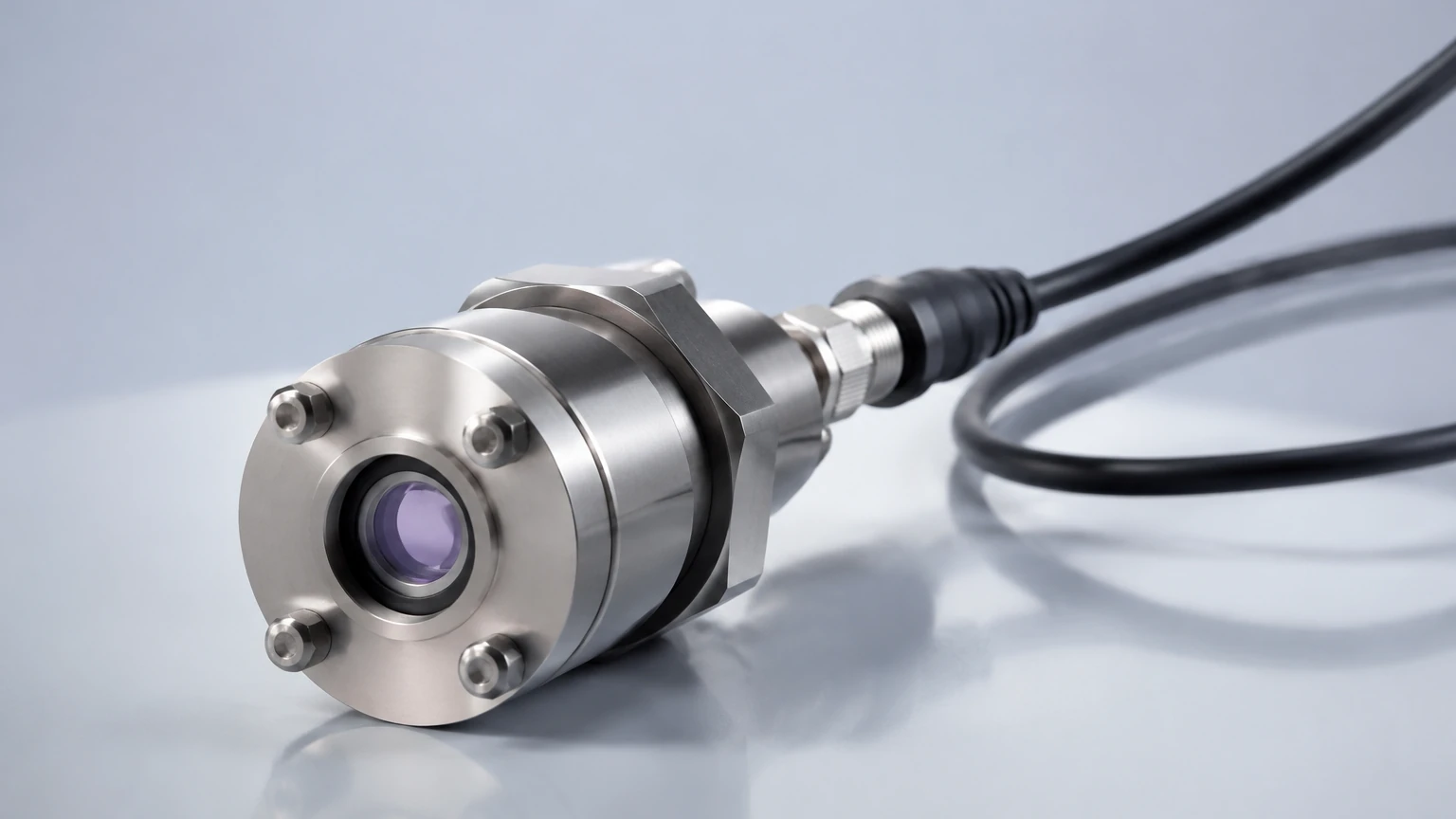
Usually constructed from 316L stainless steel, Hastelloy C276, or specialized polymers like PEEK, the housing must be chemically compatible with the process fluid. It features inlet and outlet ports (typically NPT, flange, or Tri-Clamp) to integrate into the existing piping.
Optical Windows
Since the probe must "see" into the fluid, a transparent window is required. Sapphire is the industry standard due to its extreme hardness (9 on the Mohs scale), high thermal conductivity, and broad spectral transparency. In less demanding applications, fused silica or quartz may be used.
Sealing Systems
To prevent leaks, high-performance seals are essential. These are often O-rings made of Viton, EPDM, or Kalrez (FFKM) for aggressive chemical environments. The seals must withstand the mechanical stress of the probe insertion while maintaining a hermetic barrier.
Probe Mounting Interface
This is the mechanism that secures the Raman probe. It often includes adjustable sleeves or compression fittings that allow the operator to fine-tune the immersion depth to optimize the signal-to-noise ratio.
Technical Selection Criteria for Industrial Applications
Selecting the correct flow cell enclosure for inline raman probes requires a thorough understanding of the process conditions. Engineers should use the following table as a baseline for evaluation:
| Criteria | Specification Options | Practical Considerations |
| :— | :— | :— |
| Material of Construction | 316L SS, Hastelloy, PTFE, PEEK | Must match the corrosion profile of the fluid. |
| Pressure Rating | Vacuum to 100 bar (1450 psi) | Must exceed the maximum possible surge pressure. |
| Temperature Range | -20°C to +250°C | Consider thermal expansion of different materials. |
| Window Material | Sapphire, Fused Silica | Sapphire is preferred for high-pressure/abrasive fluids. |
| Connection Type | Flanged, Threaded, Sanitary | Sanitary (Tri-Clamp) is required for food/pharma. |
| Pathlength | 0.5 mm to 10 mm | Depends on the opacity and concentration of the sample. |
When these specifications are finalized, it is also useful to consider how the data will be integrated into the wider plant control system. For instance, combining Raman data with hydrostatic or radar level data from a Main Page allows for mass balance calculations that are far more accurate than volume-based measurements alone.
Installation and Maintenance Best Practices
Proper installation is vital to the longevity of both the flow cell and the Raman probe.
Orientation and Flow Direction
The flow cell should ideally be installed in a vertical section of piping with the flow moving upward. This ensures the cell remains completely flooded and prevents the accumulation of air bubbles, which can scatter the laser light and cause significant signal noise. If horizontal installation is necessary, the probe should be mounted from the side, not the top or bottom, to avoid sediment or gas pockets.
Flow Velocity
Maintain a flow velocity sufficient to prevent fouling on the optical window. In many chemical processes, a velocity of 1.5 to 2.5 meters per second (m/s) is recommended to provide a self-cleaning effect. However, excessively high velocities can cause cavitation or erosion of the window seals.
Cleaning and Maintenance
Over time, a film or "biofilm" may develop on the window. Many modern flow cell enclosures for inline raman probes are designed with Clean-In-Place (CIP) capabilities. If manual cleaning is required, the enclosure should feature a bypass valve system so the probe can be removed without shutting down the main process line. Use only soft, non-abrasive materials and appropriate solvents (like Isopropanol) to clean sapphire windows.
Limitations and Operational Challenges
While highly effective, there are limitations to using flow cell enclosures for Raman probes that engineers must account for:
* Fluorescence Interference: Some process fluids naturally fluoresce when hit by a laser, which can overwhelm the Raman signal. While the enclosure cannot stop fluorescence, it can be equipped with cooling jackets to maintain lower temperatures, which sometimes helps reduce background noise.
* Particulate Matter: High concentrations of suspended solids can block the laser path. In these cases, a flow cell with a very short pathlength or a specialized back-scattering geometry is required.
* Window Fouling: In sticky or polymerizing reactions, material can bake onto the window. This requires frequent maintenance or the use of ultrasonic cleaning attachments.
* Alignment Sensitivity: Even a sub-millimeter shift in the probe’s position within the enclosure can lead to a loss of signal. Secure, vibration-resistant mounting is mandatory.
Integration with Level Measurement and Process Control
In a B2B industrial environment, sensors do not operate in isolation. The data from a flow cell enclosure for inline raman probes is most valuable when contextualized with physical process parameters. For example, in a mixing tank, the Raman probe monitors the concentration of a reactant, while a radar level meter or a magnetic level gauge (available via the Main Page) monitors the total volume.
If the Raman signal indicates a drop in concentration, the control system can cross-reference the level data to determine if the change is due to a reaction occurring or simply due to the addition of more solvent. This holistic approach to process monitoring reduces waste and ensures batch-to-batch consistency.
Frequently Asked Questions (FAQ)
Q: Can I use a standard pipe T-junction instead of a dedicated flow cell enclosure?
A: While possible for very basic testing, it is not recommended for industrial use. Standard fittings do not provide the necessary light shielding, precise optical alignment, or the high-quality window seals required to protect an expensive Raman probe.
Q: How often should the optical window be replaced?
A: Sapphire windows are extremely durable and can last for years if not subjected to extreme mechanical shock or hydrofluoric acid (which etches sapphire). Regular inspection of the seals is more critical than window replacement.
Q: What is the maximum distance between the probe and the window?
A: This depends on the probe's focal length. Most industrial Raman probes have a focal point 0.5 mm to 5 mm beyond the probe tip. The flow cell enclosure must be engineered to match this specific distance.
Q: Is it necessary to ground the flow cell enclosure?
A: Yes, especially in hazardous environments where flammable solvents are present. Static electricity can build up due to fluid flow, and the enclosure must be properly bonded and grounded to prevent sparks.
By following these engineering guidelines and selecting a robust flow cell enclosure for inline raman probes, facilities can achieve high-fidelity chemical analysis that complements their existing level and pressure monitoring infrastructure. For more information on integrating these technologies into your process, consulting a professional instrumentation provider is recommended.
Download Flow Cell Enclosure for Inline Raman Probes as a PDF